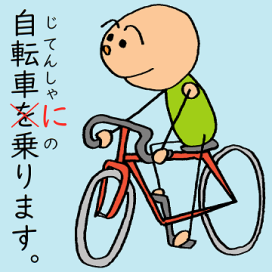
In the section 23, you learned two types of sentence constructions;
A1
[Conditional Clause A]+toki, [Main Clause].
Exmaple: Douro o Wataru toki, Kuruma ni Ki o Tsukemasu. (When crossing a road, I pay attention to cars.)
A4
[Conditional Clause A]+to, [Main Clause].
Example: Douro o Wataru to, Kombini ga Arimasu. (If you corss the road, you will find a convinience store.)
Is the difference between the two clear to you?
(1) Freedom about Main clause
{[A]+toki,[B].}
— When A is happening, someone does B. The “someone” has freedom to do B to some extent. “Some extent” means that B is limited to be what an ordinary people usually do. If B is what an ordinary people usually don’t, different expression needs to be used. But it is not what we are focusing on now.
– Example: Uchi ni Kaeru toki, Osake o Kaimasu. (When I am on my way home, I will buy Sake.)
There is a freedom about what you buy on your way home. Someone wants to buy Alcohol, another person packages of ready-made food for night meal.
{[A]+to, [B].}
— When A has happened, then B happens, or B is caused as the result of A. A tends to be a hypothetical condition, but once A has happened, there is not much freedom about occurrence of B.
– Example: Uchi ni Kaeru to, Mazu Doa no Kagi o Akemasu. (When I get home, I open the door key first.)
– Example: Ame ga Furu to, Undou-kai wa Chuushi desu. (If it rains, the sports event will be cancelled.)
(2) Time sequence of the conditional clause and the main clause.
{[A]+toki,[B].}
— While A is happening, B happens.
Exmaple: Douro o Wataru toki, Kuruma ni Ki o Tsukemasu. (When crossing a road, I pay attention to cars.)
During crossing the road, you pay attention to cars.
{[A]+to, [B].}
— Once A has happened, and then B is caused.
Exmaple: Douro o Wataru to, Shoutengai ni Tsukimasu. (When you have crossed the road, you get to the shopping mall.)
When you got to the shopping mall, your action crossing the road has already ended.
<Quiz>
Choose “toki” or “to”. The answers will be shown tomorrow.
(1) Terebi o Miru { toki or to }, Megane o Kakemasu.
(2) Terebi o Miru { toki or to }, Iroirona Nyu’usu ga Wakarimasu.
(3) Ano Singou de Hidari ni Magaru { toki or to }, Yuubinkyoku ga arimasu.
(4) Eki ni Tsuita { toki or to }, Tanaka-san ni Aimashita.
This post was written with reference to the Section23 of “Minna no Nihongo (2nd Edition)” published by “3A Corporation”





















 Agony or Fun?! Second Language Learning