Japanese Learning: Interrogative form of Noun Predicate Sentence; [Noun]wa [Wh- interrogative word] desuka.

Yesterday we learned one interrogative form of a noun predicate sentence. It was a “yes-no question”. Today, we are going to learn a “Wh-question”. In order to introduce a “Wh-question”, let us first look at positive forms of noun predicate sentences.

1. Ano hito wa Sato-san desu. : That person is Ms. Sato.

2. Achira no kata wa Suzuki-san desu. : That person is Mr. Suzuki.

You see differences between the sentences 1. and 2. “Ano” in 1. turned to be “Achira” in 2., and “hito” in 1. turned to be “kata” in 2. The sentence 2. is more polite than 1. The issue of politeness is not an object of today, however, please note that choices of words are affected by how much the sentence should be polite. The following explanation uses the sentence 1. whose politeness is medium level.

If you want to make the sentence 1. a yes-no questions, just put “-ka” at the end.

1’. Ano hito wa Sato-san desuka : Is that person Ms.Sato?

But today, we need to make it a “Wh-question”. There are some interrogative words in Japanese for “when”, “where”, “who”, “what” and “why”. Today only “who” is used. The question word “dare” is corresponding to “who”, so if you want the sentence 1. to be “Wh-question”, it can be as follows;

3. Ano hito wa dare desuka : Who is that person?

Do not mind that the wh-word “dare” is being used not in the subject but in the predicate. Although “dare” can also be used as a subject, that type of construction should be introduced later. Learning more commonly used expressions earlier and less common ones later is important in the second language learning.

Remember today’s expressions as a conversation of question and answer as below.

A : Ano hito wa dare desuka : Who is that person?

B : Ano hito wa Sato-san desu : That person is Ms. Sato.
Japanese Learning: Interrogative form of Noun Predicate Sentences; [Noun1]wa [Noun2]desuka.

When trying to learn a construction of the second language, it is better to know three forms of the construction; Positive, Negative, and Interrogative forms. As for noun predicate sentences, these three forms are shown as below.

1. Positive form: [Noun1]wa [Noun2]desu.

2. Negative form: [Noun1]wa [Noun2]dewa arimasen.

3. Interrogative form: [Noun1]wa [Noun2]desuka.

It is very simple to make an interrogative sentence. You just put a particle “-ka” at the end of the sentence.

Please note that now we are talking about only “yes-no questions” for interrogative form. “Wh-questions” and “alternative questions” are not dealt with today.

So, “[Noun1]wa [Noun2]desuka.” is a “yes-no questions”. How do we answer to the question in Japanese? In general, yes is “Hai”, no is “Iie (in three moras; I-I-E)”, but be careful, “Hai”and “Iie” are not exactly the same as “yes” and “no”.

-Hai : What you are saying is right (The answer is not always followed by a positive expression)

-Iie : What you are saying is not right (The answer is not always followed by a negative expression)

Although this issue “yes-no and hai-iie are not the same” does not has to do with today’s examples, please note the difference between usages of yes-no and hai-iie.

Take a look at examples of yes-no questions and answers with “hai” and “Iie”. “Ja” is the short form of “Dewa”, in the following case means “Then”.

A : Koukousei desuka?

B : Iie, watashi wa koukousei dewa arimasen.

A : Ja, Daigakusei desuka?

B : Hai, Watashi wa Daigakusei desu.

You will find that two questions by A don’t use “Anata (you in English)”. “Anata(=you)” is a word often used when a wife calls her husband. So, use the word “Anata” sparingly, or avoid to use.

Japanese Learning: Present-Negative of Noun Predicate Sentence; [Noun1]wa [Noun2]dewa arimasen.

Japanese sentences are classified in three by the type of predicates;

1. Noun predicate sentences

2. Adjective predicate sentences (I-adjectives and Na-adjectives)

3. Verb predicate sentences

Today, too, we are going to learn “1. Noun predicate sentences”. Yesterday’s “[Noun1]wa [Noun2]desu.” is a positive sentence. A negative sentence is as follows;

[Noun1]wa [Noun2]dewa arimasen.

“Arimasen” is actually a negative form of a verb “aru/arimasu” that means something exists. However, now we are learning noun predicate sentences, not verb predicate sentences. Therefore, I recommend you just remember “dewa arimasen” like a one word. In conversations, “dewa arimasen” is usually contracted to be “ja arimasen”.

Let’s look at the sentence “[Noun1]wa [Noun2]dewa arimasen.”

-Noun1: a name of something.

-wa: this is the particle (post position) to indicate that preceding word is the topic of the sentence. When the topic and the subject are identical in the sentence, “-wa” can be a subject marker as well as topic marker.

-Noun2: a name of something.

-dewa arimasen (-ja arimasen): Being placed at the end of a sentence, this functions to make the sentence present-negative. This ending is polite. Do not use the short form “dewa nai (ja nai)” for an ending of the sentence because it sounds rude.

Let’s make a noun predicate sentence “[Noun1]wa [Noun2]dewa arimasen.” by putting real Japanese words.

Watashi: I (prenoun)

wa: topic marker (particle) — also subject marker in this case

Koukousei : a high school student. Although its spelling is “koukousei”, the pronunciation is like “Koh-koh-se-e”

dewa arimasen: present-negative, polite ending

Watashi wa Koukousei dewa arimasen. (I am not a high school student.)

Japanese Learnig: Noun predicate sentence; [Noun1]wa [Noun2]desu.

Japanese sentences are classified in three by the type of predicates;

1. Noun predicate sentences

2. Adjective predicate sentences (I-adjectives or Na-adjectives)

3. Verb predicate sentences

Out of three, it is better to start with “1. Noun predicate sentences” when you learn Japanese as a second language. Today’s sentence “[Noun1]wa [Noun2]desu.” is a noun predicate sentence.

“Noun” means a group of words which means a name of something. Pronouns are also included in this category “Nouns”.

You find the sentence “[Noun1]wa [Noun2]desu.” consists four parts. They are as follows.

-Noun1: a name of something.

-wa: one of particles (post-positions) to indicate that preceding word is the topic of the sentence. We can call “-wa” a topic marker. However, a topic of a sentence coincides the subject of the sentence in many cases. Although there is another particle “-ga” that is subject marker, you need to know that particle “-wa” can also be a subject marker as well as topic marker.

-Noun2: a name of something.

-desu: At the end of a sentence, “desu” is attached to the behind of the noun predicate of a sentence. The function of “desu” is to make the sentence present-positive and to end the sentence politely.

Or you can think that the sentence “[Noun1]wa [Noun2]desu.” is comprising two segments. Then you will know that each segment is a combination of [meaningful word] plus [functional word]. And a meaningful word has a certain length, but a functional word is short as one letter, or two letters.

Let’s make a noun predicate sentence “[Noun1]wa [Noun2]desu.” by putting real Japanese words.

Watashi: I (prenoun)

wa: topic marker (particle) — also subject marker in this case

Dai-Gakusei : a university student

desu: present-positive, polite ending

Watashi wa Dai-Gakusei desu. (I am a university student.)

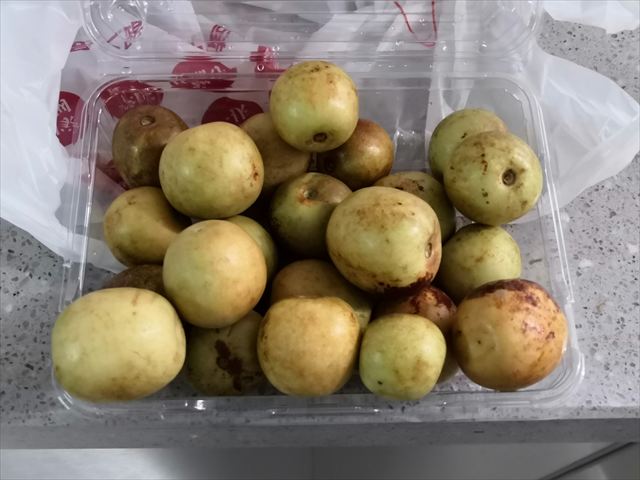
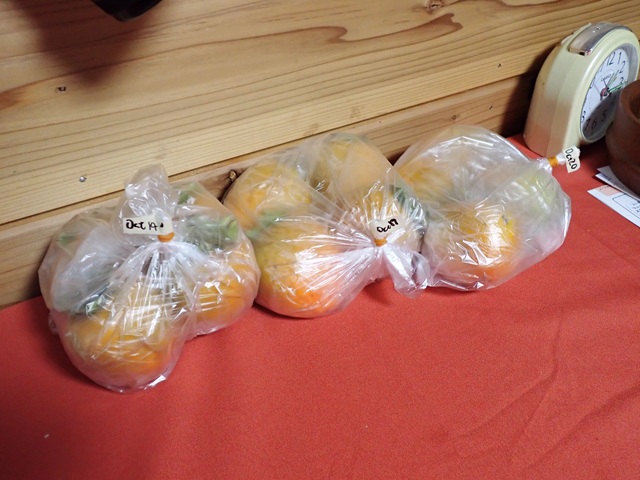
In a few days, I can eat sweet persimmon (if successful to remove bitterness)

Removing Bitterness is Ongoing

Dates on the tape show when I put the persimmons into plastic bags; Oct.14, 17, and 20. I think I will be able to eat one a day from Wednesday.

Now almost three months have passed since I retired my job and came back Japan. Probably I spend these days with a little bit of lazy life style. It’s like; wake up in the morning at 6, then cook breakfast, eat it at 7, read English book with a dictionary until 9:30, then usually I work in the garden to care vegetables and fruits trees through the morning hours.

Today, rather than to work in my garden, I went to a supermarket before noon, because rainfall was coming according to weather forecast. I took my lunch with a watching video sharing site (the famous one). And then I have been watching a DVD of Japanese teaching training course from 2 to 4. But I was sleeping most of the time. I started practicing a piano at 4, cooking a supper at 5, eat the supper at 6:20, and now I am writing this.

Perhaps I will not be able to teach Japanese again. I am still trying to study teaching skills for the next time I teach Japanese language for foreign people. But I may give up the career as a Japanese teacher. I am not sure for this matter.

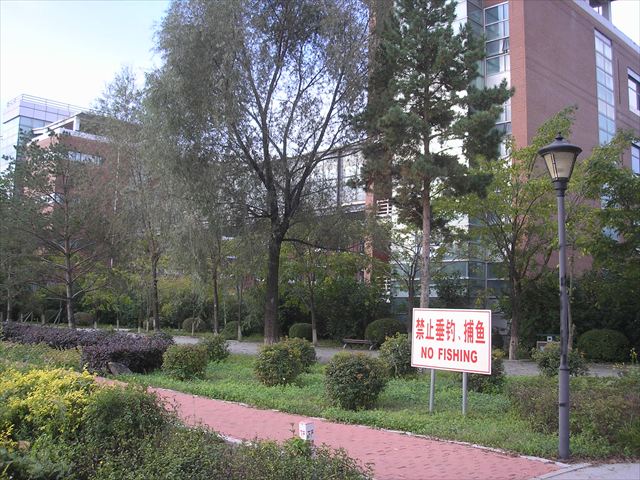
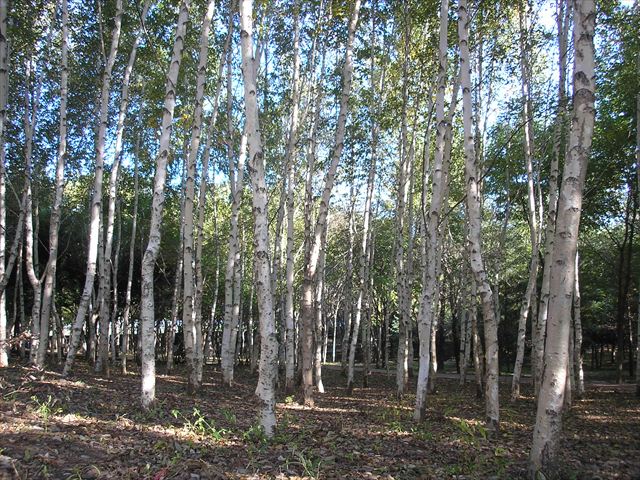
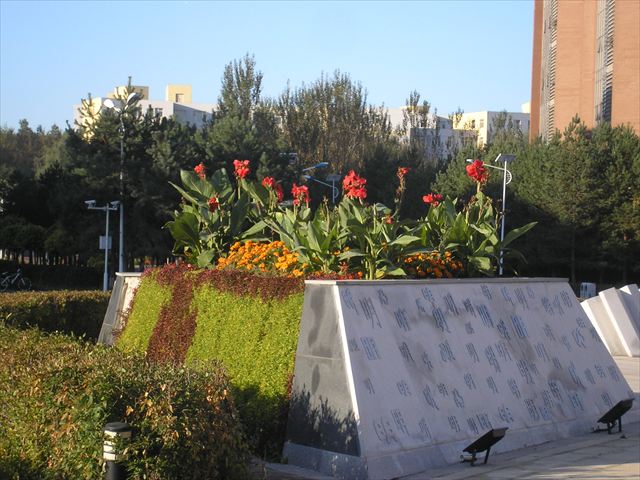
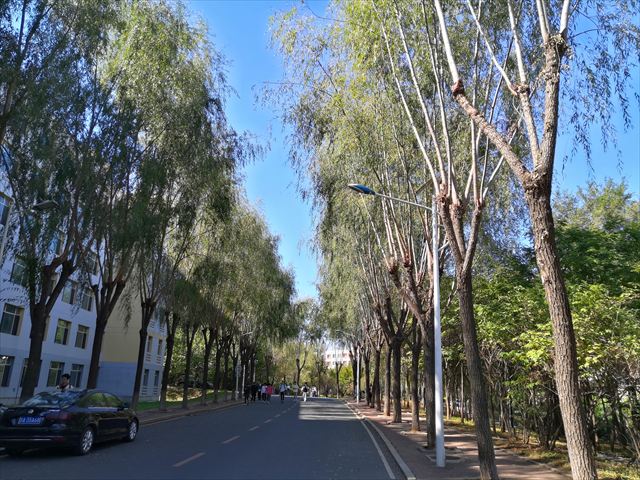
Pictures of the Campus in which some Water Fronts are

Tonight, I don’t think of what to write. Instead of writing my bad English, let me upload the pictures which I took in September, 2019. I just want to keep the name of the university secret.

I had spent four years to be a Japanese teacher. When I took these photos in 2019, I thought my dream had come true. But at that time, I didn’t know what was coming after the first semester.

It’s Autumn; The air is cooling down, and Ginkgo Smells.

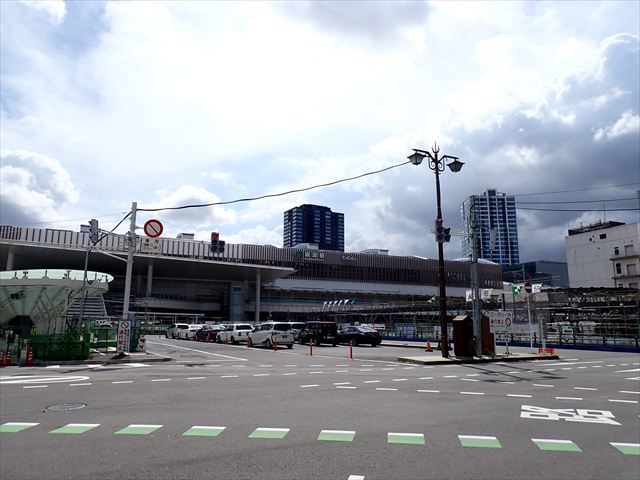
I went to Niigata today. I needed to use an Automated Teller Machine in the city. When I walked a pedestrian road along the wide street in front of the JR Niigata Station, I felt the smell of Ginkgo. It’s not a good flagrance, if not odor. But it is sure that smell makes me realize that the autumn has come.

Just under the JR Niigata station is the Bus Terminal

Toyoko Inn and Bus Terminal

JR Niigata Station

Many Ginkco Fruits were on the Ground, smelled.

After using ATM, I quickly returned home by getting on a Local train.

In the afternoon, I tried watching DVD in my house. The DVD was about teaching Japanese as foreign language. But I slept while playing it. Nothing was left in my memory.

Random Photos at This Time Around in Two Years Ago (September, 2023)

For the new second-year students, it is the time to change their major. Some of students leaves Japanese course for other majors at the beginning of new school year. Since most of them are usually good students, knowing a particular student is leaving Japanese major makes me disappointed in some extent.

But I think I should not complain or criticize those students who changed their major. Because, in most of the cases, their experience of learning Japanese for one year will no longer be useful into the future. And they have to study hard in order catch up other classmates in the new major they have moved to. it must be a tough decision to make, I guess.

I wish them a fruitful learning in the new major and a bright future to come with new knowledge. And if they will, it is possible to learn Japanese by themselves.

Learning how to teach after quitting the job as a teacher

Today, in the morning, I worked in my field. When it comes to growing vegetables in this autumn season, there is not much thing remaining. But I still have one thing to do. That is to plant onion’s seedlings and garlic’s bulbs. In order to plant them, I need to make one more ridge in the field. It will be five meter long; three meters for onions and two meters for garlic. What is tough is to get rid of roots of weeds from the place for the ridge and furrow. Since the place had been untouched for two years, now weeds’ roots in the ground are like spaghetti.

I worked in the field from 8 to 9:30 am. and then I got shower. From 10, I was watching a DVD that is about teaching Japanese as a second language. Actually, I had brought those DVD with me to the campus during the years I was teaching in a university. Watching the DVD today, I regret that I should have watched while I was teaching in the university. There are a lot of tips for teachers to teach a foreign language. For example, there is a concept of MMC for beginner’s level; the first M is mechanical training, the second M stands for meaningful training, and C for communicative activities. Did I do that? Usually, I didn’t extend my teaching to communicative activities. And there was no clear distinction between mechanical and meaningful trainings in my teaching. I would like to improve my teaching skill, but I don’t see any chance to apply improvements to my teaching in the future. I have already retired from the job as a Japanese teacher.

I had planned to go shopping in the afternoon. But it was hot like 34 Celsius degrees. So, I didn’t go to a supermarket, but continued to watch the DVD about teaching Japanese in the afternoon. I practiced my piano from 4 to 5 pm, cooked a supper from 5, had the supper at 6:30, and then I went shopping. I got back home at 8 pm, and started writing this.

What I Bought Tonight

Sometimes I Receive a Message from my Students.

I bought a new smartphone last month. Before I went to the mobile phone store, I hadn’t known that a google account was necessary for android. So, I had to make another google account in the shop. If I had known this matter, I would have brought ID and password of existing google account of mine. In addition, I installed “LINE” for my mobile phone, which also increased number of Accounts. Now I have so many accounts for emails and SNS. I am not sure if I can handle all of them.

This morning, I found an email in one of my mail boxes. Actually, I haven’t noticed it for several days. I wrote a reply and sent it. If a message comes, I will write a reply. That is okay. But sometimes I also want to send a message from me to my students. In fact, I am not sure they are happy with my message. Some are happy and write a reply to me soon, but some students perhaps are unhappy, think it troublesome, and are reluctant to reply to me. They may feel it difficult to write a reply to a person who is thirty years older than they are. Basically, doing communication is good, but I have to be careful how I communicate with my students; who to send, how often, what to write, and so on.

Some day, most of my students will forget about me. It is okay for me. They will grow up as an adult, and devote to the day-to-day life in new circumstance. As for my side, too, it is impossible to remember all the students I taught. Time flies and memories will be gone. But for now, I think it is not so bad to send messages to my students, while I remember them well. Now I am thinking about writing one message to one student a day. I hope that my message would not be so troublesome for the student.

Group photo at graduation

Rough calculation gives me the following; I taught students of seven grades (in six years). There were about 50 students in a grade. Therefore, approximately I taught 350 students.