Spring Flowers in the Garden

00413

I wanted to make the title “Spring Flowers in my Garden”, but actually it is not my garden. I have just stayed at my parents’ home for these several months. I cannot get back to the country where my university is because of corona virus pandemic. Anyway, spring season never stops and the peach flowers have already gone.


00414

Coming next would be flowers of azalea. Its white bud makes me think of vanilla ice cream.
 

00415

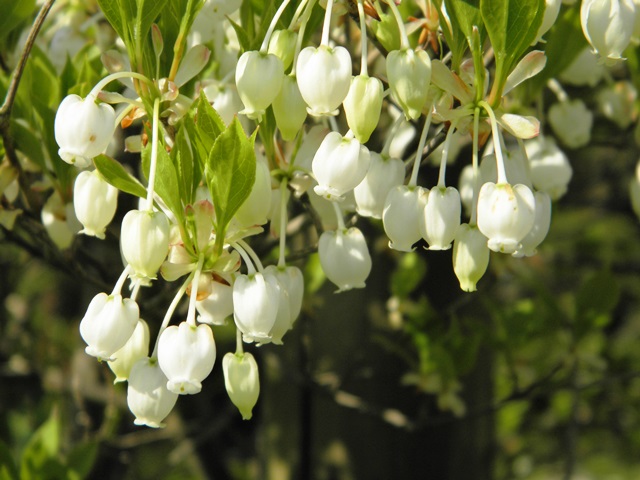
This is also a white azalea, Doudan-Azalea flowering downward. It seems to contrast to the red leaves in autumn, although we cannot see white flowers in spring and red leaves in autumn at the same time.


00416

This is also “Downward flowers” of silverberry. I planted only one tree of silver-berry (or goumi) in the garden. This means that I will not be able to get any fruit in the near future because there should be another silver-berry but a slightly different kind. In order to get fruits, most of fruit trees needs another tree nearby for pollination.


00417

Buds of an apple tree. For the pollination as I mentioned for silver-berry, I planted two apple trees in one place. They were Kougyoku and Tsugaru. This photo was probably of Kougyoku’s.


00418

Here is another apple’s flower that has already opened. This is Alpus-Otome.


00419

This is flowers of gooseberry. Maybe it is safe to say that the fruits look more beautiful than the flowers. If I can take a photo of gooseberry fruit, I would like to put it on this blog.


00420

Actually this photo and the below were taken two weeks ago.


00421

Yes, this is peach flowers two weeks ago. I am not sure if I will be able to eat sweet peaches from this tree in summer because I am just an amateur about fruit tree growing.

Online Teaching for Class 1837 (Conversation) on Apr.20, 2020

Date: April 20th on Monday, 2020 from 8:00 to 9:30 (9:00 – 10:30 in JST)

Course: Japanese Conversation 4

Used app: Streaming on DingTalk, Presentation by Powerpoint with 81 slides

Numbers of Students: 28

Fully attendant for 90min : 20,    Completely Absent : 3,

Shorter signing-in: 71, 41, 31, 19, 7 minutes.

Responses onto the BBS:

– Attendance check by a student his/herself: 25. One out of 25 was recorded as completely absent. One student did not report the attendance by him?herself but was recorded with 41 minutes attendance. Probably the student came late and left early.

– 1st Questionnaire: 19 students responded. This was not a question but a questionnaire. The students were asked to answer which of the four summer festivals in Japan they want to come and see. The festivals were Nebuta in Aomori, Tanabara in Sendai, Bon-Odori in anywhere, and Fireworks in everywhere. Most of the students prefer fireworks.

– 2nd Quiz: 17 students responded. The quiz was to find a different type of conjunctive particle out of five sentences. Four sentences used “If” type conjunctive particles and only one sentence used “Even-if” type conjunctive particle. The students were asked to find “Even-if” type. All the 17 answers were correct.

– 3rd Quiz: 20 students responded. The quiz was to ask right connections between negative “-nai” and conditional conjunctive particle “-ba”. All the answers were correct.

Attendance check at the end: 20 students responded. This is a quiz to ask the right conjugation of verb ‘iku/ikimasu” for conditional form.

Teaching: 

– Listening to conversation between part time job workers.

– Review on hearsay expressions using “-souda”, “-rashii”. “He/she says”, and “It is said that”

– Feedback about a Test result; A small test was given to students on April 13. The result was explained to the students for further understanding about differences between hearsay and guessing

– Introduction of the conditional conjunctive particle “-ba” and verb conjugations for conditional form

Homework Assignment:  Students were asked to type verb conjugations to conditional forms.There were 30 verbs but 60 answers were required. 30 were conditional forms directly obtained from dictionary forms. 30 were also conditional forms but obtained from potential forms.

Issues and Problems:

I am not sure whether it is standardized teaching or not as to conditional forms that are obtained from potential forms. It might bring a severe confusion to students because it makes students think as if 5-dan conjugation verb were also conjugated to have -reba. Reba ending is only for 1-dan conjugation verbs, Kuru, and Suru (actually Ra-row 5-dan verbs, too). What I thought was simple. It is useful to know conditional forms coming from potential forms because Japanese use very often that kind of conditional forms in conversation.

Online Teaching for Class 1939 (Listening) on Apr.22, 2020

Date: April 22th on Wednesday, 2020 from 8:00 to 9:30 (9:00 – 10:30 in JST)

Course: Japanese Listening 2

Used app: Streaming on DingTalk, Presentation by Powerpoint (58 slides)

Numbers of Students: 27

26 students stayed with me from the start to the end. One student is recorded his?her shorter attendance of 81minutes.

Students’ Responses:

– Attendance Check : All the 27 students typed his/her attendance on BBS

– Quiz 1 : 23 students answered. This question was to measure students’ understanding about a newly introduced phrase [V-masu] -ni Ikimasu that means the purpose of movement.

– Quiz 2: 24  answered. Questions are to ask the difference between I-adjective “-hoshii” and auxiliary verb “-tai”. The slide for the answer is shown below as Figure 1.

– Quiz3: 24 answered. This question was to make the students answer their own preferences. The question was using the construction of the day; which do you like, a dog or cat? 18 students answered that they like cat, and only 6 students liked a dog.

– Quiz at the End: 27 students typed a sentence for question “Which do you like, A or B?”.

Teaching:

1: Review of conversation for suggestion and invitation.

2:Grammatical Topics of the first half of Section 16 of the Textbook

– A noun “Hou” that specifies one of the two as a selection.

– “-no” that makes an adjective a kind of noun

– Conjunctive particle “-kara” for stating a reason.

– Introduction of sentences to say capability

– “-noda/nda” for explaining and/or revealing

– Clauses that modify a noun

– Auxiliary verb “-tai” to express one’s wish

– “-to” that is putting between the thoughts and a thinking verb

Of course these topics were not the things that can be taught in one or two hours. I just explain briefly. I know that it was not enough for students to even figure out the concepts of these issues.

Homework Assignment:

– Homework was not assigned during the class. Although I said that it would be given through the BBS, it depends on me.

Issues and Problems:

– I am just wondering whether or not it could be effective by just playing the listening materials of the textbook and making the students listen to it. I think I have to do something to make it more effective. But I don’t know how to do right now.


i00322

Figure.1 The Difference between “-hoshii” and “-tai”


Online Teaching for Class 1939 (Listening) on Apr.20, 2020

Date: April 20th on Monday, 2020 from 9:50 to 11:20 (10:50 – 11:20 in JST)

Course: Japanese Listening 2

Used app: Streaming on DingTalk, Presentation by Powerpoint (47 slides)

Numbers of Students: 27

25 students stayed with me from the start to the end. Two students were recorded with their shorter participation of 78 and 75 minutes.These students did not respond to any of four quiz during the class.

Students’ Responses:

– Attendance Check : All the 27 students typed “Shusseki” on BBS

– Quiz 1 : 24 students answered. The students were asked to find the right answer whose tense was appropriate related to time and the endings of a sentence.

– Quiz 2: 23 students answered. Question was to choose the right stroke order of Hiragana “NA” from two selections. 16 were right, 7 were wrong. However, maybe, some students write their “NA” in wrong order, but looking at other’s answer, they just answered as others did. Figure 1 below shows the slide to show the answer of this question.

– Quiz3: 22 students answered. This question was to find an intransitive verb from three selections. The answer could be reached by looking at particles.

– Quiz at the End: 25 students typed a phrases that meant “I went (to somewhere) to do something” in the form of “[Verb]-ni Ikimasu”. Two students mistakenly made phrases “[Noun]-ni Ikimsau”, but then they corrected.

Teaching:

1st Half: Review of the last class

– V-te Kudasai / V-nai de Kudasai ; To ask someone to do/ not to do something

– V1 nagara V2 suru : Two actions simultaneously or two occupations at the same time.

– To make verb phrase a noun phrase by putting “-no” right after the verb

– V(-masu)-ni Ikimasu : Purpose of going to somewhere

– Introduction of 4 usages of “V-teiru” in time sequence

2nd Half: Listening to Conversations of the textbook.

Homework Assignment:

No homework. The students were asked to study themselves.

Issues and Problems:

I prepared less PPT slides this time. However, some slides were left unused because of time.


i00321

Fig.1 Stroke Order of Hiragana “NA”

Online Teaching for Class 1837 (Conversation) on Apr.17, 2020

Date: April 17th on Friday, 2020 from 13:40 to 15:10 (14:40 – 16:10 in JST)

Course: Japanese Conversation 4

Used app: Streaming on DingTalk, Presentation by Powerpoint with 63 slides

Numbers of Students: 28

Fully attendant for 90min : 16,    Completely Absent : 5,

Shorter signing-in: 82, 52, 42, 41, 31, 5minutes, and the shortest was 56 seconds.

Responses onto the BBS:

– Attendance check by a student his/herself: 22.

– 1st Quiz: 17 students responded. The quiz was to talk about several usages of particle “-to”. Selections are as follows: (A) “-to” for Noun1 and Noun2, (B) “-to” for someone whom you do something together with, (C) “-to” for comparison and/or classification, (D) “-to” follows what he/she thought and/or said, and conjunctive particle “-to” for conditioning. This quiz was to make the students choose D.

– 2nd Quiz: 16 students responded. The quiz was not a question but a kind of questionnaire. Students were asked to choose a hearsay from three choices. This was a kind of tips on business.

– 3rd Quiz: 17 students responded. The quiz was to distinguish hearsay or guessing. Probably it was a little grammatical to ask the students at this time. Only two students got correct answers.

– Attendance check at the end: 20 students responded. A correct verb conjugation to fit hearsay “-souda” was asked.

Teaching: 

– Review of conversation using the auxiliary verb “-souda” for hearsay.

– Introduction of the expression “-to itte iru” for “he/she says that -”

– Introduction of the expression “-to iwarete iru” for “it is said that -”

– Introduction of the expression “-ni mieru” for “it seems that – ”

Homework Assignment:

No document need to be submitted this time. The students were asked (1) to do self-check of the small test that was a homework of last class, and (2) to listen to a mp3 that was a conversation between two part time job workers with one being new to the job.

Issues and Problems:

Today’s new expressions were “he/she said that”, “it is said that”, and “it seems that” (in Japanese!). It seems that they can be alternatives for auxiliary verbs “-youda” and “-souda”. In a strict sense, I don’t think they are identical to “youda” and “souda” in the meaning and functions. But in order for the students to do conversation without stopping it, I would like to recommend using those a little bit lengthy but easy and clear  expressions. If you use “youda” and /or “souda”, a difference of just a one letter or two changes the meaning of whole sentence; guessing or hearsay.

Online Teaching for Class 1837 (Composition) on April.17, 2020

Date: April 10th on Friday, 2020 from 8:00 to 9:30 (9:00 – 10:30 in JST)

Course: Japanese Basic Composition 2

Used app: Streaming on DingTalk, Presentation by Powerpoint with 82 slides

Numbers of Students: 27 out of 28

90 minutes attendance: 18 students

Shorter participation: 68, 41, 31, 29, 5, 5, 3, and 3 minutes, and the shortest was 3 seconds.

completely absence: 1 student

Responses to my requests like Quiz answers onto BBS:

Attendance check: 28. But one student were recorded as “Completely Absent” on the system.

Quiz 1 : 17 students responded. The question was to find an incorrect sentence from six sentences that had different words order. Actually there was no incorrect sentences, all the six sentences were correct. This question aimed at showing that there is a flexibility in words order in Japanese thanks to particles that indicate the function of a word.

Quiz 2: No student could make his/her response. Probably it was too difficult. I did not ask this question to class 1836 for the same reason. Everything was in Japanese, but let me write in English:

Question: which of A or B is described in the the following statement?

It is not clear if Ms.Hasegawa and Ms.Saito were confused each other, or these two were confused with other people.

A: I mistakenly thought Ms. Saito as Ms.Hasegawa.

B: I confused Ms.Hasegawa and Ms Saito.

This question was to show the verb “Machigaeru” needs not only a word with “-o” but also a word with “-to” to make a sentence have sufficient information.

Quiz3: 20 students responded. The question was to choose sentences that were more suitable to writing.

Teaching:

The same as composition class for 1836 on Tuesday. The first half was to give the students a feedback about the results of the last week’s homework assignment. It was a kind of test about particles. As I predicted, there were so many error caused by the influence of ‘”Wa-ga construction”.

The Second half was teaching using the textbook. It consisted review of last week and this week’s topic. The former was connecting two phrases to make a longer sentence, the latter was expressions that were more suitable for writing.

Homework:

1: Writing a composition about how to use the particle “-ga” and “-o”.

2: Writing sentences that a student made errors with for the last week’s homework.

Issues and Problems:

A huge problem with over generalization of Wa-ga Construction.

Online Teaching for Class 1939 (Listening) on Apr.15, 2020

Date: April 15th on Wednesday, 2020 from 8:00 to 9:30 (9:00 – 10:30 in JST)

Course: Japanese Listening 2

Used app: Streaming on DingTalk, Presentation by Powerpoint (52 slides)

Numbers of Students: 27

26 students stayed with me from the start to the end. One student is recorded his?her shorter attendance of 61minutes.

Students’ Responses:

– Attendance Check : All the 27 students typed his/her attendance on BBS

– Quiz 1 : 24 students answered. This question was to measure students’ understanding about listening materials. Most students sent wrong answers.

– Quiz 2: 25  answered. Questions are to check if the students know several usages of particle “-no” or not. The students were asked to choose a wrong usage of “-no” that was “-no” placed between an I-adjective and a noun.This error happens quite often for this country’s Japanese learners.

– Quiz3: 23 answered. This question was to ask what type of speech style was used in the conversation.

– Quiz at the End: 26 students typed a clause of “V1 nagara V2-masu”.

Teaching:

1: Review of conversation for suggestion and invitation.

2: Redo of two listening activities that were done in the last class. One was daily life of three persons, the other was talks travel experiences by three persons.

3: Preparation for the Section 15

– V-te Kudasai / V-nai de Kudasai

– V1 nagara V2

– Making a noun phrase from a verb phrase by placing “-no”

– To express the purpose of movement with “V(-masu) + ni + transferring verbs”

– Usages of Te-forms that appeared in section 15 of the textbook.

Homework Assignment:

– Writing “V-nai de Kudasai” and “V-te imasu” from dictionary forms.

Issues and Problems:

– This is a listening class. But the section 15 of the textbook includes a lot of important grammatical issues. It needs explanations in addition to listening activities that are needed most.

Online Teaching for Class 1836 (Composition) on Apr.14, 2020

Date: April 14th on Tuesday, 2020 from 15:30 to 17:00 (16:30 – 18:00 in JST)

Course: Japanese Basic Composition 2

Used app: Streaming on DingTalk, Presentation by Powerpoint with 82 slides

Numbers of Students: 28

22 students participated for whole 90 minutes.

5 students were recorded for their short attendances: 86, 81, 75, 36, 18minutes

1 students was completely absent.

Responses to my requests like Quiz answers onto BBS:

– Attendance check by reporting his/her-selves: 27.

– 1st Quiz: 18 students responded.

– 2nd Quiz: I decided not to do this because time was limited and it is a too difficult question.

– 3rd Quiz; 20 students responded. The question was to choose three sentences that are more suitable to writing style out of six.

– Attendance check at the end : 23 students responded. The question was to ask the functions of each particles; -wa, -ga, -o, -ni

Teaching:

1st half:

– Answers and review for quiz with 5 questions in the last class

– Importance of particles in Japanese

2nd half

– Review for the last class about connecting short sentences to make longer sentences.

– Connecting two clauses in order to write a longer sentence.

Homework:

1: Writing about usages of particles “-ga” and “-o”.

2: Rewriting sentences that had errors in last week’s homework.

Issues and Problems:

They will never learn hoe to use the particle “-o”. I realized that it is useless to teach them the importance of the particle “-o” which is a marker of an object that receives action of transitive verb. So I decided to make the students write their explanations about “-o”. For the sake of comparison, I thought it would be better to make them write about also the particle “-ga”.

Online Teaching for Class 1939 (Listening) on Apr.13, 2020

Date: April 13th on Monday, 2020 from 9:50 to 11:20 (10:50 – 11:20 in JST)

Course: Japanese Listening 2

Used app: Streaming on DingTalk, Presentation by Powerpoint (84 slides)

Numbers of Students: 27

24 students stayed with me from the start to the end. It seems that shorter participation is increasing; three students were recorded for their times as 82,74, and 72 minutes.

Students’ Responses:

– Attendance Check : All the 27 students typed “Shusseki” on BBS

– Quiz 1 : 27 students answered. This question was intended to know whether or not the students recognized that the man in the conversation was actually a suspicious guy.

– Quiz 2: 25  answered. Questions are to check if the students know or not the names of a cup of cold water, wet towel, and chop sticks in Japanese  restaurants.

– Quiz3: 24 answered. This question was to measure if students understand rough plot of the conversation or not.

– Quiz at the End: 26 students typed a sentence that meant “I am going to enjoy a party under the sakura flowers with my friends tomorrow”. One student missed particle “-o”.

Teaching:

1: Interrogative sentences of verbs predicate in past tense.

2: Listening to a Conversation for an invitation and making an appointment.

Homework Assignment:

Small test of particles “-ga”, “-o”, “-de”,”-ni”. Students are asked to fill blanks with particles in sentences. Deadline is 17th on Friday.

Issues and Problems:

It was difficult to conduct activities of conversation on line. I just imagine that the students are saying person B’s utterances while I speak as person A in a conversation.

Online Teaching for Class 1837 (Conversation) on Apr.13, 2020

Date: April 13th on Monday, 2020 from 8:00 to 9:30 (9:00 – 10:30 in JST)

Course: Japanese Conversation 4

Used app: Streaming on DingTalk, Presentation by Powerpoint with 63 slides

Numbers of Students: 28

Fully attendant for 90min : 16,    Completely Absent : 4,

Shorter signing-in: 85, 84, 84, 73, 37, 23, 11 minutes, and the shortest was 55 seconds.

Responses onto the BBS:

– Attendance check by a student his/herself: 26, but three students were recorded as completely absent

– 1st Quiz: 14 students responded. The quiz was to ask right connections between a Na-adjective and auxiliary verb “-rashii”.

– 2nd Quiz: 18 students responded. The quiz was to tell the difference of hearsay “souda” and guessing “souda”.

– 3rd Quiz: 16 students responded. The quiz was to ask right connections to auxiliary verb “rashii”. One is a negative verb predicate and the other is a  noun.

– Attendance check at the end: 14 students responded. This is a quiz to get to know similarities between hearsay and “It is said that” and between guessing and “I think that”. Of course they are in Japanese.

Teaching: 

– Review of conversation using the auxiliary verb “-rashii” for guess.

– Introduction of the auxiliary verb “-souda” for hearsay

Homework Assignment: Short test of one sheet of A4 paper to ask usage types of “youda”, connections of “rashii”, and miscellanious questions about sentences u4sing auxiliary verbs.

Issues and Problems:

Due to the time limitation, I couldn’t teach “he/she says that” which can be a substitute of hearsay. Five PPT slides were left unused.