I saw a Rainbow

Agony or Fun?! Second Language Learning
I am a native Japanese speaker who used to teach Japanese in a university somewhere on this planet. Currently I don't work but stayed in my house in Northern part of JAPAN. I hope that you could enjoy reading my posts and know what life in Japan is like.
We have learned some passive sentences in which “who makes the action” is not important in the exercise A4 and A5. Today’s sentences in the exercise A6 are also this kind of passive sentences in terms of not-mentioning the actor. The difference from A4 and A5 is that a verb in passive form has become “-te iru”. We have already learned that when the action is currently ongoing, continuously keeping done, and is repeated frequently, the verb predicate is not simply “V-masu.” but becomes “V-te imasu”. Therefore, the sentences in A6 can be regarded as an application of “V-te iru” to the passive sentences.
1. Nihon no Roketto wa Tanegashima de Uchiagerarete imasu.
(Rockets of Japan have been launched in Tanegashima Island.)
“Tanegashima” is a place name; it is located south of Kagoshima. The island is famous as the launching place of the rockets. If we don’t use “V-te iru”, the sentence would be as follows;
2. Nihon no Roketto wa Tanegashima de Uchiageraremasu.
The sentence 2 is not wrong, but it makes us wonder whether the launching is one-time event or repetitive events. Or, some may think that the launching happens in near future, without knowing Japan has already launched many numbers of rockets from that Island.
Using “V-te imasu”, the sentence can express that not one but many rockets have been launched from the island.
To change a verb in passive form to be an additional Te-form is not a big issue. The Nai-form of the passive form “Uchiagerareru/Uchiageraremasu” is “Uchiagerar<e>nai”. Therefore, it can be a kind of Group 2 verbs. Simply put “te” to the stem as making a Group2 verb Te-form. No difficult procedure is needed like Group1 verbs.
3. Kono Ude-dokei wa Ano Koujou de Tsukurarete imasu.
(This wristwatch is being made in that factory.)
Something is being made in a factory. It is usually continuous and/or repetitive action, probably not one-time event in the future. The passive form of the verb “Tsukuru/Tsukurimasu” is “Tsukurareru/Tsukuraremasu”. And then it can be Te-form that is “Tsukurarete”. If we convert the sentence 3 to an active sentence, we would get a sentence as shown below;
4. Ano Koujou wa Kono Ude-dokei o Tsukutte imasu.
(That factory is making this wristwatch.)
Those who thinks “wa-ga construction” is versatile may say “(WRONG)Kono Koujou wa Kono Ude-dokei ga Tsukutte imasu.” This is terribly wrong. An object of a transitive verb must use the particle “-o” as the object marker. In this case, it is “Udedokei o Tsukuru”. In some situation of Japanese learning, both teachers and learners try to avoid using the particle “-o”. Such people tend to use “wa-ga construction” quite often because “wa-ga construction” doesn’t use the particle “-o”. And sometimes they find another way to avoid “-o”, which is to make a passive sentence like 3. You see that there is no particle “-o” in the sentence 3 even though the sentence uses transitive verb “Tsukuru/Tsukurimasu”. Of course, the sentence 3 and 4 are not the same. The subject of 3 is ”Kono Ude-dokei wa”, and that of 4 is “Ano Koujou wa”. So, the emphases are different between 3 and 4. Although today’s sentence construction doesn’t use the particle “-o”, but it is necessary to accept that it is fundamental that an object of a transitive verb needs to be followed by the particle “-o”.
The main theme of today’s post is the combination of the passive voice and “V-te iru”.
————————————–
This post was written with reference to the exercise A6 on Section37 of “Minna no Nihongo (2nd Edition)” published by “3A Corporation”
We are learning some types of passive sentences in the section 37. Today’s sentence constructions too, do not mention who makes the action like yesterday’s sentences. The difference from the yesterday’s is that “-wa” is used for the subject marker.
1. Kono Tatemono wa Raishu’u Kowasare masu. (This building will be demolished in the next week.)
The subject is “Tatemono(building)” in the sentence 1. Since the subject marker is not “-ga” but “-wa”, both the speaker and the listener have already shared what is the Tatemono, or which Tatemono they are talking about. Look at two conversations below;
(1) The subject markers are “-ga”
A : Dono Tatemono ga Raishu’u Kowasare masuka. (Which building will be demolished next week?)
B : Kono Tatemono ga Kowasare masu. (This building will be demolished.)
The person A doesn’t know which building will be demolished at the timing of asking. Therefore, only the person B knows “Kono Tatemono” will be demolished. “Kono Tatemono” will be a new information for the person A. This is the reason why “-ga” is used for the subject marker.
(2) The subject markers are “-wa”
A : Kono Tatemono wa Raishu’u Kowasare masuka. (Will this building be demolished next week?)
B : Hai, kono Tatemono wa Kowasare masu. (Yes, this building will be demolished.)
The person A and B is talking about the same building “Kono Tatemono”. Therefore, they have already shared which building they are talking about. This is the reason why “-wa” is used for the subject marker.
The following example sentences are also shown in the form of conversation, in order to make clear that the subject is shared between the asking person and the answering person.
2.
A : Kono Otera wa Itsu Taterare mashitaka. (When was this temple built?)
B : Kono Otera wa Ni-Hyaku nen mae ni Taterare mashita. (This temple was built 200 years ago.)
3.
A : Pa’ati’i wa Doko de Hirakare masuka. (Where will the party be held?)
B : Pa’ati’i wa Koube Hoteru de Hirakare masu. (The party will be held in Kobe Hotel.)
The above conversations use “-wa” for the subject markers. Can you tell whether “wa” or “ga” is used for subject marker in the following conversation?
A : Koube Hoteru de Nani<?> Hirakare masuka. (What will be held in Kobe Hotel?)
B : Pa’ati’i <?> Hirakare masu. (A party will be held there.)
The answer will be shown tomorrow.
Yesterday and today, we have been learning some passive sentences that do not mention the actor of the passive action. This kind of sentences are uttered when the actor is not the important information. If who’s the actor is important, of course it is possible to say the actor in a passive sentence.
A : Kabin wa Dareni Kowasare mashitaka. (By whom was the flower vase broken?)
B : Kabin wa Satou-san ni Kowasare mashita. (The flower vase was broken by Sato-san.)
————————————–
This post was written with reference to the exercise A5 on Section37 of “Minna no Nihongo (2nd Edition)” published by “3A Corporation”
One thing is common between the passive sentences in the exercise A4 and A5. In the sentences of A4 and A5, the actor of the action is not important. Of course, the subject and the passive action are important in the sentences of both A4 and A5. Then, the difference between A4 and A5 is the subject markers; “-ga” is used in A4, and “-wa” in A5.
Sample of the A4 type passive sentences are as follows;
1. Toukyou de Orimpikku ga Okonaware masu. (In Tokyo, the Olympic games will be carried out.)
In fact, the Olympic games were held in 2021, but the sentence 1 is of future tense. “Okonawareru/Okonawaremasu” is the passive form of the verb “Okonau/Okonaimasu” which means “carry out”. If the passive sentence 1 was converted to be an active sentence, it would be;
– Toukyou de “???” ga Orimpikku o Okonai masu. (In Tokyo, ??? will carry out the Olympic games.)
As you see in the above sentence, we don’t know who will carry out the Olympic games. And the actor of the action “carry out” doesn’t appear in the sentence 1. It is just because who makes the action is not important;
2. Sumida-gawa de Hanabi ga Uchiagerare masu. (On the Sumida River, the fireworks will be launched.)
“Uchiagerareru/Uchiageraremasu” is the passive form of the verb “Uchiageru/Uchiagemasu”. And as well as the sentence 1. this sentence 2 also doesn’t mention who is the actor, because who makes the action is not important information in this sentence.
Both in the sentence 1 and 2, the subject markers are “-ga”. The subject marker “-ga” functions to identify what the subject is. But the “-ga” in the sentence 1 and 2 are usually explained as “’-ga’ for the new information”. When “-ga” is used for the subject marker, the concept of the subject has not yet shared between the speaker and the listener. The speaker knows it, but the listener doesn’t. The listener receives the subject as a new information. This is the difference from the case that “-wa” is used for the subject marker.
When the speaker says “[Subject] wa”, the concept of the subject has already been shared between the speaker and the listener.We will see some passive sentences in which the actor doesn’t appear tomorrow, too. But they will use “-wa” for the subject marker.
————————————–
This post was written with reference to the exercise A4 on Section37 of “Minna no Nihongo (2nd Edition)” published by “3A Corporation”
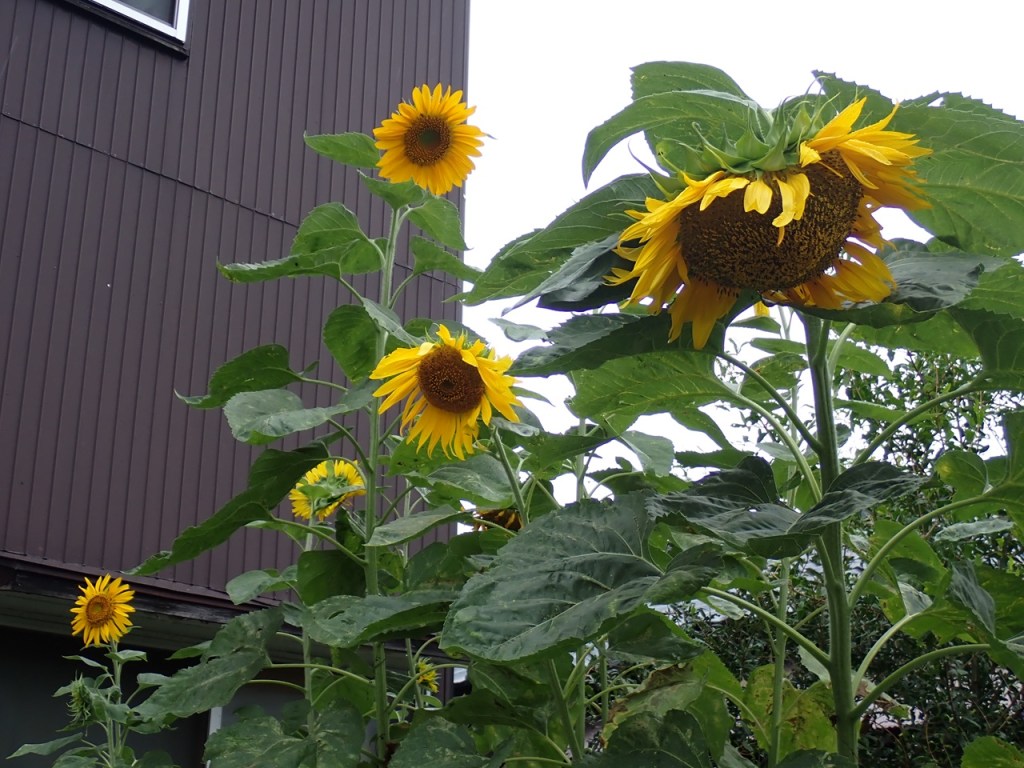
These are the sunflowers whose seeds are edible.
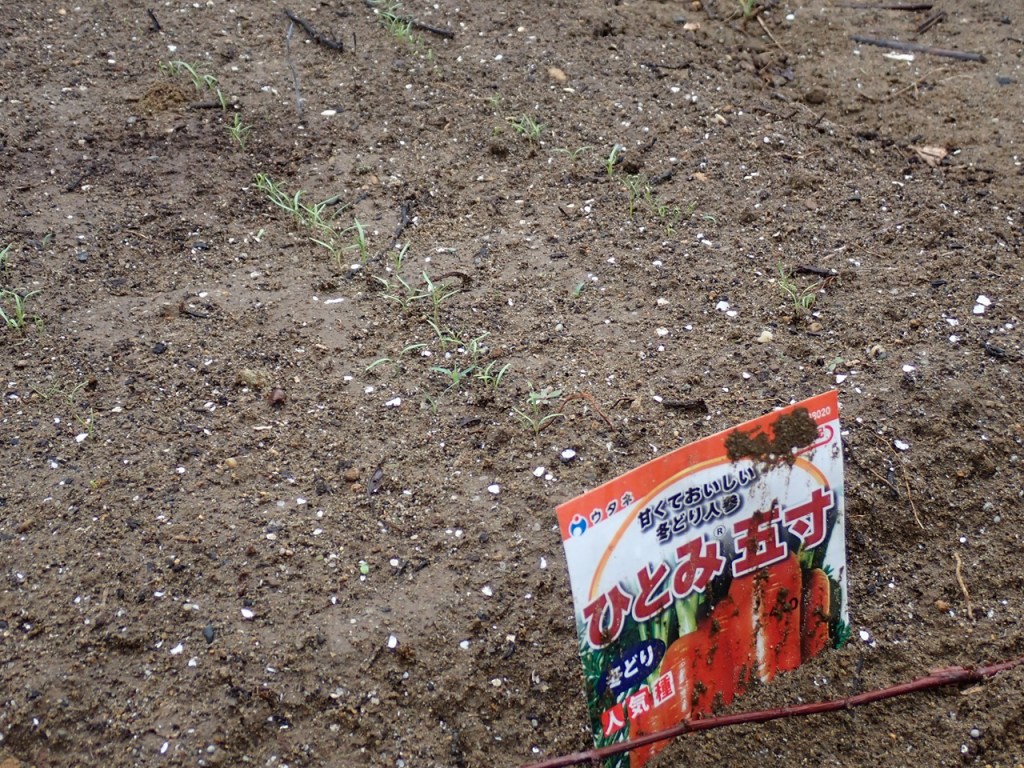
Buds of Carrot have come out of the ground. They are not for sale, just to be eaten in my house.
Let’s make it clear at the beginning. When you want to say “I was stolen my money”, which passive sentence is right?
(1) Watashi wa Okane ga Torare mashita.
(2) Watashi wa Okane o Torare mashita.
The answer is that (1) is wrong and (2) is right. Perhaps some people might think (1) is right. In fact, there is a teaching style in which both the teachers and students avoid using the particle “-o” as much as possible in some environments of learning Japanese as a second language. As a result of avoidance of the particle “-o”, many learners end up thinking “wa-ga construction” is versatile. This is the reason to choose (1) for the answer.
The right sentence is (2). As in English translation “I was stolen my money”, the money is MY money. Now we are going to learn passive sentences to express one’s possession gets a passive action. Let’s start with an active sentence;
1. Dareka ga <Watashi no Okane o> Tori mashita. (Someone stole my money.)
From this active sentence 1, it is possible to convert the sentence 1 to be a passive sentence by making the object in the active sentence the subject in the passive sentence as below;
2. <Watashi no Okane wa> Dareka ni Torare mashita. (My money was stolen by someone.)
Turning the object in an active sentence to the subject in a passive sentence, we can convert an active sentence to be a passive sentence. This is what we learned in the exercise A2. For the sake of reviewing, look at the following sentences 3 and 4. The two are an active sentence and a passive sentence, respectively.
3. Sensei wa <Watashi o> Home mashita. (The teacher praised me.)
4. <Watashi wa> Sensei ni Homerare mashita. (I was praised by the teacher.)
The object “Watashi o” in the sentence 3 has become the subject “Watashi wa” in the sentence 4. Likewise, the object “Watashi no Okane o” in the sentence 1 has become the subject “Watashi no Okane wa” in the sentence 2. Here, again, is the sentence 2.
2. Watashi no Okane wa Dareka ni Torare mashita. (My money was stolen by someone.)
Though I said “Watashi no Okane wa” is the subject of the sentence2, if I choose the subject by one word, it will be “Okane wa”. “Okane” is money, and it is a thing, not a person, let alone “Watashi (I)”.
There is an important fundamental in Second language learning. The example sentences need to have Authenticity so that the learners would think the sentences are their own expressions. One way to do that is to make the subject of the sentences “Watashi (I)”. This is important when learning passive sentences like;
Active sentence : Person A did Something to Person B.
Passive sentence : Person B was done Something by Person A.
And especially in the case that you got damaged by someone, you would want to say;
<1> I was done a bad thing by Person A.
The sentence <1> has more authenticity than a sentence like “The car A was hit by the car B”, and probably facilitates learning of passive sentences.
Although the subjects in the exercises A4 through A6 are things, we need to pay attention to what are the subjects in A2 and A3. The subjects are all “Watashi wa”.
Therefore, not the sentence2 whose subject is a thing (money);
2. Watashi no Okane wa Dareka ni Torare mashita. (My money was stolen by someone.)
but we have to learn passive sentences whose subjects are “Watashi (I)”, like below;
5. Watashi wa Dareka ni Okane o Torare mashita. (I was stolen my money by someone.)
<This post still needs additional example sentences. Therefore, this has not been completed yet.>
————————————–
This post was written with reference to the exercise A3 on Section37 of “Minna no Nihongo (2nd Edition)” published by “3A Corporation”

Niigata West Port is located in the river mouth of Shinano River. There is a big ferry boat for Hokkaido.

That tall building also has an observatory on upper floor.
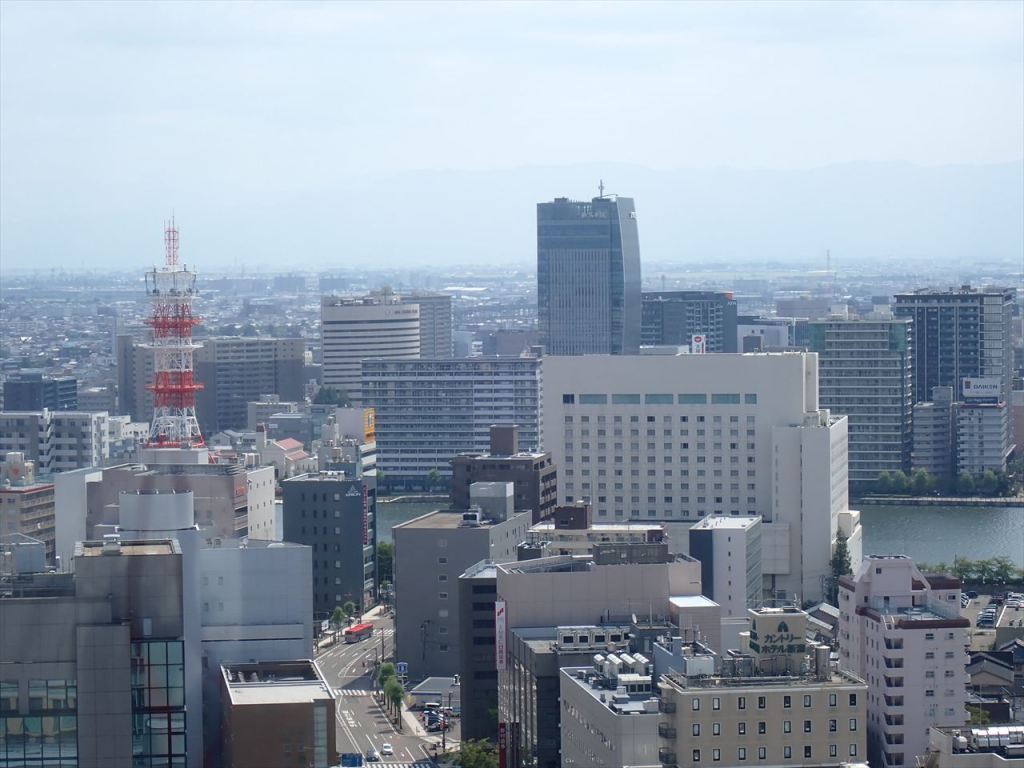
And the building with curved shape is owned by the local newspaper, which also has an observatory.
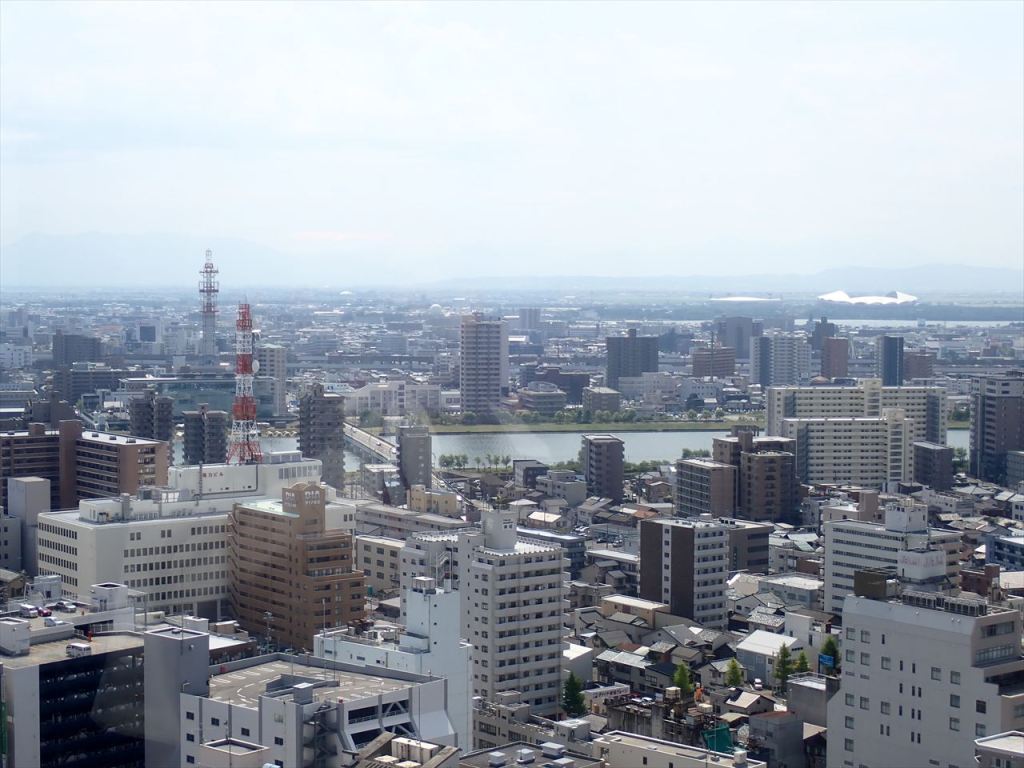
You can see Shinano River and Toyano Ragoon.
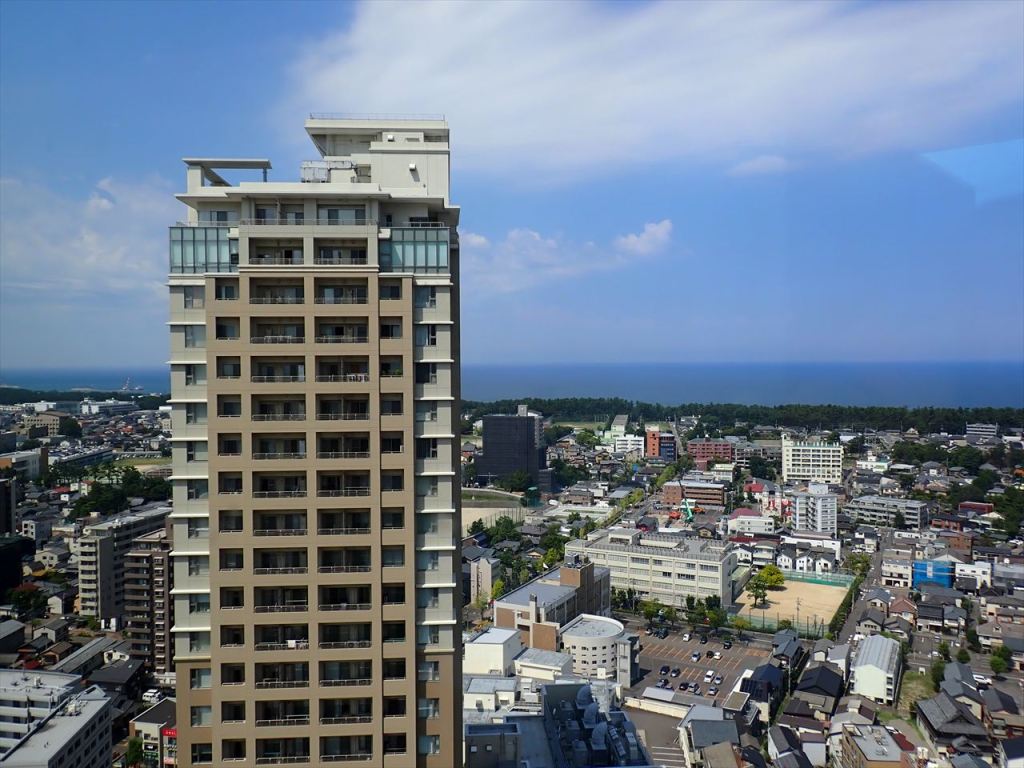
I wouldn’t like to live in a high place like that, although I don’t have money to buy an apartment in such a mansion.
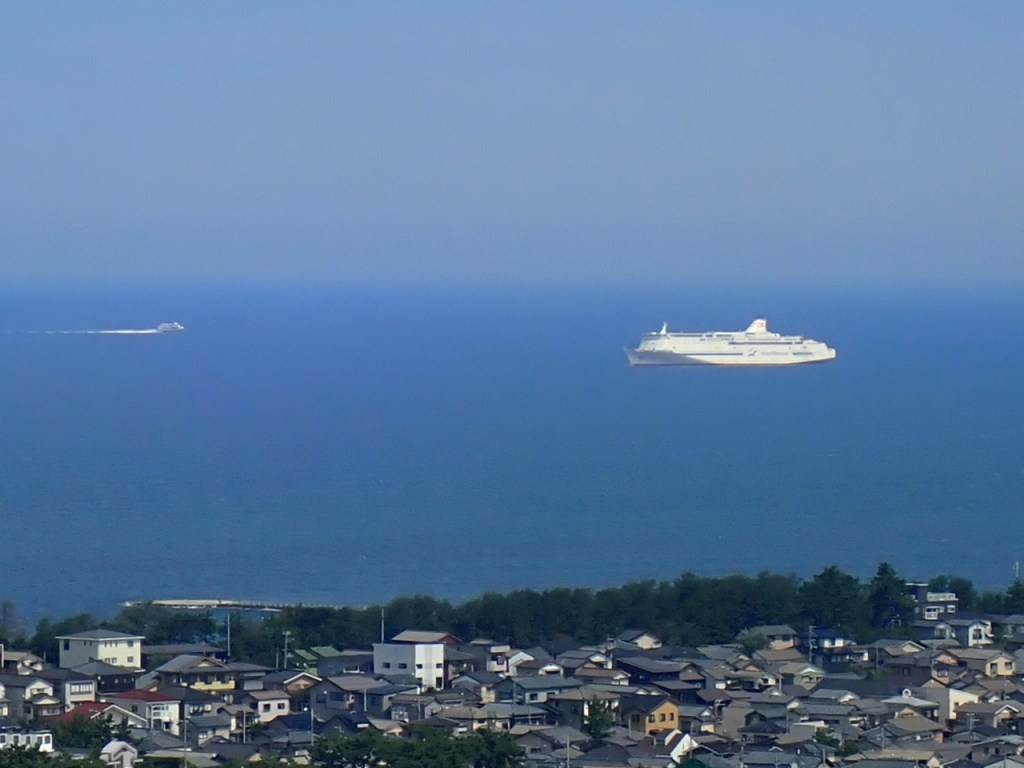
Oh, please don’t hit each other!

Okay, I was relieved.
When making a passive sentence, the verb must be in the passive form. Please refer to yesterday’s post about how to conjugate a verb to its passive form.
Here is an active sentence;
1. Sensei wa Watashi o Home mashita. (The teacher praised me.)
It is the basic of Japanese that the particle “-o” indicates the object of a transitive verb. Actually, some intransitive verbs for movement also use “-o” for the places. But anyway, “Homeru/Homemasu” is a transitive verb. In this particular sentence 1, “Watashi” followed by the particle “-o” is the object of the action of praising. This sentence 1 is grammatically okay. But when a teacher praised you, probably you want to describe the occasion by making “Watashi” the subject of the sentence. This necessitates a passive sentence.
2. Watashi wa Sensei ni Homerare mashita. (I was praised by the teacher.)
The sentence 2 is a passive sentence. Let us examine how words are changed in the conversion from the active sentence 1 to the passive sentence2.
– “Watashi o” in the sentence 1 is the object of the action “praised”.
– “Watashi wa” in the sentence 2 is the subject of the action “was praised”.
– “Sensei wa” in the sentence 1 is the subject of the action “praised”.
– “Sensei ni” in the sentence 2 is the word that the passive action came from. The particle “-ni” has a function to indicate where (who) the action came from in the sentences of giving-receiving, passive and causative.
– “Home mashita” in the sentence 1 is the predicate verb in active voice.
– “Homerare mashita” in the sentence 2 is the predicate verb in passive voice. If you make Nai-form of “Homeru” in order to know which group the Homeru is, you will get “Hom<e>nai”. Then you can tell it is a Group2 verb. The passive form of Group2 verbs can be obtained with [Stem]+rareru/raremasu. Don’t omit “ra”, though youngsters often do.
So far for the sentences 1 and 2, we have been dealing with “Homeru/Homemasu (praise)” which is a transitive verb with the particle “-o”. But what will happen in the conversion from an active to a passive sentence which use a transitive verb with both the particles “-ni” and “-o”?
3. Haha wa Watashi ni Kaimono o Tanomi mashita. (My mother asked me to go shopping.)
This is an active sentence, and a transitive verb predicate sentence using not only “-o” but also “-ni”. In the conversion from the sentence 1 to 2, the object “Watashi o” in the 1 turned to be “Watashi wa” in the 2. But for this sentence3, can you make the word “Kaimono o(shopping)” the subject in a passive sentence? No.
– Kaimono wa Haha ga Watashi ni Tanomi mashita. (When it comes to shopping, my mom aeked me to do it.)
Uh, this is a wa-ga construction which I don’t like. Most importantly. this is not a passive sentence because the predicate verb “Tanomi mashita” is still in active voice. In order to make the sentence 3 a passive sentence, we turn the word with “-ni” to be the subject, that is, “Watashi ni” in the active sentence needs to the subject “Watashi wa” in the passive sentence.
4. Watashi wa Haha ni Kaimono o Tanomare mashita. (I was asked by my mother to go shopping.)
Please compare moves of the words and changes of the particles in the conversion from sentence 3 to 4. It is interesting that the particle “-ni” has different functions in the sentence 3 and 4. In the sentence3, “-ni” of “Watashi ni” is to indicate the destination that the action is heading towards (to whom to ask). On the other, “-ni” of “Haha ni” in the sentence4 is to indicate who (where) the action came from in a passive sentence as well as in the sentence2. The particle “-o” hasn’t changed in the conversion from the sentence 3 to 4. Although “-o” changed in the case of sentence 1 and 2, after all, we need to take note that the object and the particle “-o” is strongly tightened each other in the sentence which uses a transitive verb.
And “Tanomareru/Tanomaremasu” is the passive form of the “Tanomu/Tanomimasu”. Since the Nai-form of Tanomu is “Tanom<a>nai”, it is a Group1(-M) verb. The passive form of Group1 verbs can be obtained with [Stem]+areru/aremasu (Tanom+areru).
The verb used in the sentence 1 and 2 is “Homeru/Homemasu” which is a transitive verb with the particle “-o”. And the verb used in the sentence 3 and 4 is “Tanomu/Tanomimasu” which is a transitive verb with the particle “-ni” and “-o”. Thus, it makes sense to deal with transitive verbs when talking about passive sentence. However, there are some passive sentences using intransitive verbs in Japanese. Typical examples are as follows;
5. Watashi wa Densha no Naka de Kodomo ni Nakare mashita. (I have got a trouble because my kid was crying in a train.)
6. Ie ni Kaeru toki, Watashi wa Ame ni Furare mashita. (On the way home, I got a rainfall.)
“Nakare mashita” in the sentence 5 is the passive voice of the intransitive verb “Naku/Nakimasu”. And “Furare mashita” in the sentence 6 is the passive voice of the intransitive verb “Furu/Furimasu”. Some textbooks may introduce these passive sentences of intransitive verbs. But I think it is better to use transitive verbs only at the first stage of introduction of passive sentences. Teachers know many things. But teaching everything is not always good to help students learn the new items in the second language learning.
————————————–
This post was written with reference to the exercise A2 on Section37 of “Minna no Nihongo (2nd Edition)” published by “3A Corporation”
A new conjugation pattern is introduced in the section 37, which is the Passive form. Example sentences will be shown in A2 through A6. So for today, only patterns of the passive form of verbs are shown in this post. Plus, this post discusses the difference between passive and potential forms of Group1-R verbs.
PASSIVE FORM of VERBS
Dictionary Form / Masu Form — Passive Form with “-u” ending / Passive Form with “masu”
<Group 2 Verbs>
Miru / Mimasu (see, watch, look at) — Mirareru / Miraremasu
Homeru / Homemasu (praise) — Homerareru / Homeraremasu
Kuraberu / Kurabemasu (compare) — Kuraberareru / Kuraberaremasu
<Group 3 Verbs>
Kuru / Kimasu (come) — Korareru / Koraremasu
Suru / Shimasu (do) — Sareru / Saremasu
<Group1 Verbs>
Gr1-W : Tsukau / Tsukaimasu (use) — Tsukawareru / Tsukawaremasu
Gr-K : Kiku / Kikimasu (listen to, hear) — Kikareru / Kikaremasu
Gr1-G : Kagu / Kagimasu (smell(as transitive verb)) — Kagareru / Kagaremasu
Gr1-S : Osu / Oshimasu (push) — Osareru / Osaremasu
Gr1-T : Matsu / Machimasu (wait) — Matareru / Mataremasu
Gr1-B : Yobu / Yobimasu (call) — Yobareru / Yobaremasu
Gr1-M : Fumu / Fumimasu (tread on) — Fumareru / Fumaremasu
Gr1-R : Kiru / Kirimasu (cut) — Kirareru / Kiraremasu
When it comes to verb conjugation, it is always confusing as to difference between Group2 verbs and Group1-R verbs. In the case of passive form, it seems that both are just “stem plus raremasu”. But a difficult thing happens to Group1-R verbs. Take a look at the followings;
1. Mira’a-san wa Sashimi ga Taberaremasu. (Mr.Miller can eat Sashimi.)
“Taberaremasu” is the potential form of “Taberu/Tabemasu”.
2. Mushi wa Tori ni Taberaremasu. (An insect is eaten by a bird.)
“Taberaremasu” is the passive form. Therefore, in the case of “Taberu/Tabemasu” that is a Group2 verb, the potential form and the passive form are the same. Both are “[Stem]+raremasu”.
3. Sato-san nara, Tesuto de Kyuujuu-Go ten Toremasu. (When it comes to Sato-san, she can get 95points in the examination.)
“Toremasu” is the potential form of “Toru/Torimasu”.
4. Son’na Tokoro ni Saifu o Oitara, Toraremasu. (If you leave your wallet on such a place, you will be stolen it.)
“Toraremasu” is the passive form of “Toru/Torimasu”. Then you will find that the potential form and the passive form are not the same. Examining the verb “Toru/Torimasu” by making Nai-form, it is To<ra>nai. It indicates that “Toru/Torimasu” is a Group1-R verb. So, it is important to know that the potential form and the passive form of Group1-R verbs are not the same.
– Potential form of Gr1-R = [Stem]+ reru/remasu.
– Passive form of Gr1-R = [Stem]+ rareru/raremasu.
The following examples show you in the order of Dictionary form/Masu-form — Potential form — Passive form
– Uru/Urimasu (sell) — Ureru/Uremasu — Urareru/Uraremasu
– Okuru/Okurimasu (send) — Okureru/Okuremasu — Okurareru/Okuraremasu
– Kiru/Kirimasu (cut) — Kireru/Kiremasu — Kirareru/Kiraremasu
– Sawaru/Sawarimasu (touch) — Sawareru/Sawaremasu — Sawarareru/Sawararemasu
– Suwaru/Suwarimasu (sit) — Suwareru/Suwaremasu — Suwarareru/Suwararemasu
– Tsukuru/Tsukurimasu (make) — Tsukureru/Tsukuremasu — Tsukurareru/Tsukuraremasu
– Tomaru/Tomarimasu (stay at night) — Tomareru/Tomaremasu — Tomarareru/Tomararemasu
– Toru/Torimasu (take) — Toreru/Toremasu — Torareru/Toraremasu
– Noru/Norimasu (ride) — Noreru/Noremasu — Norareru/Noraremasu
– Hairu/Hairimasu (enter) — Haireru/Hairemasu — Hairareru/Hairaremasu
The above examples are all Group1-R verbs. I don’t want to confuse you, but the potential form and the passive form are the same for Group2 verbs, for example;
Karitu/Karimasu (borrow) — Karirareru/Kariraremasu — Karirareru/Kariraremasu
Wasureru/Wasuremasu (forget) — Wasurerareru/Wasureraremasu — Wasurerareru/Wasureraremasu
How to distinguish whether a verb is Group1-R or Group2 is as follows;
<1> Make Nai-form
<2> What is the letter(s) in front of “nai”?
<3> If it’s [ra]nai, the verb is Group1-R
If it’s [i]nai or [e]nai, the verb is Group2
Example;
Kiru/Kimasu (wear) => Nai-form is Kinai => Group2
Kiru/Kirimasu (cut) => Nai-form is Kiranai => Group1-R
————————————–
This post was written with reference to the exercise A1 on Section37 of “Minna no Nihongo (2nd Edition)” published by “3A Corporation”
 Agony or Fun?! Second Language Learning