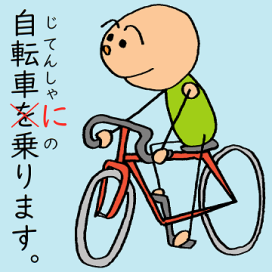
We learned the following sentence constructions in the exercise A3;
(1) [V] + youni Shite imasu.
(2) [V-nai] + youni Shite imasu.
The example sentences of (1) and (2) are as below;
1. Dekirudake O’okuno Tango o Oboeru youni Shite imasu. (I try to memorize as many words as I can.)
2. Dekirudake Amai mono o Tabenai youni Shite imasu. (I try not to eat sweets as much as possible.)
These are just declarative sentences. On the other, today’s sentences have the functions to ask a listener to do something in conversation.
(3) [V] + youni Shite kudasai.
(4) [V-nai] + youni Shite kudasai.
Let’s look at one of example sentences of (3);
3. Natsu wa Mizu o Takusan Nomu youni Shite kudasai. (Please make sure to drink a lot of water in the summer.)
“Shite kudasai” is an expression to ask a listener to do something with the construction of “[V-te]+kudasai”. Then the sentence 3 can be shortened using another “[V-te]+kudasai” as shown below.
4. Natsu wa Mizu o Takusan Nonde kudasai. (Please a lot of water in the summer.)
What is the difference between the sentences 3 and 4? The sentence 4 is a direct command or request, which probably sounds forcefully. On the other, the sentence 3 is somewhat in direct, and sounds like prompting the listener’s effort. When asking someone to do something, “[V] + youni Shite kudasai.” is better than “[V-te]+kudasai” because it sounds moderately. The same kind of things could be said about “[V-nai] + youni Shite kudasai.” and “[V-nai]de kudasai”. The followings are more examples of the sentence (3) and (4).
(3) [V] + youni Shite kudasai.
5. Motto Undou-suru youni Shite kudasai. (Please make sure you exercise more.)
6. Kaisha ni Okureru toki wa Kanarazu Renraku-suru youni Shite kudasai.
(When you get late to come to the office, please make sure you tell us it.)
(4) [V-nai] + youni Shite kudasai.
7. Zettaini Pasupo’oto o Wasurenai youni Shite kudasai.
(Please make sure you absolutely do not forget your passport.)
8. Shuugou Basho o Machigaenai youni Shite kudasai.
(Please make sure you do not go to a wrong meeting point.)
Several adverbs appear in this post; Dekirudake, Takusan, Motto, Kanarazu, and Zettaini. Actually, there is less chance to learn adverbs because learning them is usually not planned in the curriculum of Japanese learning. When you find an adverb, it is the chance for you to learn it. (Fukushi o Mitsuketara, Sono Fukushi o Manabu youni Shite kudasai.)
————————————–
This post was written with reference to the exercise A4 on Section36 of “Minna no Nihongo (2nd Edition)” published by “3A Corporation”
 Agony or Fun?! Second Language Learning