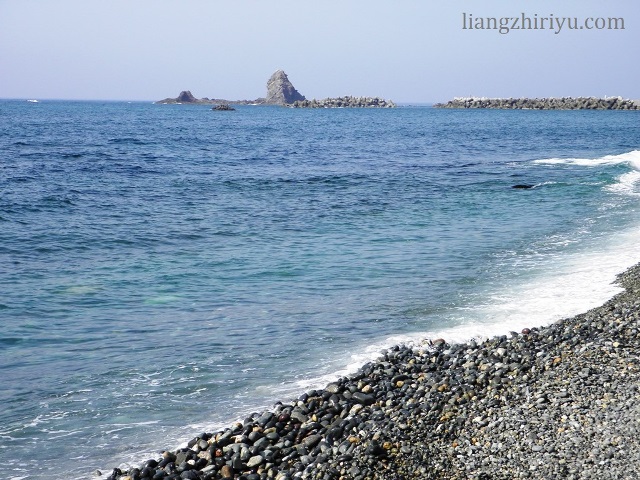
Seaside view in spring, 2018.

Ume flower and a temple in Spring 2018
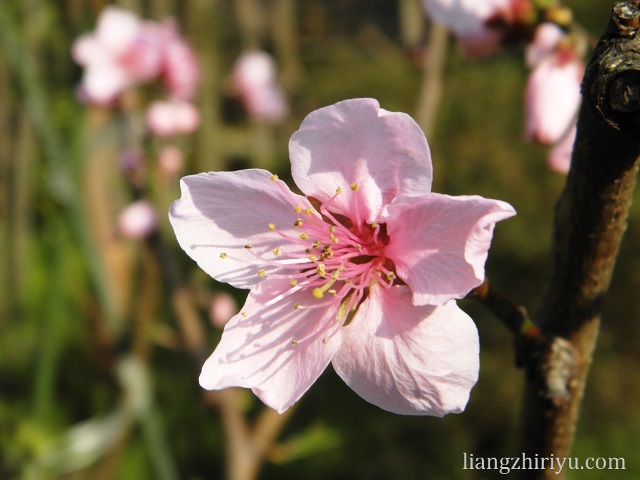
Peach flower in my Garden

Sakura in Akashi Park, Hyogo Prefecture: Spring in 2015
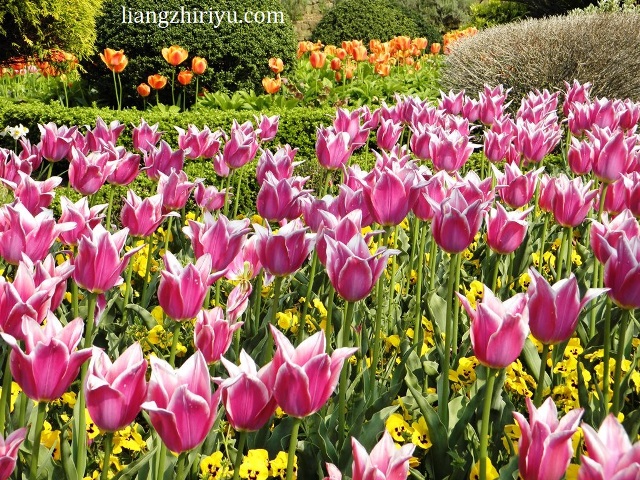
In 2015
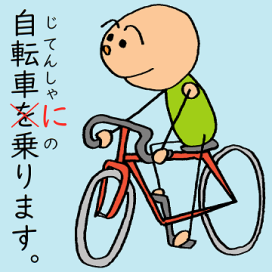
I am a native Japanese speaker who used to teach Japanese in a university somewhere on this planet. Currently I don't work but stayed in my house in Northern part of JAPAN. I hope that you could enjoy reading my posts and know what life in Japan is like.
Seaside view in spring, 2018.
Ume flower and a temple in Spring 2018
Peach flower in my Garden
Sakura in Akashi Park, Hyogo Prefecture: Spring in 2015
In 2015
Date: April 3rd on Friday, 2020 from 13:40 to 15:10 (14:40 – 16:10 in JST)
Course: Japanese Conversation 4
Used app: Streaming on DingTalk, Presentation by Powerpoint with 73 slides
Numbers of Students: 28
Fully attendant for 90min : 16, Completely Absent : 3,
Shorter signing-in: 78, 68, 65, 37, 32, 31, 12 minutes, and 1 minute. The shortest was 18 seconds.
Responses onto the BBS:
– Attendance check by a student his/herself: 25, but one student was recorded as completely absent
– 1st Quiz: Only 12 students responded. The quiz was to make a short sentences using guessing “-souda”. I wanted students to use adjectives for emotion, but some used verbs.
– 2nd Quiz: 17 students responded. The quiz was to ask how to pronounce body temperature. The unit for first decimal uses “bu” which is usually pronounced “fun”.
– Attendance check at the end: 18
Teaching:
– Review of quiz in last class putting emphasis on similarity of the changes of auxiliary verb “-youda” and Na-adjectives. Limitation of guessing “-souda” in time sequence was also explained.
– Feedback for the Homework : The students sent me drafts of conversation between a doctor and a patients. I made comments about speech style between doctor and patients. Additional comments on mother tongue interference through Kanji.
– The main teaching was about guessing “Youda”
– Listening to conversation that contains guessing “-youda” and hearsay “souda”.
Homework Assignment: Completing five sentences conversation using guessing “youda”
Issues and Problems:
This is a conversation class. So my concern is how far I should or may dive into grammatical things about auxiliary verbs “youda”,”souda”, ‘rashii’, and so on..
Date: April 3rd on Friday, 2020 from 8:00 to 9:30 (9:00 – 10:30 in JST)
Course: Japanese Basic Composition 2
Used app: Streaming on DingTalk, Presentation by Powerpoint with 57 slides
Numbers of Students: 24 out of 28
90 minutes attendance: 17 students
Shorter participation: 85, 80, 72, 72, 70, 58, 10 minutes
completely absence: 4 students
Responses to my requests like Quiz answers onto BBS:
Attendance check: 26. But of the 26, two students were recorded as “Completely Absent” on the system.
Quiz 1 through 5: Students were asked to submit 5 answers in the form of text right after the class. Only 18 students sent me the answers.
5 point ; 2 students, 4 point; 15 students, and 3 points by one student. Many students made an error by over-generalizing of “Wa-ga construction”. That’s why I wrote the issue of “Wa-ga construction” on post on Tuesday for class 1836.
Teaching:
The same as composition class for 1836 on Tuesday. However, I changed some slides. I replaced 1836 students composition to 1837’s in the feedback session.
Homework:
The same as composition class for 1836 on Tuesday.
Issues and Problems:
The same problem of over generalizing of “Wa-ga construction” was even worse in this class 1837.
When I prepared for a question for this composition class, I found that auxiliary verb “-souda” could be used in the past tense sentence. Last week I told 1837 students in conversation class, that guessing “-souda” was used for present and future. To be exact, I should have told that guessing “-souda” was for future side from talking point on the time sequence. And talking point could be in past. This matter necessitated some additional slides for conversation class in the afternoon.
Date: April 1st on Wednesday, 2020 from 8:00 to 9:30 (9:00 – 10:30 in JST)
Course: Japanese Listening 2
Used app: Streaming on DingTalk, Presentation by Powerpoint (86 slides)
Numbers of Students: 27
All 27 students stayed with me from start to the end.
Students’ Responses:
– Attendance Check : All the 27 students typed “Shusskei” on BBS
– Quiz 1 : 25 students typed their answers. Actually 21 answers were incorrect. 4 students revised their answers to correct.
– Quiz 2 at the End: 26 students typed the correct answer “-ni”. This was to ask a particle that fill blanks of three sentences. “-Ni’ is the answer for those three for functions of;
1: Time of action, 2: Destination that the movement is heading toward, and 3: Place of existence.
Teaching:
1: Review of the last class;
– How to use two adjectives
– Types of verbs: Transitive v.s Intransitive verbs, Combination of a verb and particles, and especially putting emphasis on combination between transitive verbs and particle”-o”.
2: Listening Mondai3
I introduced a double meanings of “Iidesu”
3: Listening of conversation
Students memorization was promoted by increasing blanks on the script. Additional rote training of particles that fit into between objects and verb.
Homework Assignment:
Reading aloud conversation script twenty times, although there would be no evidence whether a student did or did not do this homework.
Issues and Problems:
It may be too early to teach the first grade students at this moment about how to connect two adjectives.
Date: March 31th on Tuesday, 2020 from 15:30 to 17:00 (16:30 – 18:00 in JST)
Course: Japanese Basic Composition 2
Used app: Streaming on DingTalk, Presentation by Powerpoint with 55 slides
Numbers of Students: 28
24 students participated for whole 90 minutes.
3 students exhibited short attendances: 81, 52, 25 minutes
1 students was totally absent.
Responses to my requests like Quiz answers onto BBS:
Attendance check by reporting his/her-selves: 27.
Five quiz were assigned during class. Students sent the answers to me right after the class. Only 18 of 27 students did so.
Teaching:
1st half: Feedback of proofreading and corrections of the second draft of “My Winter Break”
2nd half: Feedback of quiz that was done in the last class. The quiz was mainly focused on Tense/Aspect issue of Japanese sentences. One of ways for draft correction was also taught in the class. That focused on inconsistency between start and ending of a sentence.
Homework:
300 letters advertisement for a new product of electric appliance for family use. A sample as below was shown to the students.
Issues and Problems:
I found a huge issue about “Wa-ga construction”. Students always over-generalize “Wa-ga construction” for the sentences which are actually not suitable for using this particular construction. This is because Japanese textbooks in this country always impress learners as if “Wa-ga construction” were an important basic of Japanese.
There is a simple reason why “Wa-ga construction” is thought to be important. “Wa-ga construction” is, as indicated by the name, structural. It has the structure of word order with the theme, a subject, and predicate. It is simple and easy to understand because there is no need to analyze words functions that are specified by several kinds of particles. There are only two particles in “Wa-ga construction”; “-wa” and “-ga”. Since these two are used for theme and subject, it is not necessary for a learner to think about what function each word has in a sentence. For other sentences that are not “Wa-ga construction”, students need to analyze words’ functions through several particles in conjunction with verb.
It is easy to understand, so students stick to “Wa-ga construction” and then come to think it is important. But I think it is more important for Japanese learner to learn particles and their functions. I think I need to stop students’ over-generalization of “Wa-ga construction” and to teach use of other particles and their functions.

Date: March 30th on Monday, 2020 from 9:50 to 11:20 (10:50 – 12:20 in JST)
Course: Japanese Listening 2
Used app: Streaming on DingTalk, Presentation by Powerpoint (86 slides)
Numbers of Students: 27
All 27 students stayed with me from start to the end.
Students’ Responses:
– Attendance Check : 26 of 27 typed “Shusskei” on BBS
– Quiz 1 : 23 students typed the correct answer “B”. This quiz was to confirm if a student got a context right from listening.
– Quiz 2: 26 students typed the correct answer “A”. This quiz was to tell the difference a Japanese verb “Aimashu” and English verb “See”.
– Ending Quiz: 25 students typed transitive verbs of their own choice.
Teaching:
1: Listening comprehension using a script with many adjectives
2: Review of Homework. The HW was dictation from my voice recording.
3: Verb Predicate Sentences.
– Proper use of particles,
– To tell the differences between transitive verbs and intransitive verbs
– Patterns of sentence ending with positive/negative and present/past tenses
Homework Assignment:
None
Issues and Problems:
It seems that most of Japanese textbooks in this country doesn’t pay attentions to learning particles. It is very important in Japanese to choose proper particles for a particular verb.
Date: March 30th on Monday, 2020 from 8:00 to 9:30 (9:00 – 10:30 in JST). This is the first class on 5th week in second semester
Course: Japanese Conversation 4
Used app: Streaming on DingTalk, Presentation by Powerpoint with 64 slides
Numbers of Students: 28
Fully attendant for 90min : 20, Completely Absent : 2,
Late sign-in and/or early sign-out: 74, 71, 42, 32minutes, 35seconds, and the shortest 3 seconds.
Responses onto the BBS:
– Attendance check: 28, all the students wrote “Shusseki” on BBS, however, it is obvious that some students left the class immediately.
– 1st Quiz: 17 responses. Quiz is to tell the difference of speech levels between auxiliary verbs “youda”and “mitaida”.
– Attendance check at the end: 18 responses. This is to ask the meaning of “Kambyou-suru” whose Kanji(s) have different meaning in Chinese.
Teaching:
– Auxiliary verb “Mitaida”
– “Noun + rashii” for expressing a typical trait
Homework Assignment: Making a Japanese conversation script by listening to Chinese conversation to see a doctor in a hospital.
Issues and Problems: A lot, but I don’t have time to write them down now.

Seaside view in spring, 2018.
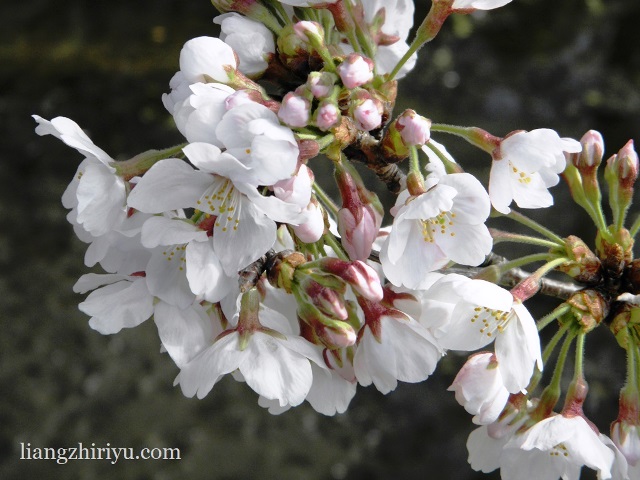
Sakura in Akashi Park, Hyogo Prefecture: Spring in 2015
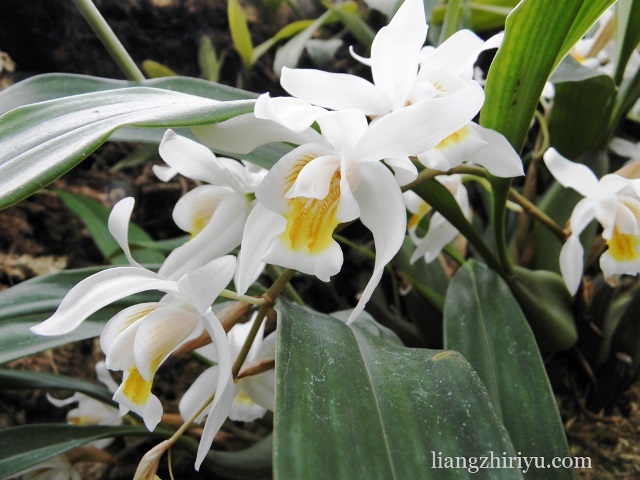
I forgot when and where I took this photo

Somewhere in Kanto Region in spring, 2008

Sakura in Akashi Park, Hyogo Prefecture: Spring in 2015
Date: March 27th on Friday, 2020 from 13:40 to 15:10 (14:40 – 16:10 in JST)
Course: Japanese Conversation 4
Used app: Streaming on DingTalk, Presentation by Powerpoint with 76 slides
Numbers of Students: 28
Fully attendant for 90min : 19, Completely Absent : 4,
Shorter signing-in: 59, 37, 36, 22minutes, and the shortest was 18seconds.
Responses onto the BBS:
– Attendance check: 25
– 1st Quiz: 18 Quiz is to find the sentence that uses auxiliary verb “Souda” for hearsay among other sentences that use “Souda” for guess.
– 2nd Quiz: 19 Quiz is to tell the similarity of conjugation between “Youda” and “Na-adjectives”
– Attendance check at the end: 18 This was also done in the form of quiz that requires to select the right combination for connections between (1) Adjective”Ii” and “Souda” for guess, and (2) Adjective “Ii” and “Youda”.
Teaching:
– Auxiliary verb “Youda”
Homework Assignment: No homework at this time
Issues and Problems:
The number of PPT slides were more than what I could use in a class of 90 minutes. That meant I wasted hours for preparation for those slides. I should have predict how many slides could be used in 90 minutes class. In order to make prediction accurate, I should have measured how many minutes and seconds each slide would take and calculated total number of slides.
Date: March 27th on Friday, 2020 from 8:00 to 9:30 (9:00 – 10:30 in JST)
Course: Japanese Basic Composition 2
Used app: Streaming on DingTalk, Presentation by Powerpoint with 73 slides
Numbers of Students: 28
19 students signed in whole of the 90 minutes class. 9 students had been signed in shorter than 90 minutes: 75, 74, 66, 50, 32, 7, 3minutes, 37seconds, and amazingly the shortest was 5seconds.
Responses to my requests like Quiz answers onto BBS:
Attendance check: 27. But of the 27, one student signed in late.
Q1: Definitions of the word categories “Nouns”, “Verbs”, and “Adjectives” : 18
Q2: Questions about Tense consistency in Japanese : 18 (they are all wrong answers)
Attendance Check at the End: 19
Teaching:
Feedback of proofreading and corrections
Tense-Aspect of verb predicate sentences of Japanese
Homework:
Rewriting a Composition about how the student was spending this winter break within 300 characters.
Issues and Problems:
Students are just inputting the same answer that the top student has input. If the top student input a wrong answer, all the students will make the same mistake. This was the case for the second quiz. The right answer was 2 out of 1, 2, and 3. In the class 1836, the first student input “1”, then all the following students input the wrong answer 1″. In this class 1837, the first student input “3”, then all the following students input the wrong answer “3”. I want each student to think about the answer by his/herself.
 Agony or Fun?! Second Language Learning