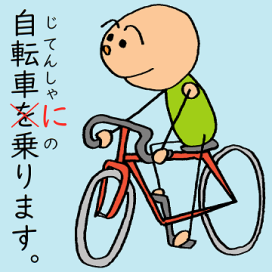
The main item to learn in the Section 28 is the conjunctive particle “-shi,” that is for mentioning two things parallelly. In addition, another conjunctive particle “-nagara,” is introduced in A1 yesterday. “-nagara,” is to express that two actions are ongoing simultaneously. Today’s A2 is also about conjunctive particle, which is “-te(de),”, but it would be better to think A2 is introducing one of usages of “[V-te] imasu.” For Japanese learners at beginner’s level, “[V-te] imasu.” is explained to have three or four usages.
<Functions of “[V-te] imasu.”>
<1> Ongoing Action
– Satou-san wa Ima Denwa de Hanashite imasu. (Sato-san is now talking on a phone.)
This is introduced in the section 14 of Minna no Nihongo. In a sentence of present tense, the adverb “Ima” is usually used in order to say the action is ongoing “Now”. In a sentence of past tense, usually it is specified when the action was ongoing like below;
– Kinou Ie ni Kaetta toki, Chichi wa Nete imashita. (When I came back home yesterday, my dad was sleeping.)
<2-1> Continuous Action
– Satou-san wa Suzuki-san o Shitte imasu. (Sato-san knows Suzuki-san.)
Probably English translation would be better if it’s “Sato-san has known Suzuki-san for long.”. This usage of “[V-te] imasu.”, being introduced in the section 15, expresses that a subject keeps on doing action for a while. Some textbooks introduce another (forth) usage that is part of “Continuous action”.
<2-2> Persistence of Result
– Doa ga Aite imasu. (The door is left open.)
This usage of “[V-te] imasu.”, introduced in the section 29. When the verb in Te-form is an intransitive verb describing instantaneous action, “[V-te] imasu.” means the result of action remains until the time of talking.
<3> Repetitive Action
– Maiban Ku-ji no Nyu’usu o Mite imasu. (I watch the news program at 9 p.m. every night.)
This is what we learn today. This is at A2 in the Section 28. A sentence means that a subject repeats action by this usage of “[V-te] imasu.” It is usually with an adverb having meaning of always and/or every, like; Itsumo (always), Taitei (usually), Mainichi (every day), Doyoubi wa Itsumo (every Saturday) and so on.
Here are some example sentences for this usage “Repetitive Action” of “[V-te] imasu.”
1. Yasumi no Hi wa Taitei Ie de Piano o Hite imasu. (I usually play piano on holiday.)
Note that “wa” is not a subject marker but a topic marker. The subject in this sentence is “Watashi”.
2. San-nen mae Kyouto ni Sunde itatoki, Maishuu Otera o Mini Itte imashita. (When I lived in Kyoto three years ago, I visited temples every week.)
The sentence 2 is of past tense. “Sunde ita” is “V-te iru” of <2-1> Continuous Action, and “Mini Itte imashita” is “V-te iru” of <3> Repetitive Action
3. Maishuu Nichiyoubi, Sentaku o Shitari, Souji o Shitari Shite imasu. (Every Sunday, I wash clothes and clean the room.)
There is a complicated sentence in A2 S28 of Minna no Nihongo. That is the third sentence which uses “Tari-tari construction”. My example sentence uses different words, but the construction is basically the same. “Shitati Shite” seems a double use of the same verb, but this is quite often used. The English translation in the parentheses may not convey the nuance of “Tari-tari construction”. Though “I” wash clothes and clean the room, there is no order about which to be done first. Also, these two are not done simultaneously because if washing and cleaning are simultaneous, “-nagara, ” would be used.
————————————–
This post was written with reference to the exercise A2 on Section28 of “Minna no Nihongo (2nd Edition)” published by “3A Corporation”
 Agony or Fun?! Second Language Learning