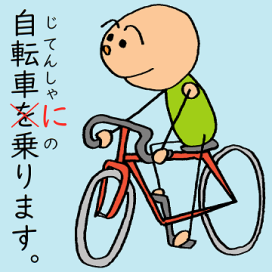
Japanese learning (A2 S27): Short Potential Expressions using Potential Form, and Changes of Particle from “-o” to “-ga” in cases of Transitive Verbs; [ ___ ] wa [ ___ ] ga [V-pt].

Yesterday, we learned how to conjugate a verb from Dictionary and Masu forms to Potential Form. For example, “Shiraberu” of Gr2 becomes “Shiraberareru” with “ra” in the middle, while “Hashiru” of Gr1-R becomes “Hashireru” without “ra”. And it is interesting that “Suru” of Gr3 becomes “Dekiru”. Using those potential forms of a verb, we are learning a sentence construction that uses Potential Form today.

If the verb is an intransitive verb, it doesn’t have much difficulty. The following examples use “Oyogu” which is an intransitive verb.

– Watashi wa Sen Me’etoru Oyogimasu. (I swim 1000 meters.) — Original verb sentence

– Watashi wa Sen Me’etoru Oyogemasu. (I can swim 1000 meters) — verb in Potential Form

But what will happen when a transitive verb sentence turns to be a potential expression with conjugation of the verb into potential form?

1a. Watashi wa Nihongo o Hanashimasu. (I speak Japanese.)

=>1b. Watashi wa Nihongo ga Hanasemasu. (I can speak Japanese.)

2a. Watashi wa Ichinichi Sanjukko Tango o Oboemasu. (I memorize 30 words a day.)

=> 2b. Watashi wa Ichinichi Sanjukko Tango ga Oboeraremasu. (I can memorize 30 words a day.)

Do you see any change other than the change of the verbs? Let’s review the construction of a transitive verb predicate sentence. It is;

3. [Subject] wa(/ga) [Object] o [Transitive verb] masu/masen/mashita/masendeshita.

In this construction, the particle “-o” is the object marker. The object is what the action of transitive verb exerts on. But when this sentence has changed to be a potential expression; the construction of 3 becomes as follows.

4. [ ___ ] wa [ ___ ] ga [Potential Form] masu/masen/mashita/masendeshita.

You will notice this 4 is a Wa-ga construction. In general sense, a Wa-ga construction can be regard as;

4’. [Topic] wa [Subject] ga [Predicate].

But in the case of Potential Expressions, it seems like to be;

4’’. [Subject] wa [Object] ga [V-pt] masu/— .

Actually, describing a potential expression as 4’’ has a huge concern. Because some Japanese learners don’t like the particle “-o”. Those learners try not to use and even eliminate the particle “-o” from their Japanese. This could result in wrong understanding of transitive verb sentence as below:

[WRONG] 3’. [Subject] wa [Object] ga [Transitive verb] masu/—.

3’ is wrong, but you can often hear that Japanese learners speak like 3’. This is a result of avoidance of particle “-o” and overgeneralization of Wa-ga construction.

So, it is important to know that the two sentences below are much different kind, even though they come from the same transitive verb.

3. [Subject] wa [Object] o [Transitive verb] masu/—.

4’’. [Subject] wa [Object] ga [V-pt] masu/— .

The sentence 3 is to express that an action taker exerts action onto an object.

The sentence 4’’ is to express it is possible to make action onto something. Therefore, what is described as [Object] in the sentence 4’’ is a thing that action can be done. And this [Object] is, to say, the center of consciousness to be specified.

Do you remember how to choose “wa” or “ga” for a subject marker?

[Known Subject] wa [Nature/Condition to be explained].

[Subject to be Specified] ga [Known Nature/Condition].

When the purpose of the sentence is to specify what the subject is, “ga” is used for the subject marker. This time, an object is to be specified when expressing an action is capable of doing.

Using “ga” is what to learn in A2 S27, however, the following sentence doesn’t sound completely wrong.

4’’’. [Subject] wa [Object] o [V-pt] masu/— .

For example; Watashi wa Nihongo o Hanasemasu. (I can speak Japanese.)

Not sounding completely wrong, or this being okay means that how the particle “-o” is essential for a transitive verb. Therefore, It is absolutely important to learn a transitive verb sentence (3.) first, and then only those who have mastered it should learn sentence like 4’’. The worst thing is overgeneralization of Wa-ga construction.

Let’s learn today’s sentence structure while also reviewing potential form of verbs.

<Group 2 Verbs>

Kiru / Kimasu (wear clothes)

– Hitori de Kimono o Kimasu. (I wear traditional Japanese clothes by myself.)

=> Hitori de Kimono ga Kiraremasu. (I can wear a Kimono by myself.)

Taberu / Tabemasu (eat)

– Nama no Kaki o Tabemasu. (I eat raw oysters.)

=> Nama no Kaki ga Taberaremasu. (I can eat raw oysters.)

<Group 3 Verbs>

Kuru / Kimasu (come)

– Ashita Hachi-ji ni Koko ni Kimasu. (I am coming here at eight tomorrow.)

=> Ashita Hachi-ji ni Koko ni Koraremasu. (I will be able to come here at eight tomorrow.)

Suru / Shimasu (do)

– Ato Ni-jikan Renshu Shimasu. (I am going to practice two hours more.)

=> Ato Ni-jikan Renshu Dekimasu. (I can practice two hours more.)

<Group1 Verbs>

Gr1-W : Utau / Utaimasu (sing)

– Watashi wa Nihongo no Uta o Utaimasu. (I sing Japanese songs.)

=> Watashi wa Nihongo no Uta ga Utaemasu. (I can sing Japanese songs.)

Gr-K : Hiku / Hikemasu (Play a music instrument)

– Watashi wa Gita’a o Hikimasu. (I play a guitar.)

=> Watashi wa Gita’a ga Hikemasu. (I can play a guitar.)

Gr1-G : Togu / Togimasu (sharpen)

– Naifu o Togimasu. (I sharpen a knife.)

=> Naifu ga Togemasu. (I can sharpen a knife.)

Gr1-S : Naosu / Naoshimasu (repair, correct)

– Jitensha no Panku o Naoshimasu. (I repair the flat tire of the bicycle.)

=> Jitensha no Panku ga Naosemasu. (I can repair the flat tire of the bicycle.)

Gr1-T : Motsu / Mochimasu (hold)

– Mou Hitosu Kaban o Mochimasu. (I hold one more bag.)

=> Mou Hitotsu Kaban ga Motemasuasu. (I can hold one more bag.)

Gr1-B : Asobu / Asobimasu (play for fun) — Intransitive verb

– Kono Kouen de Asobimasu. (I play in this park.)

=> Kono Kouen de Asobemasu. (We can play in this park.)

Gr1-M : Yomu / Yomimasu (read) — Yomeru / Yomemasu

– Eigo no Hon o Yomimasu. (I read an English book.)

=> Eigo no Hon ga Yomemasu. (I can read an English book.)

Gr1-R : Tsukuru / Tsukurimasu (make, cook)

– Nihon Ryouri o Tsukurimasu. (I cook Japanese food.)

=> Nihon Ryouri ga Tsukuremasu. (I can cook Japanese food.)


This post was written with reference to the exercise A2 on Section27 of “Minna no Nihongo (2nd Edition)” published by “3A Corporation”
Japanese Learning: Difference between Wa-Ga Construction sentence and Transitive Verb predicate sentence

This series have explained “Wa-ga construction” for several days, because the Japanese textbook “Minna no Nihongo” is dealing with “Wa-ga construction” in Chapter 9. And it is not only an introduction of “Wa-ga construction”, also an introduction of particle “ga”. If you were introduced particle “ga” through “Wa-ga construction”, you might think that the particles “wa” and “ga” could coexist in a sentence. Yes, they can be in a sentence together if the sentence is Wa-ga construction, but most of the time you have to choose one of the two (wa or ga) for subject in a sentence.

1. Watashi wa Nihonjin desu. (I am Japanese.)

2. Watashi ga Nihonjin desu. (I am the person who is Japanese.)

In the both sentence 1 and 2, the subject is “Watashi”. But the subject marker in 1 is “wa”, while the subject marker in 2 is “ga”. How do you properly choose “wa” or “ga” for a subject? The exact explanation would be lengthy. For the simplicity, let me say as below.

– When the predicate is the important information, use “wa” for subject marker.

– When the subject itself is the important information, use “ga” for subject marker.

Anyway, sticking to “Wa-ga construction” would cause a huge damage on your sense about Japanese. The followings are quiz about Wa-ga construction sentences that use verbs for predicate and Verb predicate sentences. Choose “ga” or “o”. And answer the type of verb.

1. Watashi wa Okane { ga or o } arimasu. (I have money.)

   Type of verb? — { Intransitive or Mobile intransitive or Transitive }

2. Watashi wa Okane { ga or o } moraimasu. (I get money.)

   Type of verb? — { Intransitive or Mobile intransitive or Transitive }

3. Watashi wa Ie { ga or o } demasu. (I get out of my house.)

   Type of verb? — { Intransitive or Mobile intransitive or Transitive }

4. Watashi wa Imouto { ga or o } imasu. (I have a younger sister.)

   Type of verb? — { Intransitive or Mobile intransitive or Transitive }

5. Watashi wa Imouto ni Purezento { ga or o } agemasu. (I give a present to my younger sister.)

   Type of verb? — { Intransitive or Mobile intransitive or Transitive }

6. Watashi wa Yuugohan { ga or o } tabemasu. (I eat supper.)

   Type of verb? — { Intransitive or Mobile intransitive or Transitive }

Answers will be shown tomorrow.

Japanese Learning: How to make a transitive verb sentence interrogative; Asking what the object is or asking what the action is.

Yesterday, we learned verb predicate sentences that use transitive verbs and the particle “o”. A transitive verb expresses an action that exerts its effect onto an object directly. And the particle “o”, as the object marker, is attached to just behind the object. So, the sentence construction is as below;

1. [Subject] wa [Object] o [Transitive verb] masu.

example; Watashi wa Ocha o Nomi masu.

Where;

– Ocha: noun; tea

– Nomimasu: transitive verb; drink

Note that the order of words is different from transitive verb sentence of English.

English: [Subject] [Transitive Verb] [Object] — SVO

Japanese: [Subject wa] [Object o] [Transitive Verb] — SOV

How can we make a transitive verb sentence an interrogative sentence?

(1) Yes-No question

Put “ka” at the end of the sentence;

A : Satou-san wa Ocha o Nomi masuka. (Ms. Sato, do you drink tea?)

B : Hai, watashi wa Ocha o Nomi masu. (Yes, I drink tea.)

(2) Asking what the object is;

A : Satou-san wa Nani o Nomi masuka. (Ms. Sato, what do you drink?)

B : Watashi wa Mizu o Nomi masu. (I drink water.)

(3) Asking what the action is;

A : Satou-san wa Nani o Shimasuka. (Ms. Sato, what are you going to do?)

B : Watashi wa Koh’hii o Nomi masu. (I am going to drink a cup of coffee.)

In (3), the question uses verb “Shimasu”. Shimasu is a verb similar to the verb “do” in English. And most of the time “Shimasu” functions as a transitive verb, although occasionally it can be an intransitive verb (such a case will be explained later). It is interesting that even if the answer could use an intransitive verb, the question is “Nani o Shimasuka” which is obviously phrase of object and transitive verb. An example is as below

A : Satou-san wa Nani o Shimasuka. (Ms. Sato, what are you going to do?)

B : Watashi wa Gakko e Ikimasu. (I am going to the school.)

The verb “Ikimasu” is an intransitive verb.

<この投稿は“スリーエーネットワーク、みんなの日本語 初級I 第2版, 第6課A1とA2”の内容を参照しています。>

Japanese Learning: Introduction of transitive verbs that use the particle “o” for an object; [Object] o [Transitive verb] masu.

First of all, quiz answers come first.

Q1: “Ni” should not be used for “senshuu”;

Senshuu, Hataraki mashita. (Last week, I worked.)

Q2: “Ni” should be used for “hachi-ji Juugo-fun”;

Hachi-ji Juu go-fun ni, Gakkou e Ikimasu. (I go to the school at eight fifteen.)

These days, we are studying “verb predicate sentences”. When you use a verb for the predicate, you need to choose the ending correctly. The ending is not “desu-type” but “masu-type”. The masu-type sentence ending has four variations;

– Present-positive => [verb] masu.

– Present-negative => [verb] masen.

– Past-positive => [verb] mashita.

– Past-negative => [verb] masen deshita.

The above four patterns are for predicate with politeness. Actually, verbs have more patterns not only for predicate but also for other usages for passive, hypothetical, modifying phrases, and so on. In other words, a verb conjugates. We won’t learn conjugations of verbs today, but I want you to know that verb conjugations are big issues in Japanese language.

Today’s main theme is introductions of transitive verbs and particle “o”. When an action works directly onto something (an object), the action is described by a transitive verb. And the object of the transitive verb needs to be marked with particle “o”.

The construction of a transitive verb sentence is as follows;

[Subject] wa [Object] o [Transitive verb] masu.

example: Watashi wa Yuugohan o Tabemasu. (I eat supper.)

Where;

– Yuugohan: noun; supper

– Tabemasu: transitive verb; eat

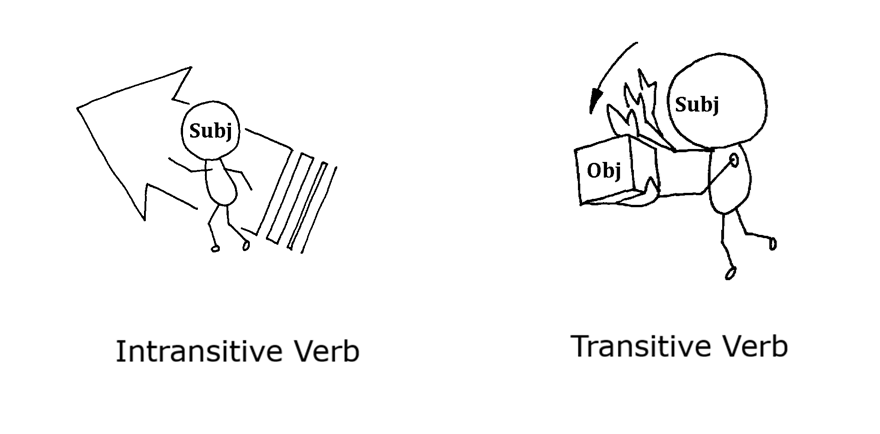
When you learn Japanese, you need to have a clear image of intransitive verb or transitive verb. Refer to the illustration below about the difference between intransitive verbs and transitive verbs.

Example:

Intransitive verb sentence; Watashi wa Gakkou e Ikimasu. (I go to the school.)

Transitive verb sentence; Watashi wa Yuugohan o Tabemasu. (I eat supper.)