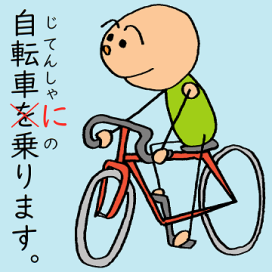
A Japanese sentence consists of several phrases (“Bunsetsu”), or let me use, “Chunk”.
– [Chunk]+[Chunk]+ – – – + [Chunk].
Each chunk has the following structure.
– [Chunk] = [ {Word for Meaning} + {Word for Function} ]
Words for meaning can be long, while words for functions are usually short with one-letter or two-letters. For the sake of simplicity, let us think about two word-groups; they are nouns and verbs. Let us forget about adjectives and adverbs. Nouns and Verbs are, of course, words for meaning. The difference we need to care is words for functions to be connected to Nouns or Verbs. Note that I am talking in very simplified way but Chunks for Nouns and Verbs are;
– [Chunk] = [ {Noun} + {Particle} ]
– [Chunk] = [ {Verb} + {Auxiliary Verb} ]
What we can see in these two are;
– Being a noun or a verb brings is strictly distinguished in Japanese.
– A particle cannot be connected to a verb directly.
Let’s review the above argument with samples. There is a sentence below with five chunks.
1. Watashi wa Tomodachi to Resutoran de Hiru-Gohan o Tabe masu.
(I eat a lunch in a restaurant with my friends.)
If you divide the sentence 1 into chunks, you will get;
2. [Watashi wa] [Tomodachi to] [Resutoran de] [Hiru-Gohan o] [Tabe masu.]
“Watashi”, “Tomodachi”, “Resutoran”, “Hiru-Gohan”, and “Tabe(ru)” are words for meaning, on the other, “wa”, “to”, “de”, “o”, and “masu” are words for function. Words for meaning use several letters, but words for functions are short. “masu” is not four-letter, but two-letter word in Hiragana. As to distinguish nouns and verbs, “Watashi”, “Tomodachi”, “Resutoran”, and “Hiru-Gohan” are nouns. “Tabe(ru)” is a verb. Being a noun or a verb brings is strictly distinguished in Japanese. So, the five chunks are divided into two as below;
– [Chunk] = [ {Noun} + {Particle} ] ; [Watashi wa] [Tomodachi to] [Resutoran de] [Hiru-Gohan o]
– [Chunk] = [ {Verb} + {Auxiliary Verb} ] ; [Tabe masu.]
And a particle cannot be connected to a verb directly. Therefore the sentence below is WRONG.
3. (WRONG) Tomodachi to Hiru-Gohan o Taberu wa Tanoshii desu.
The error happens to “Taberu wa”, because “Taberu” is a verb, “wa” is a particle, and they cannot be connected to each other directly. But when you want to say “It is a fun to have lunch with my friends”, how do you correct the wrong sentence 3?
– WRONG: [ {Verb} + {Particle} ]
– RIGHT: [ {Noun} + {Particle} ]
The solution is to use a formal noun between a verb and a particle;
– RIGHT: [ {Noun} + {Particle} ] = [ {Verb + (formal noun)} + {Particle} ]
That is, {Verb + (formal noun)} is equivalent to {Noun}. Actually, we have already learned one of formal nouns to make a verb a noun equivalent, which is “koto”. This time we are learning “no” as this kind of word. However, there is a difficulty about “no”, because there is a particle “no” that works purely as a particle. For example, the following “no”s are works as particle in the structure of [ {Noun} + {Particle} ]. But “no” to make “noun-equivalent” is used right behind a verb, an I-adjective, and Na-adjective, and “no” itself works as a noun. Examples are;
– { Verb + no } + {Particle} ; Taberu no wa
– { I-adj + no } + {Particle} ; Oishii no wa
– { Na-adj + no } + {Particle} ; Taisetsuna no wa
Since “no” itself works as a noun, those conjugating words; verbs, I-adjectives, and Na-adjectives are in the conjugation form that can be put in front of a noun.
– Verb in forms of ; Dictionary form, Ta-form, Nai-form, and V-nakatta
– I-adejctive in form of ; [Stem]+ i
– Na-adjective in form of ; [Stem]+ na
The exercise A1 in the section 38 uses only the dictionary form to put in front of “no”. The sentence construction of A1 is as follows;
[Verb clause with verb in dictionary form]+ no + wa [Predicate using an Adjective].
Sample sentences are as below;
4. Tomodachi to Isshoni Gohan o Taberu no wa Tanoshii desu.
(It is fun to eat a meal with my friends.)
5. Ashita madeni Repo’oto o Kaku no wa Muri desu.
(It is impssible to write a report by tomorrow.)
6. Onsen ni Hairu no wa Kimochi ga Ii desu.
(Bathing Onsen makes me feel good.)
————————————–
This post was written with reference to the exercise A1 on Section38 of “Minna no Nihongo (2nd Edition)” published by “3A Corporation”







 Agony or Fun?! Second Language Learning