Japanese Learning (A1 S18): Dictionary Form of Verbs, Introduction as a form to place in front of a Noun; [V-dic] + [Noun].

Have you noticed that I use both dictionary form and masu-form when introducing a verb?

It’s like “Taberu/Tabemasu”. I think it depends on each Japanese teacher’s belief as to which form to be used, dictionary form or masu-form. I myself put on priority to Masu-form, because Masu-form can be used in conversation. If you use Dictionary form for sentence endings in your conversation, you would sound too much casual, friendly, or childish, sometimes even rude. But if it’s not conversation, especially you are learning grammar, you would feel the Dictionary form is better because verbs in dictionary form are concise. That’s the reason I use both forms in this blog when showing a verb.

In Minnano Nihongo, dictionary forms are introduced at Exercise A1 in Section 18. You will find that all the dictionary forms end by the vowel “u”. And Group2 and Group3 verbs end with the letter “ru”. In the following, verb examples are shown in the order of Masu-form and Dictionary form;

Group2

Mimasu => Miru (look at, watch, see)

(Fuku o ) Kimasu => Kiru (wear a cloth, not “come”)

Demasu => Deru (get out of)

Oshiemasu => Oshieru (teach/tell some information)

Group3

Kimasu => Kuru (come, not “wear a cloth”)

Shimasu => Suru (do)

Unten shimasu => Unten suru (drive a car)

Group1

Gr1-W : Kaimasu => Kau (buy)

Gr1-K : Hatarakimasu => Hataraku (work)

Gr1-G : Isogimasu => Isogu (hurry, hasten)

Gr1-S : Dashimasu => Dasu (take something out)

Gr1-T : Machimasu => Matsu (wait)

Gr1-B : Tobimasu => Tobu (fly)

Gr1-M : Yomimasu => Yomu (read)

Gr1-R : Norimasu => Noru (Get on (a train/car))

What is the purpose of introducing Dictionary at this stage of Japanese learning? It is important to know Dictionary form, because when you are checking the meaning of a verb in dictionary, you need to know the dictionary form of the verb. Although the sentence endings with dictionary forms can save your time and space in notebook, such short endings are not suitable to conversation with other people. Then, why dictionary form now?

At this stage of Japanese learning, you need to know that a verb in Dictionary form can be connected to a noun behind. Dictionary form is not the only form to connect to a noun, Nai-form and Ta-form are also connected to a noun. But let us concentrate on Dictionary form today. Do you remember that, if there is a Te-form, there is also another conjugation word behind? Sometimes a verb in Te-form is directly connected to another verb, for example, “Motte Kimasu”, “Hanashite imasu”, and so on.

Simply put;

– Te-form is to be followed by another verb. (example; Tabete imasu)

– Dictionary form is to be connected to a noun behind. (example: Taberu koto*)

You need to apply different forms of verb whether the following word is a noun or a verb. The important thing is, a noun and a verb must be strictly distinguished in Japanese.

*The noun “koto” in the example above will be explained tomorrow.

This post was written with reference to the exercise A1 on Section 18 of “Minna no Nihongo (2nd Edition)” published by “3A Corporation”

Japanese Learning (A1 S16): Sequence of Actions; V1-te, V2-te, V3

Let us look at complex sentences consisting with two verb clauses in which “te” of Te-form of the first verb functions as conjunctive particle.

[Verb clause1]+te, [Verb clause2]. = [V1-te], [V2].

There are three types of sentences of this construcion.

1. Sequence of actions; Action of verb1 has happened, and then action of verb2 takes place.  

2. Incidental actions; While action of verb2 is being carried out, action of verb1 is keeping on.

3. Cause/Reason; Action of verb1 is the cause/reason of action2 of verb2.

There is one thing that is important for this construction “[V1-te], [V2]”. The subject for verb1 and the subject for verb2 must be identical. Only for 3, The subject for verb1 and the subject for verb2 can be different.

And in order to make clear difference between 1.”Sequence of actions” and 2.”Incidental actions”, a well-written textbook introduces 1. using three verbs as the following;

1′. [V1-te], [V2-te], [V3].

So, we will learn this construction 1′ to describe a sequence of actions.

4. Ashite Koube e Itte, Minato o Mite, Chuuka-Ryouri o Tabemasu.

(Tomorrow, I will go to Kobe, see the port, and eat Chinese cuisine there.)

This sentence is in future tense.

5. Kinou no Yoru, Bangohan o Tabete, Douga-Kyouyuu Saito o Mite, Nemasita.

(Last night, I ate supper, watched a video sharing site, and then went to bed.)

This sentence is in past tense.

6. Nichiyoubi, watashi wa Soujishite, Sentakushite, Kaimononi Ikimasu.

(On Sunday, I clean the room, wash my clothes, and go shopping.)

Note that each sentence has three verbs, and the subject for the three verbs is identical (it’s “I”).

This post was written with reference to the exercise A1 on Section 16 of “Minna no Nihongo (2nd Edition)” published by “3A Corporation”

Japanese Learning (A3 S15): Expression to say that Action is Lasting ; “[ V-te ] iru”

The functions of “[V-te] iru” are not limited to the following, but major four functions are;

– Action ongoing

– Repetitive action

– Lasting action

– Sustained result of an action

The top one “Action ongoing” was already explained. Today’s expression is “Lasting action”. First take a look at sentences that do not use “[V-te] iru”;

– Watashi wa Koube ni Sumimasu. (I will live in Kobe.)

– Watashi wa Miller-san o Shirimasu. (I will get to know Mr. Miller.)

– Watashi wa Kekkon Shimasu. (I will marry.)

Looking at these three, you will find that English translations are all in future tense. And note that the second one sounds a little funny because it is unusual to expect to know in the future someone you have already known the name. In order to make these future-tense expressions lasting situation in present, “[V-te] iru” needs to be used.

1. Watashi wa Koube ni Sunde imasu. (I live in Kobe.)

2. Watashi wa Miller-san o Shitte imasu. (I know Mr.Miller.)

3. Watashi wa Kekkon Shite imasu. (I am married.)

It is unclear if the verb “Sumu/Sumimasu(live)” for 1. is momentary or stative, but “Shiru/Shirimasu(get to know)” for 2. and “Kekkonsuru/Kekkonshimasu(get married)” are momentary verbs whose action can be done in a moment or very short period of time. Therefore, it is important to know that actions of momentary verbs can be described as lasting situations by using “[V-te] iru”.

For those who are unfamiliar with Te-form of verbs;

Sentence 1’s “Sunde” is the Te-form of “Sumu/Sumimasu”, whose Nai-form is “Sumanai”. Since the vowel before “nai” of Nai-form is “a”, the verb “Sumu/Sumimasu” is of Group1. Therefore, the following is applied to get Te-form.

“i/chi/ri=>tte, bi/mi/ni=>nde, ki=>ite, gi=>ide, shi=>shite, and Itte is for Ikimasu”

Since the letter before “masu” of “Su<mi>masu” is “mi”, “mimasu” turns to be “nde”.

Then you get “Sunde” as the Te-form of “Sumu/Sumimasu”.

Sentence 2’s “Shitte” is the Te-form of “Shiru/Shirimasu”, whose Nai-form is “Shiranai”. Since the vowel before “nai” of Nai-form is “a”, the verb “Shiru/Shirimasu” is of Group1. Therefore, the following is applied to get Te-form.

“i/chi/ri=>tte, bi/mi/ni=>nde, ki=>ite, gi=>ide, shi=>shite, and Itte is for Ikimasu”

Since the letter before “masu” of “Shi<ri>masu” is “ri”, “rimasu” turns to be “tte”.

Then you get “Shitte” as the Te-form of “Shiru/Shirimasu”.

Sentence 3’s “KekkonShite” is the Te-form of “KekkonSuru/KekkonShimasu”. Since “Suru/Shimasu” is one of two Group3 verbs. You just need to remember that its Te-form is “Shite”. Then you get “KekkonShite” as the Te-form of “KekkonSuru/KekkonShimasu”.

Note that what is symbolized to be “[V-te] iru” become “Sunde imasu”, “Shitte imasu”, and “KekkonShite imasu”. “iru” is in dictionary form that can also be the short-ending style of a sentence. But the short-ending style using dictionary form is not good for conversation with people. For the sake of shortness, concise expression “iru” is being used in explanation of grammar. In a conversation, “iru” must be “imasu” for politeness. Note that different speech style (speech level) is used when talking about grammar and when talking to people as a real conversation.

This post was written with reference to the exercise A3 on Section 15 of “Minna no Nihongo (2nd Edition)” published by “3A Corporation”

Japanese Learning (A1 S15): Asking Permission to do Something : “[ V-te ] mo Ii desuka”

Today’s expression also uses Te-form of verbs.

1. [Verb Clause] temo Ii desuka = [V-te] mo Ii desuka

“Ii” is an I-adjective that means “Good/Okay”. In respect of grammar, this is a construction that uses the conjunctive particle “-temo,” which connects phrases adversely. However, “-temo,” as an adverse conjunctive particle will be explained in the section 25 in comparison with a sequential conjunctive particle “-tara,”. At this time, rather than grammar things, focus on functionality of the construction of “1”. “[V-te] mo Ii desuka.” is an expression to ask someone’s permission when you want to do something. Take a look at the examples below;

2. Pasokon de Repooto o Kaitemo Ii desuka. (Is it okay to write a report with a personal computer?)

3. Kono Jisho o Tsukattemo Ii desuka. (Is it okay to use this dictionary?)

4. Koko ni Itemo Ii desuka. (Is it okay to be here?)

For those who don’t know Te-form of verbs;

Sentence 2’s “Kaite” is the Te-form of “Kaku/Kakimasu”. Nai-form is “Kakanai”. Since the vowel before “nai” of Nai-form is “a”, the verb “Kaku/Kakimasu” is of Group1. The letter before “masu” of Masu-form is “ki”. Applying;

 “i/chi/ri=>tte, bi/mi/ni=>nde, ki=>ite, gi=>ide, shi=>shite, and Itte is for Ikimasu”,

then you can get “Kaite” as the Te-form of “Kaku/Kakimasu”.

Sentence 3’s “Tsukatte” is the Te-form of “Tsukau/Tsukaimasu”. Nai-form is “Tsukawanai”. Since the vowel before “nai” of Nai-form is “a”, the verb “Tsukau/Tsukaimasu” is of Group1. The letter before “masu” of Masu-form is “i”. Applying;

 “i/chi/ri=>tte, bi/mi/ni=>nde, ki=>ite, gi=>ide, shi=>shite, and Itte is for Ikimasu”,

then you can get “Tsukatte” as the Te-form of “Tsukau/Tsukaimasu”.

Sentence 4’s “Ite” is the Te-form of “Iru/Imasu”. Nai-form is “Inai”. Since the vowel before “nai” of Nai-form is “i”, the verb “Iru/Imasu” is of Group2. Replace “masu” with “te” gives you Te-form of Group2 verbs. Then you can get “Ite” as the Te-form of “Iru/Imasu”.

This post was written with reference to the exercise A1 on Section 15 of “Minna no Nihongo (2nd Edition)” published by “3A Corporation”

Japanese Learning (A1 S14): What if omitting check whether Group2 or Group1, while applying I/Chi/Ri=>tte, Bi/Mi/Ni=>nde, Ki=>ite, Gi=>ide, Shi=>shite, and Itte is special for Group 1?

This lengthy post is going to tell you a kind of experimental method to get Te-form of Japanese verbs.

We learned how to convert a verb from Masu-form to Te-form two days ago. To put it simply, the method is as follows:

Step1. Determine whether the verb is Group2 or Group1

Step2. In the case of Group1, check the letter just before “masu”

Step3. Apply “I/Chi/Ri=>tte, Bi/Mi/Ni=>nde, Ki=>ite, Gi=>ide, Shi=>shite”

If you apply this method, the only exception* happens for the verb “Iku/Ikimasu”, which basically means “go” in English.

How is “Iku/Ikimasu” exceptional? Let us examine;

Step1. Determine whether the verb is Group2 or Group1

This determination uses “Nai-form”. The Nai-form of “Iku/Ikimasu” is “Ikanai”.

– If the vowel before “nai” is “i” or “e”, the verb is a Group2 verb.

– If the vowel before “nai” is “a”, the verb is a Group1 verb.

Nai-form “Ik<a>nai” tells you that “Iku/Ikimasu” is a Group1 verb.

Step2. In the case of Group1, check the letter just before “masu”

Masu-form is “I<ki>masu”. Therefore, the letter “ki” is important to know what the Te-form of “Iku/Ikimasu”. Note that “ki” is two letters in alphabet, but “ki” is one letter “き” in Japanese.

Step3. Apply “I/Chi/Ri=>tte, Bi/Mi/Ni=>nde, Ki=>ite, Gi=>ide, Shi=>shite”

Since the letter just before “masu” is “ki”, Te-form of “Iku/Ikimasu” might be as below, by replacing “ki” by “ite”;

 Ikimasu (in Masu-form ) + ite => Iki + ite (“ite” is substituted into “ki”) => Iite

BUT, Te-form “Iite” for “Iku/Ikimasu” is wrong. It must be “Itte”. Therefore, Itte as Te-form of “Iku/Ikimasu” is the exception, even though “Iku/Ikimasu” is a Group1 verb.

How do you feel about the method from Step1 through Step3 above? Probably Step1 is incomprehensible for most of Japanese learners. Why Step1 is necessary? Why Nai-form is used for determination? What is the meaning of focusing on the vowels in front of “nai”? Learners neither understand nor master the method in most cases.

So, from here, an experimental kind of things starts. As a method to get Te-form from Masu-form, how about omitting the Step1. If you did Step1, and then Step2 and Step3, the only exception is “Iku/Ikimasu”*. It is expected, if you skip Step1 and start from Step2, exceptions may increase. The number of exceptions is acceptable? Let us think about it; If you skip the Step1, the method will be as the followings;

If the letter before “masu” of Masu-form is one of { i, chi, ri, bi, mi, ni, ki, gi, or shi }, apply;

i/chi/ri=>tte, bi/mi/ni=>nde, ki=>ite, gi=>ide, shi=>shite, and Itte for Ikimasu

The followings are exceptions that you cannot obtain the right Te-form from this method;

[ i =>tte ]

– Kuimasu (悔います) i=> Kutte is Wrong, Kuite is Right because Kuiru/Kuimasu is Group2.

[ chi =>tte ]

– Kuchimasu (朽ちます) chi=> Kutte is Wrong, Kuchite is Right because Kuchiru/Kuchimasu is Group2

– Michiru (満ちます) chi=> Mitte is Wrong, Michite is Right because Michiru/Michimasu is Group2.

[ ri => tte ]

– Karimasu (借ります) ri=> Katte is Wrong, Karite is Right because Kariru/Karimasu is Group2.

– Korimasu (懲ります) ri=> Kotte is Wrong, Korite is Right because Koriru/Korimasu is Group2. Be careful for Koru(凝る/凝ります) whose te-form is Kotte,

[ bi => nde ]

– Abimasu (浴びます) bi=> Ande is Wrong, Abite is Right because Abiru/Abimasu is Group2.

– Obimasu (帯びます) bi=> Onde is Wrong, Obite is Right because Obiru/Obimasu is Group2.

– Kobimasu (媚びます) bi=> Konde is Wrong, Kobite is Right because Kobiru/Kobimasu is Group2.

– Sabimasu (錆びます) bi=> Sande is Wrong, Sabite is Right because Sabiru/Sabimasu is Group2.

– Nobimasu (伸びます/延びます) bi=> Nonde is Wrong, Nobite is Right because Nobiru/Nobimasu is Group2.

– Wabimasu (詫びます) bi=> Wande is Wrong, Wabite is Right because Wabiru/Wabimasu is Group2.

[ mi => nde ]

– Shimimasu (染みます) mi=> Shinde is Wrong, Shimite is Right because Shimiru/Shimimasu is Group2.

[ ni => nde ]

– Nimasu (煮ます) ni=> Nde is Wrong, Nite is Right because Niru/Nimasu is Group2. Note that Niru(似る)/Nimasu(似ます) also takes “Nite” for Te-form.

[ ki => ite ]

– Akimasu (飽きます) ki=> Aite is Wrong, Akite is Right because Akiru/Akimasu is Group2. Be careful for Aku/Akimasu(開く/開きます),because its Te-form is “Aite”

– Ikimasu (生きます) ki=> Iite is Wrong, Ikite is Right because Ikiru/Ikimasu is Group2. Be careful that Te-form of Iku/Ikimasu(行く/行きます) is “Itte”

– Okimasu (起きます) ki=> Oite is Wrong, Okite is Right because Okiru/Okimasu is Group2. Be careful for Oku/Okimasu(置く/置きます), because its Te-form is “Oite”.

[ gi => ide ]

– Sugimasu (過ぎます) gi=> Suide is Wrong, Sugite is Right because Sugiru/Sugimasu is Group2.

These are what I found for exceptions when omitting the Step1 to convert a verb from Masu-form to Te-form. I guess exceptions are not limited to the above, there should be more. Do you think it is okay to treat them as exceptions? Is the number acceptable? Probably not.

Therefore, if we discuss the method to get Te-form of a verb, Step1 is necessary. The step1 is to distinguish Group1 verbs and Group2 verbs. Then, the next question is whether or not that All the Japanese language schools really teach the Step1 when they introduce “i/chi/ri=>tte, bi/mi/ni=>nde, ki=>ite, gi=>ide, shi=>shite, and Itte for Ikimasu”. I am not sure, or, I don’t think so. I think there are two ways to learn how to make Te-forms of Japanese verbs.

– 1: Knowing the Step1 through 3 first, and then applying these to get Te-forms.

– 2: Make you exposed a lot of Japanese, and you remember Te-form of each verb.

Perhaps 1 is a kind of deductive way, and 2 is inductive way. In the realm of second language learning, deductive or inductive things are always an important issue. We have looked through the steps to get Te-form, and now know that those steps are complicated and cumbersome. So, when it comes to get Te-form, the inductive way would be better for most of Japanese learners. But just in case, some learner likes the elaborate method of “ichiri=>tte, bimini=>nde, ——”. I hope this long post may be helpful for someone.  

* “Iku/Ikimasu” is not the only exception actually. For example, the Te-form of “Tou/Toimasu(問う/問います)” which is a Group1 verb is not “totte” but “toute”. But this is unnecessary knowledge for beginner’s level.
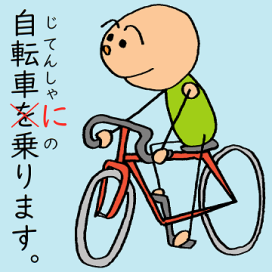
Japanese Learning (A1 S14): How to Convert a Verb from “Masu-form” to “Te-Form”; I/Chi/Ri=>tte, Bi/Mi/Ni=>nde, Ki=>ite, Gi=>ide, Shi=>shite, and Itte is special for Group 1

Yesterday, Te-form of verbs was introduced. A verb in Te-form can be followed by another conjugating word (often a verb). Actually, “Masu-form without masu” can also be followed by another conjugating word. But anyway, it is important to know that there are two patterns of conjugation in Japanese; one is for being placed in front of a noun, the other is for being placed in front of another conjugating word. Te-form is the latter.

And have you found in yesterday’s post that there were groupings for verbs, which were called “Group1”, “Group2”, and “Group3”? Their definitions are as below;

Suppose there is one Japanese verb, and you want to know what group the verb is. Make “Nai-form” of that verb. And check the vowel just in front of “nai”.

– The vowel in front of “nai” is “a”, then the verb is a Group1 verb.

– The vowel in front of “nai” is “i” or “e”, then the verb is a Group2 verb.

– Verbs in Group3 are irregular verbs. They are Kuru/Kimasu and Suru/Shimasu.

Let us examine the verbs that appeared yesterday’s post as to these groupings;

– Imasu (in Masu-form) => Inai (in Nai-form); The vowel in front of “nai” is “i” => Group2

– Nemasu => Nenai; The vowel in front of “nai” is “e” => Group2

– Kimasu => Group3

– Shimasu => Group3

– Tsukaimasu => Tsukawanai; The vowel in front of “nai” is “a” => Group1

– Kakimasu => Kakanai; “a”+ “nai” => Group1

– Ikimasu => Ikanai; “a”+ “nai” => Group1

– Isogimasu => Isoganai; “a”+ “nai” => Group1

– Hanashimasu => Hanasanai; “a”+ “nai” => Group1

– Machimasu => Matanai; “a”+ “nai” => Group1

– Tobimasu => Tobanai; “a”+ “nai” => Group1

– Yomimasu => Yomanai; “a”+ “nai” => Group1

– Tsukurimasu => Tsukuranai; “a”+ “nai” => Group1

Once you have got to know which group the verb is, you can convert the verb from Masu-form to Te-form through the following procedure;

< Te-forms of Group2 and Group3 Verbs >

[Masu-form without masu] + te

examples — [Masu-form], [Masu-form without masu] + te, and Te-Form

– Imasu, I+te, Ite

– Nemasu, Ne+te, Nete

– Kimasu, Ki+te, Kite

– Shimasu, Shi+te, Shite

< Te-forms of Group1 Verbs >

SPECIAL ONE: Ikimasu => Itte

OTHER THAN Ikimasu

 Check the letter just before “masu”

– i+masu/chi+masu/ri+masu => tte

— imasu => tte

example : Tsukaimasu => Tsuka+imasu => Tsukatte

— chimasu => tte

example : Machimasu => Ma+chimasu => Matte

— rimasu => tte

example : Tsukurimasu => Tsuku+rimasu=> Tsukutte

– bi+masu/mi+masu/ni+masu => nde

— bimasu => nde

example : Tobimasu => To+bimasu => Tonde

— mimasu => nde

example : Yomimasu => Yo+mimasu => Yonde

— nimasu => nde

example : Shinimasu => Shi+nimasu => Shinde

– ki+masu => ite

example : Kakimasu => Ka-kimasu => Kaite

– gi+masu => ide

example : Isogimasu => Iso-gimasu => Isoide

– shi+masu => shite

example : Hanashimasu => Hana+shimasu => Hanashite

TODAY’S SUMMARY

When you convert a verb from Masu-form to Te-form;

Group2 and Group3 verbs; Take place of “masu” by “te”

Group1 verbs;

– Ikimasu is an exception, its Te-form is “Itte”

– Check the letter before “masu”

— i/chi/ri => tte

— bi/mi/ni => nde

— ki => ite

— gi => ide

— shi => shite

It is essential for Japanese learners to be able to convert any Japanese verbs into Te-form.

Japanese Learning (A1 S14): One of Verb Conjugation Forms, “Te-Form”; [Verb Stem]+ te/ite/ide/tte/nde/shite

Some of words in Japanese conjugate. The word groups that conjugate are Verb, I-adjective, Na-adjective, and Auxiliary verb. These conjugating words change at the end part of the word, while the head of the word does not change.

[Word to conjugate] = [Unchanging Part] + [Changing Part]

Take a look at verb “Kau” which means “buy” in English.

– Dictionary form = Kau

– Nai form = Kawanai

– Masu form = Kaimasu

You can see that the head of the word “ka” doesn’t change, and its end part changes to be “u”, “wanai”, and “imasu”.

There are many conjugation forms in addition to the three above. But here is a basic thing about conjugations of Japanese words. It is not only for verbs, but also for I-adjectives and Na-adjectives. You need to know two patterns; one is a conjugating word being placed in front of a noun, the other is a conjugating word being placed in front of another conjugating word.

1. [Conjugating word] + [Noun]

2. [Conjugating word] + [Another conjugating word]

For sake of simplicity, let us think of 2 as [Conjugating word] + [Another verb]. Using these basic concepts, we can classify properties of those conjugation forms.

– Dictionary form = Kau — can be placed in front of a Noun

– Nai form = Kawanai — can be placed in front of a Noun

– Masu form = Kaimasu — must be the ending of a sentence

– Te form = Katte — can be placed in front of another verb

So “Te-form” of a verb is a conjugation pattern that can be placed before another verb (or another conjugating word, too be exact).

The followings are examples of “Te-form” of verbs. Note that the list is written in the order of a Masu-form and a Te-form.

Group 2 Verbs

– Imasu — Ite

– Mimasu — Mite (Be careful, it’s not “Mitte”)

– Nemasu — Nete

– Okimasu — Okite (This is “Get up/wake up”. Not “put on”)

Group 3 Verbs

– Kimasu — Kite

– Shimasu — Shite

– Benkyoushimasu — Benkyoushite

Group 1 Verbs

– Tsukaimasu — Tsukatte

– Kakimasu — Kaite

– Ikimasu — Itte

– Isogimasu — Isoide

– Hanashimasu — Hanashite

– Machimasu — Matte

– Tobimasu — Tonde

– Yomimasu — Yonde

– Tsukurimasu — Tsukutte

Te-form of verbs is so important. More detailed explanation will be done soon.

This post was written with reference to the exercise A1 on Section 14 of “Minna no Nihongo (2nd Edition)” published by “3A Corporation”