I am a native Japanese speaker who used to teach Japanese in a university somewhere on this planet. Currently I don't work but stayed in my house in Northern part of JAPAN. I hope that you could enjoy reading my posts and know what life in Japan is like.
I put a feeder in the garden. A sparrow comes every morning.
Another lily flower opened in the garden. It is good to cut the flowers to make the bulbs grow bigger.
A solar eclipse was seen today. The photo shows the shapes of the sun that is the lights coming through the paper screen of Japanese style “Shouji”. The paper is worn out and has got many holes. So I need to change the paper screen…if I have time to do so…
The reason why I write this blog is to make records about my activities as a Japanese teacher. So I don’t mind if people hardly visit this blog. Having said that, it is really amazing that only very few people come here these days….
Date: June 19th on Friday, 2020 from 8:00 to 9:30 (9:00 – 10:30 in JST)
Course: Japanese Basic Composition 2
Used app: Video conference on DingTalk, BBS of the class was also used simultaneously to show the students some pictures.
Numbers of Students:
– 24 students input their attendances on BBS. However only 19 students sent me their compositions at the end of the class. Also several students replied to me in the interview session. Therefore the self-claiming attendance is not accurate measure to record students’ attendance.
Class Activities:
Three activities were done in the class.
-1: To proofread and correct their paper about tourism of a particular prefecture of Japan. This was a task only in the first session.
-2: To compose a description about 4-picture manga which was one of three that were drawn by the late Machiko Hasegawa. This was a task in the second session. Those compositions were sent in the form of JPEG to the teacher when the class was over.
-3: Each student was called by teacher one by one to video call. He/she was asked to read out part of his/her paper for 1 minutes and 30 seconds. The teacher gave a feedback for writing and/or speaking. Since these interview took time, this activity had been done all through the first and second sessions. So two activities were simultaneously ongoing; 3 and either of 1 or 2. 17 students could made interviews with me.
Homework:
. – No HWA
Issues and Problems:
On Tuesday 16th for class 1836 , I called each student one by one after I closed video conference. That took minutes only just to make a connection. So for this time, I was just keeping the video conference turned on, I called a student in that conference. This might have been a disturbance for other students to write their composition. However, I wanted to save the class time.
Date: June 19th on Friday, 2020 from 13:40 to 15:10 (14:40 – 16:10 in JST)
Course: Japanese Conversation 4
Used app: Video conference on DingTalk, BBS was also used supplementarily to show some pictures during the video conference. The teacher used Powerpoint on part of computer display. The PPT was a kind of aid for teacher to conduct the class and also for playing audio that was embedded to a slide.
Numbers of Students:
– At the beginning: 26 by Self-claiming attendance by the means of input “Shusseki” onto BBS
– At the end: 20 by asking a question
Class Activities:
– Introduction of Causative-Passive sentences using “Dekiru Nihongo” Chap.13
– The teacher asked the students many questions using the function of video conference. So the class activities were mush interactive.
Homework Assignment:
– No HWA
Issues and Problems:
I asked the students whether or not he/she had the textbook there. This was the question that I made at the end of the class to check their attendance through the class time. The answer was surprise to me. None of them has it. They all left the textbook in the university dormitory. Until that time, I didn’t know that . Without knowing they didn’t have the textbook, I have already done most of the semester. I usually put all the pictures onto my PPT slides. Therefore the students hadn’t feel the necessity of textbook. So no one student told me that.
Date: June 17th on Wednesday, 2020 from 15:30 to 17:00 (16:30 – 18:00 in JST)
<This was a supplementary class that was done in irregular hours>
Course: Japanese Conversation 4
Used app: Video conference on DingTalk, BBS was also used so that students could refer to during the video conference. Twelve images and three audio clips were presented on the BBS for the class 1837.
Numbers of Students: 24 out of 28. Four students were thought to be absent throughout the class
Class Activities:
-Causative sentences of the type that gives a permission.
–
Homework Assignment:
– No HA.
Issues and Problems:
Video conference was often stopped. It seems that much more capacity is needed on internet communication when we do video conference.
Interactive activities took more minutes than I thought. I think it is okay because I still have many hours to teach until the semester ends. How much I taught is not a matter. How much the students have learned is the matter.
Date: June 15th on Monday, 2020 from 8:00 to 9:30 (9:00 – 10:30 in JST)
Course: Japanese Conversation 4
Used app: Streaming on DingTalk, Presentation by Powerpoint with 64 slides
Numbers of Students: 26 out of 28.
– Fully attendant for 90min : 21
– Shorter signing-in: 86, 47, and 26 seconds.
– Two students can be assumed their participation through the activities, although the system recorded no signing in.
Responses onto the BBS:
– Attendance check by a student his/herself: 26.
– 1st Quiz: 19 students responded.
– 2nd Quiz: 26 students responded.
– Attendance check at the end: 19 students responded.
Teaching:
– Causative sentences, issues of “-totte” v.s. “-taishite”, and “V1-ta toorini V2”
Homework Assignment:
– Five students were asked to send a MP3 or M4A by Wednesday night. Those students were asked to record their own speaking of conversation between two part time job workers.
Issues and Problems:
This was the last time that I taught in the form of PPT slide show streaming. The following conversation classes for 1837 class were changed to be in the form of Video conference. This change happened because I had to do many supplementary classes in the last three weeks of this semester.
Date: June 16th on Tuesday, 2020 from 15:30 to 17:00 (16:30 – 18:00 in JST)
Course: Japanese Basic Composition 2
Used app: Video Conference on DingTalk. BBS was supplementary used to show pictures that were materials for composition. Powerpoint was also used but only on the teacher’s computer screen.
Numbers of Students: 28.
Students’ Responses:
-1: Attendance check at the beginning: 26 students responded. One didn’t.
-2: Submission of composition at the end of the class: 25 students sent me photographs of their composition on sheet of paper. Two students didn’t.
Class Activities:
-1: In the 1st session, the students were asked to proofread and revise the chapter of suggestion in their paper.
-2: Each student was called and read part of his/her paper. Teacher gave him/her advice.
-3: In the 2nd session, the students write a short essay to describe one of three mangas that were shown on BBS. The students were required to take a photo of their hand writing and send it to me.
Homework:
To write abstract, conclusion, and remarks for the paper.
Issues and Problems:
I sent comments on their composition to describe a manga one by one after the class.
Date: June 9th on Tuesday, 2020 from 15:30 to 17:00 (16:30 – 18:00 in JST)
Course: Japanese Basic Composition 2
Used app: Streaming on DingTalk, Presentation by Powerpoint with 58 slides
Numbers of Students: 28.
– 90 minutes attendance: 24 students
– One student was recorded as complete absent through the class time by the system. However, the student sent me the answers of 5-question quiz. Three students were recorded their shorter participation; 84, 83, and 79 minutes.
Responses to my requests like Quiz answers onto BBS:
-1: Attendance check at the beginning: 27 students responded. One came late.
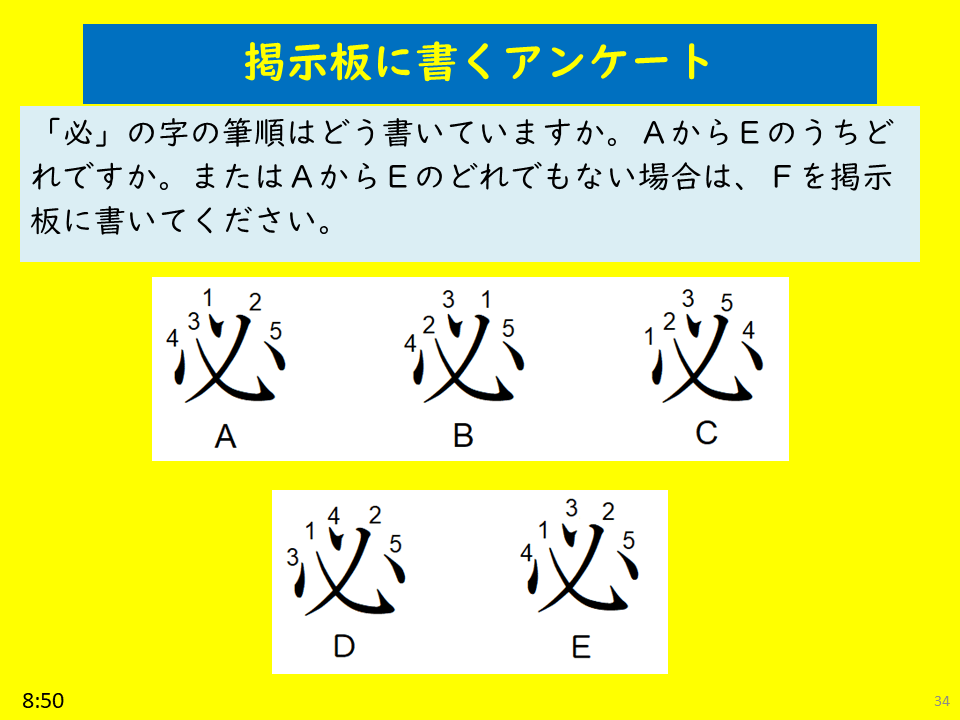
-2: Connection check in the middle of the class: 25 students responded to the question about stroke order of the kanji “必”.
-3: Attendance check at the end: the answers of 5-question quiz were sent to me right after the class. 25 students sent. 8 student got the perfect scores of 5. But of the eight, two students sent their answers more than 20 minutes late.
Teaching:
Review of 5-question quiz of the last class. Writing a research paper about tourism, and some grammatical issues from the textbook.
Homework:
To write abstract, conclusion, and remarks for the paper.
Date: June 12th on Friday, 2020 from 13:40 to 15:10 (14:40 – 16:10 in JST)
Course: Japanese Conversation 4
Used app: Streaming on DingTalk, Presentation by Powerpoint with 68 slides
Numbers of Students: 24 of 28, 4 were recorded as completely absent by the system. Of the four, one student sent me a message for sick leave before the class.
Fully attendant for 90min : 19
Shorter signing-in: 86, 79, 73, 65 minutes and 1 minute.
Responses onto the BBS:
– Attendance check by a student his/herself : 25 students input “Shusseki” onto BBS. However one student was recorded by the system as completely absent and did not leave any activities for quiz. Therefore the student was judged as absent.
– 1st Quiz: 20 students responded. The quiz was to choose right combinations of particles and causative forms of verbs.
– 2nd Quiz: 20 students responded. Before the quiz, procedures of cooking curry was explained in Japanese. The quiz was to choose the order of three major steps in cooking curry. This quiz was not just for fun, but to measure how the students understand the abstract idea and to make this a kind of introduction of a construction “V1-ta To’orini, V2-te kudasai”
– Attendance check at the end: 20 students responded. Students were asked to choose the right sentence from the five that were to be the construction “V1-ta To’orini, V2-te kudasai”.
Teaching:
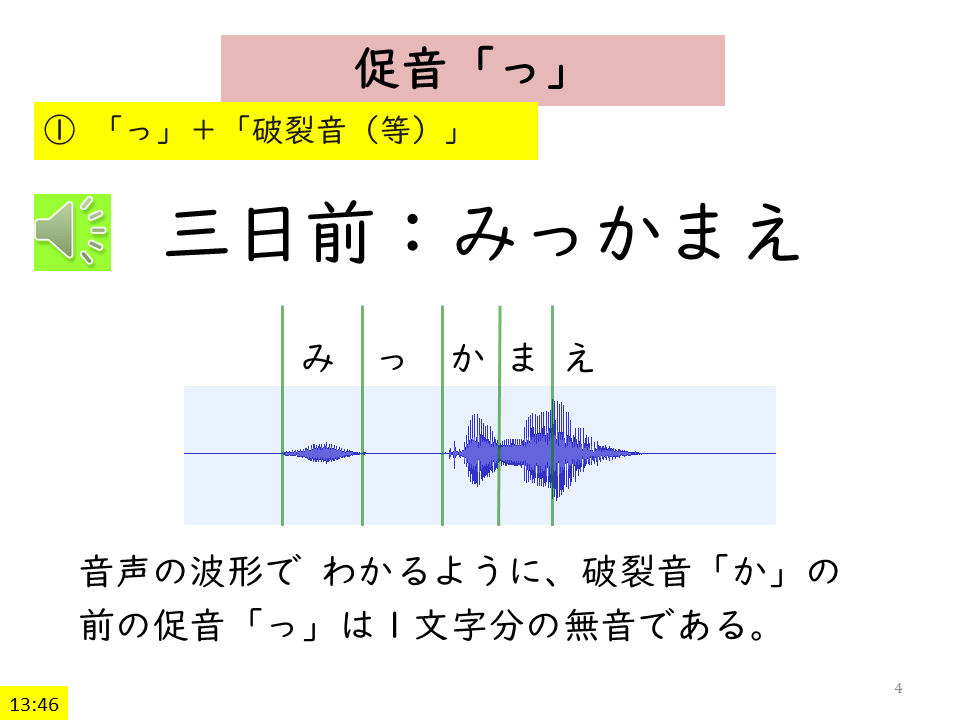
– Pronunciation of the small “-tsu”: Small “-tsu” should be silent of length of 1 mora when it is before a explosive sound. 1 mora length of silence was shown using Figure1 below. When a small “-tsu” is before friction sound, it becomes 1 mora length of friction sound.
– Review of causative sentences with comparisons between causative sentences of intransitive verbs and of transitive verbs.
– Exercises of conversations using causative sentences whose actions were expressed by intransitive verbs.
– Introduction and exercise of a construction “V1-ta To’orini, V2-te kudasai”.
Homework Assignment:
– Five students were asked to send a mp3 or m4a sound data by speaking the script of conversation of two part time job workers; Park-san and Chin-san that was in Dekiru Nihongo (yellow).
Issues and Problems:
<I don’t have time to write them>
Figure 1. 1 mora Silence of Small “-tsu” before Explosive Sound
Date: June 12th on Friday, 2020 from 8:00 to 9:30 (9:00 – 10:30 in JST)
Course: Japanese Basic Composition 2
Used app: Streaming on DingTalk, Presentation by Powerpoint with 57 slides
Numbers of Students: 22 out of 28; 5 students were thought to be absent based on the system and responses.
– 90 minutes attendance: 21 students
– One student was recorded for shorter attendances of 62 minutes.
Responses to my requests like Quiz answers onto BBS:
-1: Attendance check at the beginning: 25 students responded. Of the 25, it seemed that three students were not participating because of no responses to the class activities.
-2: Connection check in the middle of the class: the internet connections were checked by making the students input Alphabet onto BBS. 20 students responded. Actually one student input it 8 minutes late, this was judged that the student was not with me at the time of question. This was a question to ask the stroke order of one Kanji that meant “certainly” and/or “surely” as shown in the figure 1 below. 19 student answered C. There was only one exception of F that meant her stroke order was not covered by A through E. Japanese use either of A, B, or C that are commonly accepted. But A is being taught in school recent years. On Tuesday class, many students answered that their stroke orders were none of A, B, or C. So I added D and E for the class 1837. But this time almost of 1837 students answered with C. I don’t know the reason why many 1836 students answered differently.
-3: Attendance check at the end: the answers of 5-question quiz were sent to me right after the class. 21 students sent. Only one student got the perfect scores of 5.
Teaching:
Teachings were almost identical to the class for 1836 on Tuesday.
Homework:
Homework assignment was also almost identical to what was assigned for class 1836.
Issues and Problems:
I forgot to make quiz #3 when I was making PPT slides for Tuesday composition class 1836. So I gave the 1836 students a quiz only by my voice on Tuesday. I again forgot to make quiz #3 today. One student pointed that out by typing on BBS saying “Teacher, is there quiz #3?. Then again I gave the 1837 students the quiz #3 only by my speaking. For that particular question #3, 4 of 21 students just gave up answering. It meant that several students are not good at listening. This course is not listening but composition. So I don’t think it is my duty in this course to enhance the students’ listening. However, it seems that such students listening abilities are not in a good level at the time of the end of second years, because I said my question very simply and also used English. Can I, or, how can I incorporate listening activities into composition class, if I try to improve their listening?


 Agony or Fun?! Second Language Learning