My another photo blog “LQ Laoshi’s Photo Gallery”(outside wordpress)


Agony or Fun?! Second Language Learning
I am a native Japanese speaker who used to teach Japanese in a university somewhere on this planet. Currently I don't work but stayed in my house in Northern part of JAPAN. I hope that you could enjoy reading my posts and know what life in Japan is like.
My another photo blog “LQ Laoshi’s Photo Gallery”(outside wordpress)
I haven’t recovered from fatigue that had accumulated by hard work in the last semester. Most of the time I couldn’t get up from my bed even in daytime. Nonetheless the university forced me to work for scoring “Contest”. I worked for about 16 hours in total for evaluation each student’s performances.
Now the first year anniversary day of my dad’s death is approaching. Although numbers of the expected participants to the ceremony are small, I ordered return presents for those people. They are all elders and trying to come through bad weather of the middle of winter. I thought I had to choose good presents for them. I went to the only department store in the city to make the order. While I was looking at the gift catalog at the gift corner in that department store, the clerk lady didn’t want me to be there for long. So I left there with the catalog, got back to my house, and let my mom choose the present. That was on Thursday, I had to go there again to fix the order on Sunday. Two times of go-and-back required me to pay for JR-train, of course the department lady didn’t care about such things, Okay, those were good excursions for me.
The main dish for Monday supper was Mackerel boiled with soy sauce; Fried sliced pork on Tuesday, Soba noodle with Tempura on top on Wednesday, Leftovers of lunch that was Chinese food on Thursday, Grilled salmon slice on Friday, Chicken thigh boiled with soy sauce on Saturday, and grilled salmon slice again on Sunday.
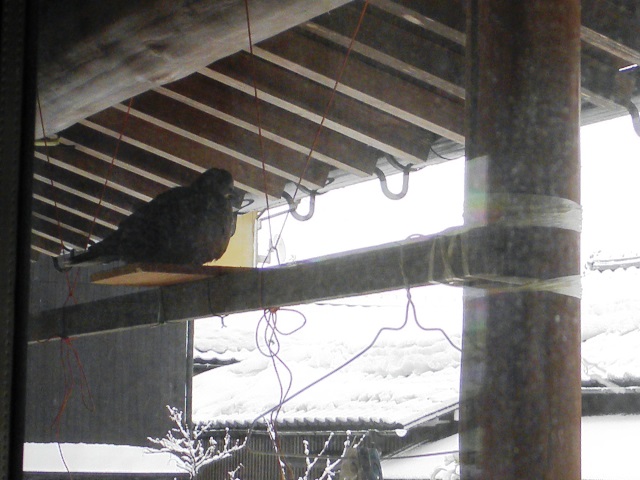
I put a small wooden plate so that the pigeon could rest on it without being hit by snow fall.
My another photo blog “LQ Laoshi’s Photo Gallery”(outside wordpress)
I don’t have time to write a log of the last week. The university makes me work even in spring break. So there had been no any single holiday to me recently.
My another photo blog “LQ Laoshi’s Photo Gallery”(outside wordpress)
January 11, Monday
I used two hours in the morning for posting the last week’s log here in the morning.
I worked for six hours in the rest of the day. The main dish in supper was boiled fish.
January 12, Tuesday
I cleared snow in the morning, worked for four hours, and went to a library and supermarket. I cooked curry for supper.
January 13, Wednesday
I worked for ten hours. That was preparation for the Japanese business manner class in coming spring semester. I cooked pork for supper.
January 14, Thursday
As was the day before, I worked for ten hours to prepare for the business manner course. I went to the library in the afternoon by walk. The main dish in supper was grilled salmon.
January 15, Friday
I got to know that the university would make me work even in the winter break.
January 16, Saturday
I went to Niitsu 1st-6th morning market in the morning to buy Kimchi from Ms.Yamashita.
Since I wouldn’t like to work, I spent most of the afternoon by internet-surfing.
January 17, Sunday
I worked all day as usual to prepare for spring semester. Now my concern is whether or not I will be able to be ready for the coming spring semester because the university is going to make me work for an additional task during this break, which I didn’t predicted.
My another photo blog “LQ Laoshi’s Photo Gallery”(outside wordpress)
January 4, Monday
One and a half hours were spent for posing the last week’s log here in the morning. The rest of the morning hours were used for reviewing my scoring of the final exam for reading class. I just made scoring on image files captured from PDF because I could not get students’ real answer sheets in paper format. Once I finished reviewing, I started the second check by inputting students’ answer one by one into a big spread sheet of excel in the afternoon. After the supper, I made some tables of my grading so that it would help me input grading on online registering system. I went to bed at 10:30p.m.
January 5, Tuesday
I started working in the morning. That was to register my grading for the students’ performance in the fall semester. But when I was still doing that, the system had become stopped its function. I knew that the capacity of that registering system was very limited. So I just thought I would do that later. And then I went to out and got on a local train. I needed to get rid of snow in a house. Now the house doesn’t have a person to manage. If there was snowfall, the path from the road to the entrance would be completely covered with snow. It took two hours to make a path by digging and throwing snow with heavy steel shovel. It made me tired. I went to bed at 8:30 p.m.
January 6, Wednesday
I just wasted my time in the morning. Probably it was partly because I was tired from the hard work in the fall semester and mostly because I couldn’t even open the web page for the online registering system for the students’ grading. It seemed that I could not complete registering by the deadline. I took a long nap on the bed in the afternoon. I woke up and then went out. I got on a local train to go to Niigata. I bought a mouse in the electric appliance store by the JR Niigata station. I got back my house at 5:30 p.m. I cooked supper. The main dish was boiled flat fishes with soy sauce.
January 7, Thursday
Since I couldn’t register myself the students’ grades online, I asked the chief to register them on behalf of me. Although I asked the task, I myself had to used the whole morning hours for this to be done. In the afternoon I started preparation for the coming spring semester. I tried making the course design for the business manner class for the third grade students. I cooked salmon for the supper, practiced my bass an hour, and then went to bed at 8:30 p.m. I usually read an English book on the bed until I feel asleep. For this kind of reading a foreign language book, I think it is common not to use a dictionary. But this time I try to use my CASIO electronic dictionary as much as I can understand meanings of English sentences. There are a lot of words that I don’t know. A lot ‘n’ lot. Never is there an end for the second language learning.
January 8, Friday
I didn’t work in morning hours. I just rip music from my music CD and saved them in my Sony Walkman that was mp3 music player. Let me say this; the CDs were that I bought by my money. The mp3 player is for me to listen. So there is no copy-right violation because it is sheer personal use only.
In the afternoon was as follows; I took a nap for an hour. I went to a supermarket to buy foods. I revised the course design for business manner class. I cooked chicken for supper. I recorded my voice so that my students could improve their listening. I practiced my electric bass for an hour. I went to bed at 9 p.m. And then I fell asleep with the help of reading an English book.
January 9, Saturday
We had got a lot of snow in this winter. I got rid of snow a little in the morning. And then I reorganized picture files on my another photo blog on “goo”. This task used two hours of my time in the morning. In the rest of the day, I had just worked for recording my reading voice to make listening materials for my students. The main dish of supper was the slice of mackerel grilled simply with salt.
January 10, Sunday
I worked hard in the morning. But that work was not as a Japanese teacher but as a labor to clear snow. Not only for my house, I made a path for the community although it was just a ten meter or so. I was exhausted. After I finished and I was taking a little rest, I heard a sound of a heavy machine coming. It was a big snowplow probably hired by the city. In a few minutes, the machine had done what I could never do with my hands. It was just like go-and-back, and then the work had done. No sign remained that indicated I worked hard to get rid of snow before the machine came.
But that was not the end of my fight against snow. The air-conditioner as a heater in my mom’s room didn’t work. I was not sure for the reason, but I guessed that the outdoor unit was buried in snow and it could stop the fan rotation. Snow depth was already more than one meter (three feet). I dig the snow and reached the unit. As I expected, snow and ice piled up and went into the unit. They were preventing the fan from rotating inside. What I needed to do was simple; to get rid of them. But the problem was that I couldn’t remove the big circle like mesh lid on the surface of that Hitachi made air-conditioner outdoor unit. I used hot water in a kettle, a long chop stick, and even plastic straw to remove or melt the snow inside from outside through the meshed lid. I blow my breath through a straw in order to melt the snow that was sticking on the fan. Actually this method didn’t work well. I confirmed the fan could rotate, then turn on the AC. I found that that sent a warm air. It took two hours.
In the afternoon, I took two hours of nap on the bed, I went to the library by walk to return books and borrow new ones. Back in the house, I continued recording my reading a textbook for business manner course. I cooked pork for the supper.
This is a test positing as a preparation for the class ‘Japanese Conversation 4’ that will be taught in coming spring semester.
The posts under this category will be written in Japanese.
I am sorry to say that this post doesn’t have any useful information to you.
This is a test positing as a preparation for Japanese course ‘Business Manner’ that will be taught in coming spring semester.
The posts under this category will be written in Japanese.
I am sorry to say that this post doesn’t have any useful information to you.
My another photo blog “LQ Laoshi’s Photo Gallery”(outside wordpress)
December 28, Monday
I posted the last week’s log on worepress in the morning. And then I went out and got on a train for shopping in Niigata. I bought a 21.5 inch PC monitor at the big appliance shop on the south side of JR Niigata station. Now I am typing this by looking at my new monitor, I think I should have bought the bigger screen much earlier because my eye is already tired of looking at a small screen of notebook PC for these two years. And 23 inch or even 27 inch would have been better to buy, I just regret that. Back to my home before 1 p.m., I had a lunch, went to a supermarket, took a long nap, and cooked supper. After eating supper, I evaluated test results of the final examination for conversation class. I evaluated three pairs before going to bed.
December 29, Tuesday
Of course I had to give scoring for the final exam, but I didn’t start doing that in the morning. Instead, I started cutting a timber (lumber?) plate in the morning. I wanted to make two speaker boxes in order to listen to music in good sound. But it was obvious that I could not complete two speaker boxes in one day. So I just stop the work at noon. I took a nap a little while just after the lunch and then went to a supermarket. I just graded the final examination of conversation class in the late afternoon. That grading continued after supper until going to bed.
December 30, Wednesday
In the morning I started the rest of the work for making two speaker boxes. The hardest part was to make two holes to set the speaker. The diameter was 94 millimeter. Since I didn’t have any cutting machine or drill, I did that using primitive tools; a gimlet and small chisels. It tool many hours, so it was 4 p.m, when I fit two boxes on the wall of my room. My supper on the day was chicken breast. After supper I evaluated three pairs for the final exam of conversation class.
December 31, Thursday
I cleaned the room with vacuum in the morning. It was because I just didn’t want to work for the examination scoring. And the day was the last day of the year 2020. I thought that the supermarket would be congested with people who wanted to buy food for new-year holidays. So I went to the supermarket just after the shop’s opening. There were less people there shopping. It was what I predicted, but it also made me worry if the supermarket could survive or not because there were less people even in the last day of the year. Anyway, I had to use all of the rest of the day to evaluate students’ final exam for conversation class.
January 1, 2021
The colleague sent me PDF of the answer sheets in the morning. That was of reading class and the exam was conducted the day before. So I wanted to start scoring soon, but I hadn’t finished evaluation about students’ performance during the semester. I spent most of the day to complete the evaluation, although I took two hours nap in the afternoon. After supper I started scoring the answer sheet of reading class examination. I practiced my electric bass for an hour, and went to bed.
January 2, 2021
All day was spent for scoring the final exam for the reading class. I evaluated 17 students. I was actually disappointed by some of students’ answers. Some students used the postposition “-ga” for objects, which was actually to be used for subjects. One student didn’t understand adjective conjugation when the adjective works as adverb. That was my responsibility for teaching those things. Students’ answer simply meant that I failed to teach them well. Thinking like that, scoring didn’t move on to next student. I gave up scoring at 10 p.m. with seven students remaining.
January 3, 2021
Being tired of working, scoring was not proceeding well. I spent all day for scoring the final exam only for seven students. After supper I found that I had to change scoring criteria and redo the scoring again for some reasons (I cannot write the reason here). The gradings need to be registered by January 6th on Wednesday. I have to continue to work until I register all the gradings of the students by that time.
My another photo blog “LQ Laoshi’s Photo Gallery”(outside wordpress)
Dec.21 on Monday
9:05-10:25: Reading class, online, for class 1939. The article was actually weird one in which a TV anchor interviewed a historical person who was brought to the modern times by a time machine. The interviewee was brought from 1000 years ago, Murasaki Shikibu who wrote the world oldest long novel “Genji Monogatari (aTale of Genji). I expected that my students would be interested in female literature around 11 century in Heian era of Japan. After the class I took a rest until the lunch and spent two hours for uploading the last week’s weekly log to the wordpress. The rest of the afternoon was just nap and rest on the bed. My fatigue accumulated for the semester. 17:30 – 19:30: Cook and Supper. I bought some commodities from Amazon.co.jp after the supper. The shopping took two hours. And then I went to bed.
Dec.22 on Tuesday
I requested eight books to the city library in the morning. And then I started working to calculate students’ grading for the conversation class of this semester. Grading composes of the test result and performances in classes through the semester. Two are 50 to 50 in proportion. For the performances, I combined three factors to calculate. Of course the attendance is the most important. I added other two things to the attendance: One is scores of right answers to the quiz during a class. The other is how good a student responded to my questions during a class. Both are actually “Big Data” because 55 students took the classes 17 times. All the numbers are written on my business notebook by handwriting. Here is an issue; those numbers must be typed in the excel spreadsheet in order calculate the scores. In the last semester, I did that right after the class in the same day. In this semester, I decided doing this at the end of the semester because it would affect preparation for the next class if I input data about quiz answers and students’ performance right after each class. Now is the time to input “Big Data” of whole semester at one time. Actually I realized that the way in the last semester was better than inputting huge data one time at the end of semester. It is not because of accumulated fatigue at the end of the semester. If I don’t input students’ performance during semester, I cannot know how a student is doing better or worse. Every time I ask a student to answer my question during class, I need to choose a student who is suitable for asking that particular question. I mean, “This question is a little difficult, so it is better to ask an excellent student”, or “This question is a basic one, it is better to ask a below-average student”. If I input the students’ performance class by class and make it visible during semester, I can easily make a judgment for this kind of decision. In this semester, I don’t have such a good reference. Looking at the result of students’ performance, I found that my evaluations without data are not correct for some students. That is what I regret for this semester.
Dec.23 on Wednesday
Since February, I turn the light on every morning and turn it off night, at the altar where my dad’s photo is put. Having passed ten months, the fluorescent light has almost ended. If a deceased person’s photo is placed in the dark, it is NO good. I thought I would change it to a LED light of less electric and more longevity. I went to D.I.Y. shop in the morning to buy a LED light bulb, code, and a switch. Went back home I tried putting the LED light above the altar. My fault was that I didn’t think about how I fixed the bulb. It was already in the afternoon when I complete the LED lighting because the work took more than three hours. After that I made some PPT slide for the last class of conversation class on Thursday.
Dec.24 on Thursday
9:05-10:25 was conversation class for sophomore students, let’s say, the Class A. I taught the auxiliary verb “-souda” for hearsay. The important thing is the difference from “-souda” for inference. This class was the last one for Class A. Since the conversation class was canceled once some time middle of the semester, the Class A only had chances to take conversation class 16 times in this semester. IN the afternoon, 13:40-16:00 another Class B also took the conversation class. But Class B had chances to take my class 17 times. In order to treat both classes A and B equally, I made the last class a special one for Class B. At 13:40, I started the class with a test with 40 questions. I am going to evaluate students’ answers during spring semester, not now, because now is the time to grade for the semester. My purpose is that I would like to make individualized teaching that is suitable to each student such that can overcome his or her weaknesses. And then I made the students the first half of the old tale “Kasajizou” and made them write what would be the last half of the story by guessing. Actually I did the same thing last year. At that time some students wrote that old lady got angry with what her husband did. I wouldn’t say it is bad inference, though, this time, most students could predict what the ending of the story would be like correctly.
Dec.25 on Friday
I did the final examinations of conversation class; one class in the morning, the other in the afternoon. It was a pair work of conversation. I made the students make conversation for a task, record it to mp3 or m4a, and send it to me. The tests in the morning and afternoon went almost well for 28 pairs of 56 students. However, two pairs were problematic. I should not write about them in detail here.
After the afternoon test, I had to cut and make slices of salmon. It took more than hour. So my supper was delayed a little than usual. I worked two hours for grading, 40 minutes for bass practicing, read an English book a little, and then fell asleep.
Dec.26 on Saturday
I went to the morning market in Niitsu in the morning. This was the last market in this year. I worried about sold out of Ms.Yamashita’s Kimchi, I left home early. So, before 10 a.m., I was already back in home. Then I wasted three hours for uploading two blog posts here and https://blog.goo.ne.jp/liangzhi.
After taking a long nap in the afternoon, I worked to calculate the gradings of the students’ performance in the conversation class, for rest of the day.
Dec.26 on Sunday
I spent all day to evaluate the final examination of the conversation class. That’s it.
My another photo blog “LQ Laoshi’s Photo Gallery”(outside wordpress)
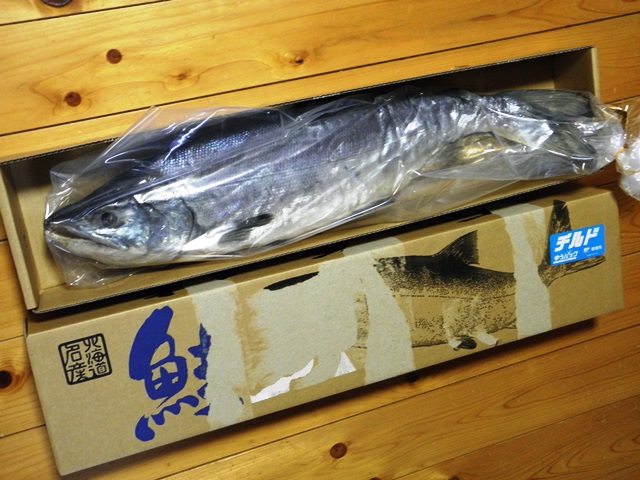
So this is the end of the year 2020. Every year at this time a lady in Hokkaido sends us a one whole salmon as a year-end gift. That lady’s husband and my dad had worked together forty some years ago. Her husband died young, but she continues to send the year-end gifts to her husband’s old colleagues. Actually my dad had long been ill and was unable to deal with salmon by himself. But I couldn’t say her to stop sending. Because I thought that sending year-end gifts to her husband’s co-workers makes her feel the connection to her dead husband.

But this year, a change had happened on our family side. My dad died in February. We should have told her soon, but we haven’t done that yet. This morning, my mom wrote a letter, although she hasn’t brought it to post office yet. Anyway, I had to cut and slice the salmon. I have done that yesterday.
The first thing I have to do was to sharpen a knife. I honed a thick blade knife with a whetstone. By the way, I want you to know that Japanese do not rubbing two knives together with clicking-clacking sounds when we sharpen a knife. We do that one by one with whetstone as in the photograph.

He is bigger than the cutting board. I use the word “He” because I guess the salmon is male. The reason is simple; his nose is sharp. A female salmons have round nose. Anyway I have to cut the salmon neatly, but I think that, for this kind of techniques, how many times one has done it before matters to do it well. I mean if I had cut salmons one hundred times, I could do it well. But this was just the third times for me to cut and slice a one whole salmon. So please do not expect much.
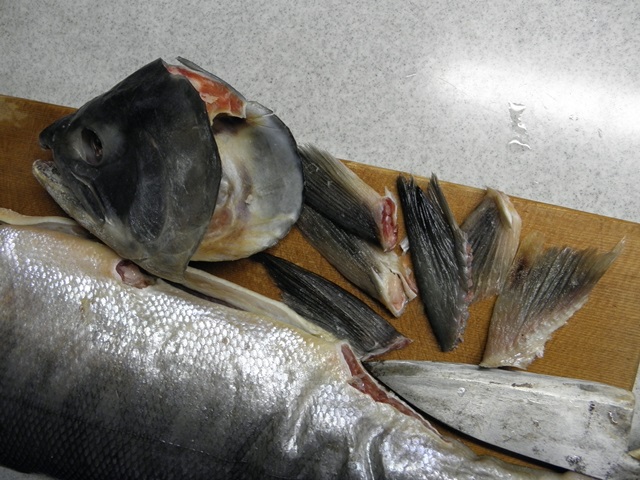
At first I cut the head and fins. Of course they can be eaten. There is no part that can be wasted as to salmon.

OK, this is the most difficult part of the process. You need to cut a half body on one side. At the center of the body, there is a line of bones from the backbone to the top. It is important to cut as close as you can to those vertical bones at the center. But I should admit that I am not good at it. You can see that meat remains on bone side thick.

The next process is to cut the backbone out from the other side of body.

And then I slice the half body so that they can be easily grilled.
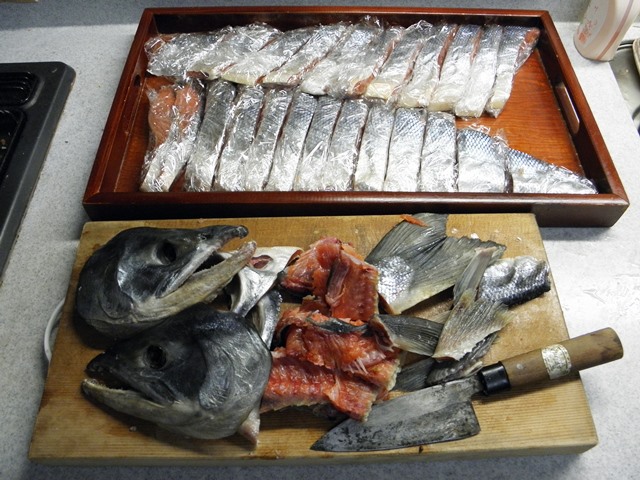
Then I wrapped each slice with cling film. Anyway I have almost done the work.
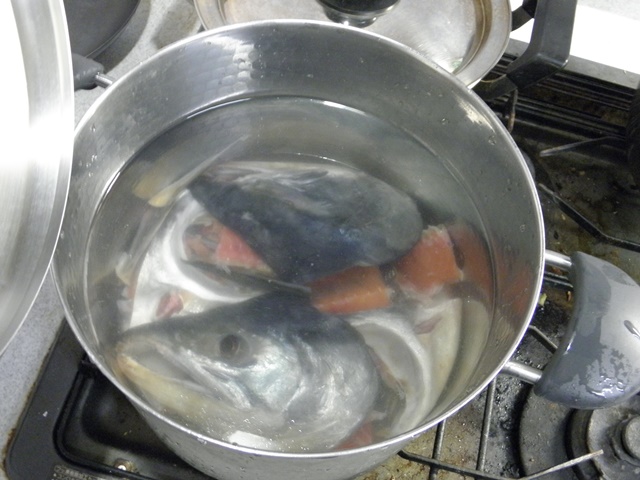
A good thing about salmon is that you can eat even the head, bones, and fins by boiling them for several hours. Those parts will eventually become soft and edible. If you have a pressure cooker, boiling hours can be shortened to the less than an hour. Since I don’t have a pressure cooker, I just boil every time I stand in the kitchen. And then the head and bone can be soft in two days.
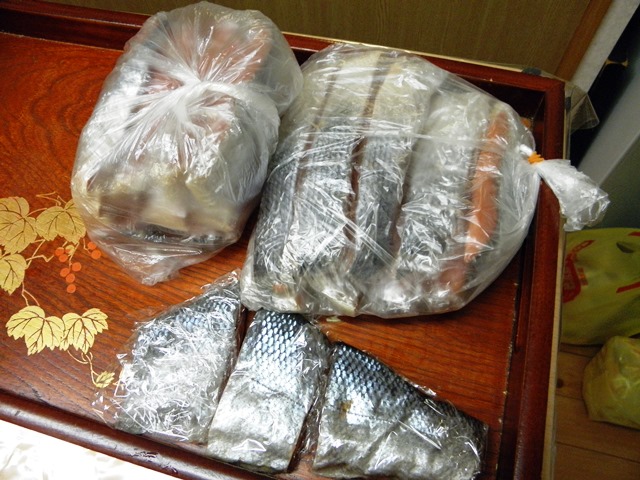
The slices of salmon were a lot. So I just put them in the freezer. But they were still a lot. So my mom wanted to give part of them to her friend. This morning my mom went out to the lady’s house to give her some slices of the salmon. The lady is taking a care of her mother alone in her house. I have to tell ya that her mother is one hundred and six years old. I hope that the salmon that I sliced will be on the table of the centenarian as part of New Year celebration.
 Agony or Fun?! Second Language Learning