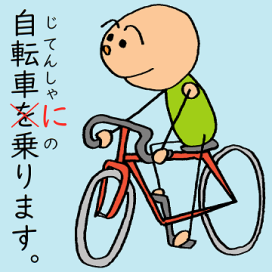
Today’s sentences also use “-ndesuga,” to confide a situation. The differences are;
– Yesterday’s : [Clause telling situation] + ndesuga, [V-te] Itadake masenka.
— Asking someone to do something
– Today’s : [Clause telling situation] + ndesuga, [V-ta] ra Iidesuka.
— Telling a situation and getting an advice for the situation
As for today’s sentence, “[V]+tara” is actually “[V-ta] ra”. This is one of application of the conjunctive particle “-tara,” introduced in the section 25. And an interrogative word is usually used in the main clause as below;
[Situation]+ndesuga, [Interrogative word] + [V-ta]+ra Iidesuka.
Take a look at some examples below;
1. Koushien* e Ikitai ndesuga, Dono Densha ni Nottara Iidesuka.
(I want to go to Koushien, so, would you please tell me which train to get on?)
* Koushien is a famous baseball stadium.
2. Bin ya Kan o Sutetai ndesuga, Nan-Youbi ni Dashitara Iidesuka.
(I want to throw bottles and cans, so, would you please tell me what day of the week I take them (to the garbage collecting place)?)
3. Kono Mondai ga Wakaranai ndesuga, Dou Kotaetara Iidesuka.
(I can’t understand this problem, so, would you please tell me how to answer it?)
————————————–
This post was written with reference to the exercise A6 on Section26 of “Minna no Nihongo (2nd Edition)” published by “3A Corporation”
 Agony or Fun?! Second Language Learning