
Online Teaching for Class 1939 (Listening) on May 11, 2020

Date: May 11th on Monday, 2020 from 9:50 to 11:20 (10:50 – 12:20 in JST)

Course: Japanese Listening 2

Used app: Streaming on DingTalk, Presentation by Powerpoint with 70 slides

Numbers of Students: 27

26 students stayed with me from the start to the end. One student was absent.

Students’ Responses:

– Attendance Check : 26 students typed his/her attendance by themselves on BBS.

– Quiz 1 : 25 students answered.The question was conversions from Masu-form to Te-form for four verbs. Some students tended to put the small “tsu” for 1-dan verbs, but it is not correct. Putting a small “tsu” happens on some types of 5-dan verbs, not 1-dan verbs.

– Quiz 2: 24 students answered.The question was  to choose the correct combination of four particles from the selections. Students typed wrong answer that came from over generalization of  “Wa-ga construction”. Many students are sticking to “Wa-ga construction” and make errors on particles by over-generalizing it. I stopped them and made them answer again.

– Quiz 2: 24 students answered. Question was about tense for past, present progressive, and non-past. All 23 were right. The purpose of this question is to make students understand the usage of “V-te iru” in the concept of tense-aspect.

– Quiz 3: 24 students answered. The question was to choose the right combination of a question and an answer. When a question was done with “Naze (why)”, the answer must have the ending “-karadesu.”. This seems like the relation between why and because. This quiz intended to make the students find the relation between “naze” and “karadesu”.

– Quiz at the End: 25 students typed their own sentences in the form of “V-te kudasai”.

Teaching:

1: Basics of Japanese grammar

– Verb predicate sentences end with “-masu”, which is different from the endings of Noun and Adjective predicate sentences.

– Do not over-generalize “Wa-ga construction” to verb predicate sentences especially for transitive verb sentences for action/movement. Use proper particle for a word’s function.

2: Review of grammar in the last class

– Introduction of Te-form, “V-te iru” for ongoing actions, and uses of particle “-de”.

3: Listening using textbook material

Homework Assignment:

– No homework was assigned.

Issues and Problems:

When the students were typing the wrong answer by over-generalizing “Wa-ga” construction, I stopped their inputting with shouting and made them input again. Since some students had not yet input, this forced redo could not be used for knowing the first reaction of a student. However, I expected that could be an effective action to make the students realize that they got an wrong answer.

Another issue was that  I was ill-prepared for the activities with textbook’s listening materials. Making the students listen to and simply showing the answer for it was not a good teaching style. I had been concentrating on making PPT slides that reflects my own ideas about damage by “Wa-da construction” or other issue. But I didn’t spend enough time to think how to use and teach the textbook materials effectively to the students.
Online Teaching for Class 1837 (Conversation) on May 11, 2020

Date: May 11th on Monday, 2020 from 8:00 to 9:30 (9:00 – 10:30 in JST)

Course: Japanese Conversation 4

Used app: Streaming on DingTalk, Presentation by Powerpoint with 58 slides

Numbers of Students: 26 out of 28, Number of completely absent was 2

Fully attendant for 90min : 14

Shorter signing-in: 85, 81, 80, 77, 49, 46, 32, 31, 28, 11, 5, and 4 minutes.

Responses onto the BBS:

– Attendance check by a student his/herself: 26. Of the 26, one student was actually recorded as completely absent from the class. One came late and stayed for 32 minutes.

– 1st Quiz: 23 students responded. The quiz was to find the best conditional conjunctive particle for a sentence stating an incident that had happened already. Some of the best students answered one that was not the best, and then many students followed it. At the point that two thirds students had input the same answer, one student typed the best one. And then remaining one third students input the (new) best answer.

– 2nd Quiz: 18 students responded. The question was to choose the better conditional conjunctive particle for a sentence of invitation. This is to make the students know realize that conjunctive particle “-to” cannot be used for will, suggestion, command, and so on.

– 3rd Quiz: 23 students responded. The question was to choose one nature which is applicable only to “-nara”. “Nara” cannot be used if the condition phrase is quite certain.

– Attendance check at the end: 20 students responded. This was to choose the best explanations for four conditional conjunctive particles “-to”, “-ba”, “-tara”, and “-nara”.

Teaching: 

– <No time to write them now>

Homework Assignment:

– Nothing to submit to the teacher this time.

– Six students were asked to send a voice mail by speaking the script of conversation of two part time job workers.

Issues and Problems:

A lot of grammatical thing to teach. It is too much for conversation class.

Online Teaching for Class 1836 (Composition) on May 9, 2020

Date: May 9th on Saturday, 2020 from 15:30 to 17:00 (16:30 – 18:00 in JST)

Course: Japanese Basic Composition 2

Used app: Streaming on DingTalk, Presentation by Powerpoint with 80 slides

Numbers of Students: 28

25 students participated for whole 90 minutes.

3 students were recorded for their short attendances: 57, 44, 32 minutes

Responses to my requests like Quiz answers onto BBS:

– Attendance check by reporting his/her-selves: 28.

– 1st Quiz: 26 students responded. This was to correct the erroneous sentence with over-generalization of “Wa-ga construction”.

– In the rest of the class, the students were given 5-question quiz. A student answered a question by taking a memo, and sent five answers right after the class. This also worked as an attendance check at the end of the class.

Teaching:

– Feedback about the students’ compositions about a health care worker from abroad.

– Review and summary of the first half of this semester.

Homework:

– Homework assignment was suspended. Although the second drafting for the essay about a health care worker must be assigned, I haven’t yet evaluated their first draft.

Issues and Problems:

The result of the quiz showed that some students didn’t understand the difference between “-teiru” and “-tekuru”. For other issues, however, I have no time to write them right now.

Online Teaching for Class 1837 (Conversation) on May 8, 2020

Date: May 8th on Friday, 2020 from 13:40 to 15:10 (14:40 – 16:10 in JST)

Course: Japanese Conversation 4

Used app: Streaming on DingTalk, Presentation by Powerpoint with 59 slides

Numbers of Students: 26 out of 28, Number of completely absent was 2

Fully attendant for 90min : 16

Shorter signing-in: 86, 82, 63, 37, 24, 16, 16, 6, 4 minutes, and the shortest was 2 seconds.

Responses onto the BBS:

– Attendance check by a student his/herself: 24. Two students came late.

– 1st Quiz: 19 students responded. The quiz was to find a sentence using the conditional conjunctive particle “-to” from four sentences.

– 2nd Quiz: 21 students responded. The question was to check the students’ understanding for limitation of use of the conditional conjunctive particle “-to”.

– 3rd Quiz: 23 students responded. The question was to make a student complete a conversation by filling the blanks correctly with understanding the difference between “-temo” and “-to”.

– Attendance check at the end: 19 students responded. Like the quiz No.3, this was also to ask proper uses of conditional conjunctive particles “-temo” and “-to”.

Teaching: 

– Conditional conjunctive particle “-to”, especially for  its limitation for the latter clause. Expressions like intention, invitation, and/or command are not used in the latter clause when the preceding clause uses “-to,”.

– Introduction of another conditional conjunctive particle “-tara,” including comparison with other conditional conjunctive particles “-to,”, “-ba,”, and “-nara,”.

Homework Assignment:

– Nothing to submit to the teacher this time. The students were asked to evaluate a short test for the section 12 by him/herself.

– Six students were asked to send a voice mail by speaking the script of conversation of two part time job workers.

Issues and Problems:

A lot of rote exercise (mechanical trainings) for sentences with “-to” and “-tara”. The students must have been tired and fed up with.

Online Teaching for Class 1837 (Composition) on May 8, 2020

Date: May 8th on Friday, 2020 from 8:00 to 9:30 (9:00 – 10:30 in JST)

Course: Japanese Basic Composition 2

Used app: Streaming on DingTalk, Presentation by Powerpoint with 79 slides

Numbers of Students: 24 out of 28

90 minutes attendance: 14 students

Shorter attendances: 87, 86, 84, 69, 58, 51, 14, 5, 4, and 3 minutes.

completely absent: 4 students

Responses to my requests like Quiz answers onto BBS:

Attendance check: 24. But, of these, one student was recorded as “Completely Absent” on the system. One student came late.

Quiz 1 : 23 students responded. The question was to find an error on use of particle. Not “-ga” but “-o” must be used for the object of an intransitive verb.

Only the quiz No.1 was done using BBS during the class. Instead, five questions were given to the students. And they were asked to send five answers immediately after the class.

Teaching:

– Feedback about the homework assignment which was to write an essay about an episode of a health care worker from abroad.

– Review of the first half of this semester. Five questions were given to the students in order to check their understanding for the issues that were already explained in the classes so far.

Homework:

– HW is suspended until I evaluate and send back the first drafts that were expressions about reading health care workers from abroad.

Issues and Problems:

<No time to write them right now>

Online Teaching for Class 1939 (Listening) on May 06, 2020

Date: May 6th on Wednesday, 2020 from 8:00 to 9:30 (9:00 – 10:30 in JST)

Course: Japanese Listening 2

Used app: Streaming on DingTalk, Presentation by Powerpoint with 79 slides

Numbers of Students: 27

26 students stayed with me from the start to the end. One student was recorded shorter participation of 78 minutes, probably coming late because this student did not send attendance of “Shusseki”.

Students’ Responses:

– Attendance Check : All the 26 students typed his/her attendance by themselves on BBS.

– Quiz 1 : 25 students answered. This question was to choose the correct usages of particles. 12 students typed the wrong answer that came from over generalization of  “Wa-ga construction”. Damage caused by “Wa-ga construction” is still severe.

– Quiz 2: 23 students answered. Question was about tense for past, present progressive, and non-past. All 23 were right. The purpose of this question is to make students understand the usage of “V-te iru” in the concept of tense-aspect.

– Quiz 3: 25 students answered. The question was to understand the difference between uses of particles “-de” and “-ni”.

– Quiz at the End: 25 students typed their own sentences that includes a subject, “Now”, and “V-te iru”.

Teaching:

1: Re- submission of homework

– Someone edited the original document of the homework on BBS. Because the replaced file contains two errors in it, a students used that one would make at least four errors. Therefore, I postponed the deadline by Friday night.

2: The very basic of Japanese sentence.

– The end of the sentence is the most important part. It needs to be changed properly according to the tense if there is a word about time that works as an adverbial. It is quite often observed that even when a word like “yesterday” is being used, students’ sentence is left as present tense at the end of the sentence. The relation between time adverbials and the sentence endings was taught.

3: Differences between intransitive verb sentences and transitive verb sentences

– “-ga” is used in an intransitive verb sentence, but it is not always. It is not the function of “-ga”. The most important function of “-ga” is to be a marker of the subject.

4: “V-te iru”

– Four types were explained about “V-te iru”. Only the usage as present progressive was the target of the textbook for now.

5: Particle “-de”

– Five uses of the particle “-de” were introduced; the place of action, tool/way, transportation, language, and materials to make something.

6: Listening materials from the textbook


Homework Assignment:

– Those who used the replace document for homework on April 30 were recommended checking and submitting the homework again.

– The new homework was given. That was to understand how to make Te-form of verbs.

Issues and Problems:

There were a lot. Probably too much. I mean the volume of what to teach in 90 minutes class. Even the most excellent student would not be able to fully understand today’s class.

Online Teaching for Class 1939 (Listening) on Apr.29, 2020

Date: April 29th on Wednesday, 2020 from 8:00 to 9:30 (9:00 – 10:30 in JST)

Course: Japanese Listening 2

Used app: Streaming on DingTalk, Presentation by Powerpoint with 69 slides

Numbers of Students: 27

26 students stayed with me from the start to the end. One student was recorded shorter participation of 71 minutes.

Students’ Responses:

– Attendance Check : All the 27 students typed his/her attendance by themselves on BBS

– Quiz 1 : 25 students answered. This question was to choose the correct usages of two particles; “-ni” for status/position after the change, and “-o” for a location you are departing from.

– Quiz 2: 24 students answered. Question was to choose the right combination about sentence endings for Noun-, Na-adjective, and I-adjective predicated sentences in past tense.

– Quiz 3: 24 students answered. The question was to distinguish an intransitive verb sentence and a transitive verb sentence.

– Quiz at the End: 25 students typed their own sentences in which an adjective conjugated to modify a verb as an adverbial. The verb must be an intransitive verb, not a transitive verb.

Teaching:

1: Review of a short test about particles

– many students have not got used to how to use “-ni”.

– There seemed to be a severe misunderstandings about “Wa-ga construction”. “Wa-ga construction” must be in the form of [The whole]wa [a part]ga [exists]. It never be [a part]wa [the whole]ga [exists].

2: Review on the last lesson

– How to make I- and Na- adjectives adverbials to modifies a verb.

– Difference between the intransitive verb for change “-naru” and the transitive verb “-suru”.

3: Listening activities using the textbook

Homework Assignment:

– On the following day on April 30, two homeworks were assigned to the students through the BBS on Dingtalk. (1) Test with 100 questions and (2) Listening and dictation.

Issues and Problems:

Some students showed that their understandings were still not good in the following points:

– couldn’t tell the difference between intransitive verbs and transitive verbs

– didn’t know that particle “-o” is usually used for transitive verb sentence

– didn’t know that an adjective must conjugate to be an adverbial

– couldn’t tell the difference between I-adjectives and Na-adjectives

– didn’t operate different conjugations for I-adjective and Na-adjective

These were exhibited when they made their own sentences at the end of the class.

Online Teaching for Class 1836 (Composition) on Apr.28, 2020

Date: April 28th on Tuesday, 2020 from 15:30 to 17:00 (16:30 – 18:00 in JST)

Course: Japanese Basic Composition 2

Used app: Streaming on DingTalk, Presentation by Powerpoint with 65 slides

Numbers of Students: 28

24 students participated for whole 90 minutes.

4 students were recorded for their short attendances: 84, 83, 82, 74 minutes

Responses to my requests like Quiz answers onto BBS:

– Attendance check by reporting his/her-selves: 28.

– 1st Quiz: 24 students responded. This was to ask whether or not the students know the old story about how the word for proofreading and revising a document “Suikou came from. Actually the question was asked not that if he/she knows it but that if a student have been taught this story in the school. All of them answered they learned the story in school.

– 2nd Quiz: 24 students responded. This question was the same as asked in the class 1939  just two days before. The question was about “Wa-ga conflict”. 24 students of 1st grade answered 18 wrong and 6 right answers. In this class, all of second grade students answered right one although it was likely some of them were just referring to answers already written on the BBS.

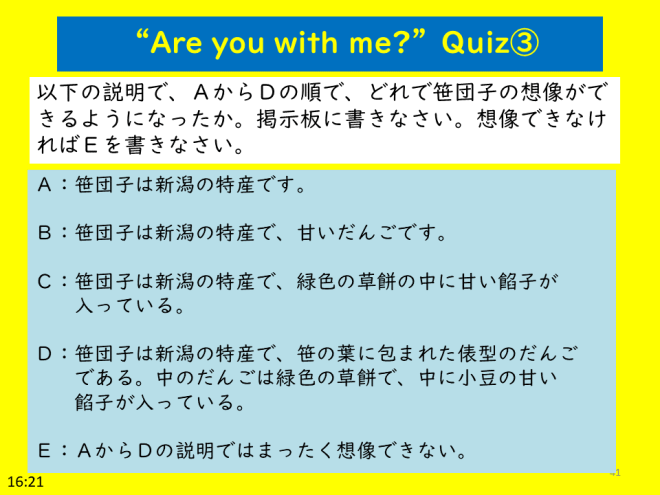
– 3rd Quiz; 24 students responded. This was a quiz but its purpose is to make the students understand the importance of detailed and concrete explanation. The question asked how much detailed explanation was needed until a student got the concept of “Sasa-dango” which is Niigata’s specialty. All the students answered that they figured out what it was like by the D that is shown in Figure 1 below.

– Attendance check at the end : 26 students responded.The students were asked to submit 5 answers that were asked during the class. The five quiz were given separately from three “Are-You-with-Me Quiz” above. Although I asked to sent it immediately after the class, 2 students sent to me 1 day or 2 days late. For those student, the half of the score was added to their gradings.

Teaching:

1st half:

– Review of the short test about particles.

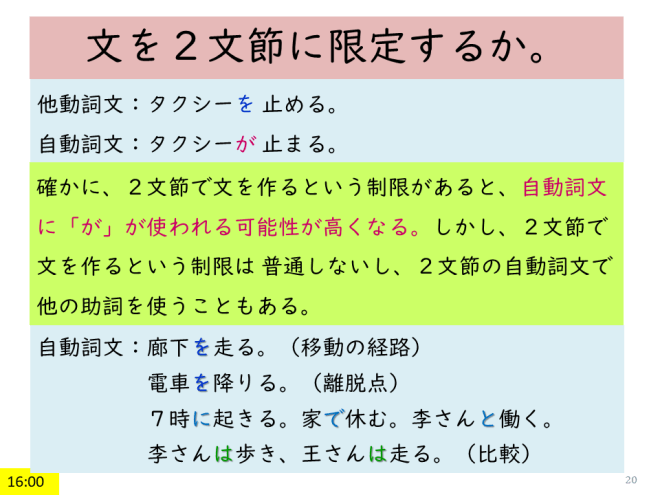
– Feedback about the second drafts of compositions “How to Use ‘-ga’ and ‘-o'”. I corrected students’ misunderstanding that ‘-ga’ is to be used in an intransitive verb predicate sentences. It is likely that ‘-ga’ is used in sentences of intransitive verb, but it is not always as shown in Figure2.

2nd half

– From the textbook; it was a little detailed word to word cautions.

– Explanations for the homework assignment.

Homework:

1: Write a short essay for student’s expression about an article.

2: Read part of a book about job seeking.

Issues and Problems:

<No time to write them right now>


i00324

Figure 1. How far an Explanation must be Done for Readers’ Understanding


i00325

Figure 2. Use of Particle “-ga” in Two-Segment Sentences

Online Teaching for Class 1939 (Listening) on Apr.27, 2020

Date: April 27th on Monday, 2020 from 9:50 to 11:20 (10:50 – 12:20 in JST)

Course: Japanese Listening 2

Used app: Streaming on DingTalk, Presentation by Powerpoint with 69 slides

Numbers of Students: 27

25 students stayed with me from the start to the end. Two students were recorded their shorter participation  with 87 and 84 minutes.

Students’ Responses:

– Attendance Check : All the 27 students typed his/her attendance by themselves on BBS

– Quiz 1 : 25 students answered. This question was to choose the correct endings for each noun, Na-adjective, I-adjective, and verb predicate sentences for present-assertive.

– Quiz 2: All the 27 answered. Question was about a negative sentence of I-adjective predicate with “tasty (Oishii)”. It was an easy question but an important one in order to avoid confusion with negative sentences of Na-adjective predicate.

– Quiz 3: 22 students answered. The question was to ask about conjugations of auxiliary verb “-youda” with pointing out a similarity with Na-adjectives. It is still too early for the first grade students to learn the auxiliary verbs. So my purpose was not there. I wanted the students to know that Da turns to be Na for modifying a noun, and Da turns to be Ni for modifying a verb.

– Quiz at the End: 24 students typed their own sentences in which an adjective conjugated to modify a verb as an adverbial.

Teaching:

1: Review of sentences of comparison

– “Noun1” is more “Adjective” than “Noun2”

– Question: Which of the “Noun1” and “Noun2” is more “Adjective”?

– Answer: Noun is more Adjective.

2: Introduction of Adjectives’ conjugations to modify a verb

– I- and Na- adjectives modifies a verb “-suru” that is a transitive verb like “do” in English.

Homework Assignment:

– No Homework.

Issues and Problems:

Two things happen simultaneously in the section 17 of the textbook. One is adjectives’ conjugations to modify a verb as an adverbial. The second thing is that an attention needs to be paid the difference between the intransitive verb “Naru” and the transitive verb “Suru”. It seems that some students couldn’t get these basic concepts of Japanese grammar.

Online Teaching for Class 1837 (Conversation) on Apr.27, 2020

Date: April 27th on Monday, 2020 from 8:00 to 9:30 (9:00 – 10:30 in JST)

Course: Japanese Conversation 4

Used app: Streaming on DingTalk, Presentation by Powerpoint with 60 slides

Numbers of Students: 22 out of 28, Number of completely absent was 6

Fully attendant for 90min : 17

Shorter signing-in: 79*2, 67, 59 minutes, and the shortest was 19 seconds.

Responses onto the BBS:

– Attendance check by a student his/herself: 25. Of these, three students were recorded as completely absent by the system.

– 1st Quiz: 15 students responded. The quiz was to measure students’ understanding about the listenin material.

– 2nd Quiz:17 students responded. The question was to choose the correct use of the conditional conjunctive particle “-tara” and “-to”. When the students started typing their answers, they were referring to what the first and second students had typed on BBS. Actually those answers “B” were not correct. When about half students typed their erroneous answer “B”, then one student typed the correct answer “A”. Then the last half students typed “A”. It was a simple thing. Most of them didn’t think of answers by themselves. But I thought the student who typed “A” first thought of her answer herself. So I sent a message to praise her courage after the class.

– Attendance check at the end: 21 students responded. It is my fault that I left yesterday’s the-last-quiz unchanged because I have not enough time to check whole through my lengthy power-point slides. However, this quiz was also important to check participation of the students to online class, therefore I asked the students to type their answers.

Teaching: 

– Listening to a conversation between two part time job workers.

– Review and exercise of a little formal negation “-zuni”.

– Exercise of “-ba” and “-nara”

– Listening comprehension of conversation using “-ba” and “-nara”.

– Introduction of a conditional conjunctive particle “-to”.

Homework Assignment:

Since there would be 10 days by the next class, more homework was assigned than usual.

-1 : Small test of the section 13 of the textbook.

-2 : Completing three conversation scripts by filling words.

-3 : Listening and reading aloud the script of two part time job workers.

Issues and Problems:

I had two classes in the day. I didn’t have enough time to prepare for this class, although I started at 3 a.m. and worked by the start of the class at 9 a.m. (in Japan standard time). In order to fill the less teaching material of powerpoint slides, I inserted a listening material from Min’nano Nihongo. That was a conversation in the section 35, which uses the conditional conjunctive particles “-ba” and “-nara”. It, somehow, worked. If I were a seasoned teacher, I would have had enough teaching material that can kill the time. But  I am not. Until I have had enough stock of teaching material, my hard working style through the night will continue.