
Online Teaching for Class 1939 (Listening) on Apr.27, 2020

Date: April 27th on Monday, 2020 from 9:50 to 11:20 (10:50 – 12:20 in JST)

Course: Japanese Listening 2

Used app: Streaming on DingTalk, Presentation by Powerpoint with 69 slides

Numbers of Students: 27

25 students stayed with me from the start to the end. Two students were recorded their shorter participation  with 87 and 84 minutes.

Students’ Responses:

– Attendance Check : All the 27 students typed his/her attendance by themselves on BBS

– Quiz 1 : 25 students answered. This question was to choose the correct endings for each noun, Na-adjective, I-adjective, and verb predicate sentences for present-assertive.

– Quiz 2: All the 27 answered. Question was about a negative sentence of I-adjective predicate with “tasty (Oishii)”. It was an easy question but an important one in order to avoid confusion with negative sentences of Na-adjective predicate.

– Quiz 3: 22 students answered. The question was to ask about conjugations of auxiliary verb “-youda” with pointing out a similarity with Na-adjectives. It is still too early for the first grade students to learn the auxiliary verbs. So my purpose was not there. I wanted the students to know that Da turns to be Na for modifying a noun, and Da turns to be Ni for modifying a verb.

– Quiz at the End: 24 students typed their own sentences in which an adjective conjugated to modify a verb as an adverbial.

Teaching:

1: Review of sentences of comparison

– “Noun1” is more “Adjective” than “Noun2”

– Question: Which of the “Noun1” and “Noun2” is more “Adjective”?

– Answer: Noun is more Adjective.

2: Introduction of Adjectives’ conjugations to modify a verb

– I- and Na- adjectives modifies a verb “-suru” that is a transitive verb like “do” in English.

Homework Assignment:

– No Homework.

Issues and Problems:

Two things happen simultaneously in the section 17 of the textbook. One is adjectives’ conjugations to modify a verb as an adverbial. The second thing is that an attention needs to be paid the difference between the intransitive verb “Naru” and the transitive verb “Suru”. It seems that some students couldn’t get these basic concepts of Japanese grammar.
Online Teaching for Class 1939 (Listening) on Apr.26, 2020

Date: April 26th on Sunday, 2020 from 9:50 to 11:20 (10:50 – 12:20 in JST)

Course: Japanese Listening 2

Used app: Streaming on DingTalk, Presentation by Powerpoint with 54 slides

Numbers of Students: 27

26 students stayed with me from the start to the end. One student is recorded his?her shorter attendance of 79 minutes.

Students’ Responses:

– Attendance Check : All the 27 students typed his/her attendance by themselves on BBS

– Quiz 1 : 23 students answered. This question was to ask if “Adj1 to Adj2” is right or not. This is not right. Two nouns can be stated in the form of ‘N1 to N2’, but two adjectives cannot be stated as ‘Adj1 to Adj2’.

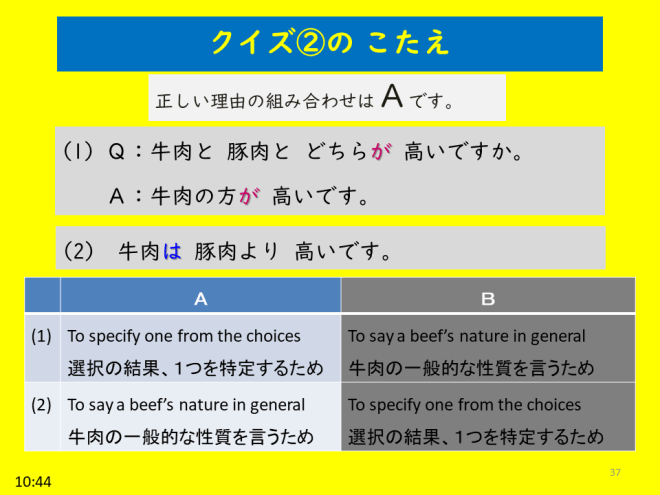
– Quiz 2: 24  answered. Question was about “Wa-ga conflict”. Japanese learner is always confused by selection of particles, “-wa” or “-ga”. In this question, the sentence (1) uses “-ga” and the sentence (2) uses “-wa” as shown in Figure 1 below. 6 students got the right answer A, 18 got the wrong answer B. It seems still difficult to learn that “-ga” is exclusively picking up a word, while “-wa” is for stating a nature of the word that had already been recognized by both speaker and listener.

– Quiz at the End: 23 students typed a sentence that meant “[Noun1] is more [Adjective] than [Noun2]” (of course in Japanese).

Teaching:

1: Review of Grammatical Topics of the first half of Section 16 of the Textbook

– “-no” that makes an adjective a kind of noun

– Conjunctive particle “-kara” for stating a reason.

–  Introduction of sentences to say capability

– “-noda/nda” for explaining and/or revealing

– Auxiliary verb “-tai” to express one’s wish

– “-to” that is putting between the thoughts and a verb for thinking

2:  Sentences for comparison

3: Redo of listening activities of the last class and Today’s new ones.

Homework Assignment:

– Homework was not assigned during the class because I didn’t have time before the coming holidays. It was noticed to the students that I would give them homework in the following day, 27th (But I couldn’t).

Issues and Problems:

This is a listening course. I play the listening materials of the textbook, make the students think of answers, and then show them the answers. However, I am suspicious about the effectiveness of this teaching style for learning Japanese. It seems like the students’ understanding is not good as I expected. One way to improve the effectiveness would be to make the students make their own Japanese sentences as utterance. I am looking for a better way to do this. As part of this, I ask the students to make his/her own sentence at the end of the class. It seems like to help me find a misunderstanding of a particular student.


i00323

Figure.1 The Reasons for Use of “-ga” and “-wa” (Particularly for this Case)

Online Teaching for Class 1837 (Composition) on Apr.24, 2020

Date: April 24th on Friday, 2020 from 8:00 to 9:30 (9:00 – 10:30 in JST)

Course: Japanese Basic Composition 2

Used app: Streaming on DingTalk, Presentation by Powerpoint with 68 slides

Numbers of Students: 26 out of 28

90 minutes attendance: 18 students

Shorter participation: 74, 66, 52, 51, 49, 36, and 2 minutes, and the shortest was 8 seconds.

completely absent: 2 students

Responses to my requests like Quiz answers onto BBS:

Attendance check: 26. But, of these, two students were recorded as “Completely Absent” on the system. Two students indicated coming late.

Quiz 1 : 21 students responded. The question was to ask correct stroke order of hiragana “NA”. 19 were right and 2 were wrong.

Quiz 2: 22 responses. The same question was given as class 1836 on April 21st.

Quiz3: 21 students responded. The same question was given as class 1836 on April 21st.

Attendance check at the end of class: the students were asked to submit 5 answers for the questions during the class.


Teaching:

The same as composition class for 1836 on Tuesday. However, the quiz of 5 questions resulted in differently. The four questions were to measure how the students understood the poem “Yuugata-no Sanjippun” well. As opposed to my expectation, many errors happened to class 1837 students more than 1836. So far I don’t know the reason.


Homework:

It was planned to make the student write the second draft of memorandum about how to use particles “-ga” and “-o”. However, I was too busy to give them instructions for the second drafting, assigning the homework was suspended.

Issues and Problems:

<No time to write them>

Online Teaching for Class 1836 (Composition) on Apr.21, 2020

Date: April 21st on Tuesday, 2020 from 15:30 to 17:00 (16:30 – 18:00 in JST)

Course: Japanese Basic Composition 2

Used app: Streaming on DingTalk, Presentation by Powerpoint with 67 slides

Numbers of Students: 28

23 students participated for whole 90 minutes.

5 students were recorded for their short attendances: 86, 85*2, 84, 53 minutes

Responses to my requests like Quiz answers onto BBS:

– Attendance check by reporting his/her-selves: 27. One student came late recorded 84 minutes participation.

– 1st Quiz: 20 students responded. This was to ask the stroke order of Hiragana “NA”. 19 students answered that they were using the right stroke order (I am suspicious), only one student reported using wrong one honestly.

– 2nd Quiz: 24 students responded immediately. One student posted his answer 7 minutes late, which indicated that he was not with the class at time of quiz No.2. This was to ask the right conjugations of eight verbs that were the form preceding another conjugate words.

– 3rd Quiz; 20 students responded. The question was to check students’ understanding for exceptional use and meaning of I-adjectives “near (chikai)” and “far (to’oi)”.

– Attendance check at the end : 20 students responded. During class another series of quiz was done with 5 questions. Submitting five answers right after the class was asked to the students as an attendance check at the end of the class.


Teaching:

1st half:

– The students were warned about plagiarizing from others’ writing to their composition.

– Reading and comprehension of a famous poem “30 minutes in the early evening (Yuugata-no Sanjippun)”. Four questions were asked to the students in order to measure their understanding the poem.

2nd half

– From the textbook; connecting two clauses in order to write a longer sentence by the conjugation form when the word was preceding another conjugation words.

Homework:

1: Rewriting their memo about the uses of particles “-ga” and “-o”.

Issues and Problems:

It is necessary to teach the importance of copyright and proper ways of citation and reproduction. The students are still unaware that it is unacceptable for them to steel someone’s writing and to use it for their compositions.

Online Teaching for Class 1939 (Listening) on Apr.22, 2020

Date: April 22th on Wednesday, 2020 from 8:00 to 9:30 (9:00 – 10:30 in JST)

Course: Japanese Listening 2

Used app: Streaming on DingTalk, Presentation by Powerpoint (58 slides)

Numbers of Students: 27

26 students stayed with me from the start to the end. One student is recorded his?her shorter attendance of 81minutes.

Students’ Responses:

– Attendance Check : All the 27 students typed his/her attendance on BBS

– Quiz 1 : 23 students answered. This question was to measure students’ understanding about a newly introduced phrase [V-masu] -ni Ikimasu that means the purpose of movement.

– Quiz 2: 24  answered. Questions are to ask the difference between I-adjective “-hoshii” and auxiliary verb “-tai”. The slide for the answer is shown below as Figure 1.

– Quiz3: 24 answered. This question was to make the students answer their own preferences. The question was using the construction of the day; which do you like, a dog or cat? 18 students answered that they like cat, and only 6 students liked a dog.

– Quiz at the End: 27 students typed a sentence for question “Which do you like, A or B?”.

Teaching:

1: Review of conversation for suggestion and invitation.

2:Grammatical Topics of the first half of Section 16 of the Textbook

– A noun “Hou” that specifies one of the two as a selection.

– “-no” that makes an adjective a kind of noun

– Conjunctive particle “-kara” for stating a reason.

– Introduction of sentences to say capability

– “-noda/nda” for explaining and/or revealing

– Clauses that modify a noun

– Auxiliary verb “-tai” to express one’s wish

– “-to” that is putting between the thoughts and a thinking verb

Of course these topics were not the things that can be taught in one or two hours. I just explain briefly. I know that it was not enough for students to even figure out the concepts of these issues.

Homework Assignment:

– Homework was not assigned during the class. Although I said that it would be given through the BBS, it depends on me.

Issues and Problems:

– I am just wondering whether or not it could be effective by just playing the listening materials of the textbook and making the students listen to it. I think I have to do something to make it more effective. But I don’t know how to do right now.


i00322

Figure.1 The Difference between “-hoshii” and “-tai”


Online Teaching for Class 1939 (Listening) on Apr.20, 2020

Date: April 20th on Monday, 2020 from 9:50 to 11:20 (10:50 – 11:20 in JST)

Course: Japanese Listening 2

Used app: Streaming on DingTalk, Presentation by Powerpoint (47 slides)

Numbers of Students: 27

25 students stayed with me from the start to the end. Two students were recorded with their shorter participation of 78 and 75 minutes.These students did not respond to any of four quiz during the class.

Students’ Responses:

– Attendance Check : All the 27 students typed “Shusseki” on BBS

– Quiz 1 : 24 students answered. The students were asked to find the right answer whose tense was appropriate related to time and the endings of a sentence.

– Quiz 2: 23 students answered. Question was to choose the right stroke order of Hiragana “NA” from two selections. 16 were right, 7 were wrong. However, maybe, some students write their “NA” in wrong order, but looking at other’s answer, they just answered as others did. Figure 1 below shows the slide to show the answer of this question.

– Quiz3: 22 students answered. This question was to find an intransitive verb from three selections. The answer could be reached by looking at particles.

– Quiz at the End: 25 students typed a phrases that meant “I went (to somewhere) to do something” in the form of “[Verb]-ni Ikimasu”. Two students mistakenly made phrases “[Noun]-ni Ikimsau”, but then they corrected.

Teaching:

1st Half: Review of the last class

– V-te Kudasai / V-nai de Kudasai ; To ask someone to do/ not to do something

– V1 nagara V2 suru : Two actions simultaneously or two occupations at the same time.

– To make verb phrase a noun phrase by putting “-no” right after the verb

– V(-masu)-ni Ikimasu : Purpose of going to somewhere

– Introduction of 4 usages of “V-teiru” in time sequence

2nd Half: Listening to Conversations of the textbook.

Homework Assignment:

No homework. The students were asked to study themselves.

Issues and Problems:

I prepared less PPT slides this time. However, some slides were left unused because of time.


i00321

Fig.1 Stroke Order of Hiragana “NA”

Online Teaching for Class 1837 (Composition) on April.17, 2020

Date: April 10th on Friday, 2020 from 8:00 to 9:30 (9:00 – 10:30 in JST)

Course: Japanese Basic Composition 2

Used app: Streaming on DingTalk, Presentation by Powerpoint with 82 slides

Numbers of Students: 27 out of 28

90 minutes attendance: 18 students

Shorter participation: 68, 41, 31, 29, 5, 5, 3, and 3 minutes, and the shortest was 3 seconds.

completely absence: 1 student

Responses to my requests like Quiz answers onto BBS:

Attendance check: 28. But one student were recorded as “Completely Absent” on the system.

Quiz 1 : 17 students responded. The question was to find an incorrect sentence from six sentences that had different words order. Actually there was no incorrect sentences, all the six sentences were correct. This question aimed at showing that there is a flexibility in words order in Japanese thanks to particles that indicate the function of a word.

Quiz 2: No student could make his/her response. Probably it was too difficult. I did not ask this question to class 1836 for the same reason. Everything was in Japanese, but let me write in English:

Question: which of A or B is described in the the following statement?

It is not clear if Ms.Hasegawa and Ms.Saito were confused each other, or these two were confused with other people.

A: I mistakenly thought Ms. Saito as Ms.Hasegawa.

B: I confused Ms.Hasegawa and Ms Saito.

This question was to show the verb “Machigaeru” needs not only a word with “-o” but also a word with “-to” to make a sentence have sufficient information.

Quiz3: 20 students responded. The question was to choose sentences that were more suitable to writing.

Teaching:

The same as composition class for 1836 on Tuesday. The first half was to give the students a feedback about the results of the last week’s homework assignment. It was a kind of test about particles. As I predicted, there were so many error caused by the influence of ‘”Wa-ga construction”.

The Second half was teaching using the textbook. It consisted review of last week and this week’s topic. The former was connecting two phrases to make a longer sentence, the latter was expressions that were more suitable for writing.

Homework:

1: Writing a composition about how to use the particle “-ga” and “-o”.

2: Writing sentences that a student made errors with for the last week’s homework.

Issues and Problems:

A huge problem with over generalization of Wa-ga Construction.

Online Teaching for Class 1939 (Listening) on Apr.15, 2020

Date: April 15th on Wednesday, 2020 from 8:00 to 9:30 (9:00 – 10:30 in JST)

Course: Japanese Listening 2

Used app: Streaming on DingTalk, Presentation by Powerpoint (52 slides)

Numbers of Students: 27

26 students stayed with me from the start to the end. One student is recorded his?her shorter attendance of 61minutes.

Students’ Responses:

– Attendance Check : All the 27 students typed his/her attendance on BBS

– Quiz 1 : 24 students answered. This question was to measure students’ understanding about listening materials. Most students sent wrong answers.

– Quiz 2: 25  answered. Questions are to check if the students know several usages of particle “-no” or not. The students were asked to choose a wrong usage of “-no” that was “-no” placed between an I-adjective and a noun.This error happens quite often for this country’s Japanese learners.

– Quiz3: 23 answered. This question was to ask what type of speech style was used in the conversation.

– Quiz at the End: 26 students typed a clause of “V1 nagara V2-masu”.

Teaching:

1: Review of conversation for suggestion and invitation.

2: Redo of two listening activities that were done in the last class. One was daily life of three persons, the other was talks travel experiences by three persons.

3: Preparation for the Section 15

– V-te Kudasai / V-nai de Kudasai

– V1 nagara V2

– Making a noun phrase from a verb phrase by placing “-no”

– To express the purpose of movement with “V(-masu) + ni + transferring verbs”

– Usages of Te-forms that appeared in section 15 of the textbook.

Homework Assignment:

– Writing “V-nai de Kudasai” and “V-te imasu” from dictionary forms.

Issues and Problems:

– This is a listening class. But the section 15 of the textbook includes a lot of important grammatical issues. It needs explanations in addition to listening activities that are needed most.

Online Teaching for Class 1836 (Composition) on Apr.14, 2020

Date: April 14th on Tuesday, 2020 from 15:30 to 17:00 (16:30 – 18:00 in JST)

Course: Japanese Basic Composition 2

Used app: Streaming on DingTalk, Presentation by Powerpoint with 82 slides

Numbers of Students: 28

22 students participated for whole 90 minutes.

5 students were recorded for their short attendances: 86, 81, 75, 36, 18minutes

1 students was completely absent.

Responses to my requests like Quiz answers onto BBS:

– Attendance check by reporting his/her-selves: 27.

– 1st Quiz: 18 students responded.

– 2nd Quiz: I decided not to do this because time was limited and it is a too difficult question.

– 3rd Quiz; 20 students responded. The question was to choose three sentences that are more suitable to writing style out of six.

– Attendance check at the end : 23 students responded. The question was to ask the functions of each particles; -wa, -ga, -o, -ni

Teaching:

1st half:

– Answers and review for quiz with 5 questions in the last class

– Importance of particles in Japanese

2nd half

– Review for the last class about connecting short sentences to make longer sentences.

– Connecting two clauses in order to write a longer sentence.

Homework:

1: Writing about usages of particles “-ga” and “-o”.

2: Rewriting sentences that had errors in last week’s homework.

Issues and Problems:

They will never learn hoe to use the particle “-o”. I realized that it is useless to teach them the importance of the particle “-o” which is a marker of an object that receives action of transitive verb. So I decided to make the students write their explanations about “-o”. For the sake of comparison, I thought it would be better to make them write about also the particle “-ga”.

Online Teaching for Class 1939 (Listening) on Apr.13, 2020

Date: April 13th on Monday, 2020 from 9:50 to 11:20 (10:50 – 11:20 in JST)

Course: Japanese Listening 2

Used app: Streaming on DingTalk, Presentation by Powerpoint (84 slides)

Numbers of Students: 27

24 students stayed with me from the start to the end. It seems that shorter participation is increasing; three students were recorded for their times as 82,74, and 72 minutes.

Students’ Responses:

– Attendance Check : All the 27 students typed “Shusseki” on BBS

– Quiz 1 : 27 students answered. This question was intended to know whether or not the students recognized that the man in the conversation was actually a suspicious guy.

– Quiz 2: 25  answered. Questions are to check if the students know or not the names of a cup of cold water, wet towel, and chop sticks in Japanese  restaurants.

– Quiz3: 24 answered. This question was to measure if students understand rough plot of the conversation or not.

– Quiz at the End: 26 students typed a sentence that meant “I am going to enjoy a party under the sakura flowers with my friends tomorrow”. One student missed particle “-o”.

Teaching:

1: Interrogative sentences of verbs predicate in past tense.

2: Listening to a Conversation for an invitation and making an appointment.

Homework Assignment:

Small test of particles “-ga”, “-o”, “-de”,”-ni”. Students are asked to fill blanks with particles in sentences. Deadline is 17th on Friday.

Issues and Problems:

It was difficult to conduct activities of conversation on line. I just imagine that the students are saying person B’s utterances while I speak as person A in a conversation.