
Online Teaching for Class 1939 (Listening) on Apr.26, 2020

Date: April 26th on Sunday, 2020 from 9:50 to 11:20 (10:50 – 12:20 in JST)

Course: Japanese Listening 2

Used app: Streaming on DingTalk, Presentation by Powerpoint with 54 slides

Numbers of Students: 27

26 students stayed with me from the start to the end. One student is recorded his?her shorter attendance of 79 minutes.

Students’ Responses:

– Attendance Check : All the 27 students typed his/her attendance by themselves on BBS

– Quiz 1 : 23 students answered. This question was to ask if “Adj1 to Adj2” is right or not. This is not right. Two nouns can be stated in the form of ‘N1 to N2’, but two adjectives cannot be stated as ‘Adj1 to Adj2’.

– Quiz 2: 24  answered. Question was about “Wa-ga conflict”. Japanese learner is always confused by selection of particles, “-wa” or “-ga”. In this question, the sentence (1) uses “-ga” and the sentence (2) uses “-wa” as shown in Figure 1 below. 6 students got the right answer A, 18 got the wrong answer B. It seems still difficult to learn that “-ga” is exclusively picking up a word, while “-wa” is for stating a nature of the word that had already been recognized by both speaker and listener.

– Quiz at the End: 23 students typed a sentence that meant “[Noun1] is more [Adjective] than [Noun2]” (of course in Japanese).

Teaching:

1: Review of Grammatical Topics of the first half of Section 16 of the Textbook

– “-no” that makes an adjective a kind of noun

– Conjunctive particle “-kara” for stating a reason.

–  Introduction of sentences to say capability

– “-noda/nda” for explaining and/or revealing

– Auxiliary verb “-tai” to express one’s wish

– “-to” that is putting between the thoughts and a verb for thinking

2:  Sentences for comparison

3: Redo of listening activities of the last class and Today’s new ones.

Homework Assignment:

– Homework was not assigned during the class because I didn’t have time before the coming holidays. It was noticed to the students that I would give them homework in the following day, 27th (But I couldn’t).

Issues and Problems:

This is a listening course. I play the listening materials of the textbook, make the students think of answers, and then show them the answers. However, I am suspicious about the effectiveness of this teaching style for learning Japanese. It seems like the students’ understanding is not good as I expected. One way to improve the effectiveness would be to make the students make their own Japanese sentences as utterance. I am looking for a better way to do this. As part of this, I ask the students to make his/her own sentence at the end of the class. It seems like to help me find a misunderstanding of a particular student.
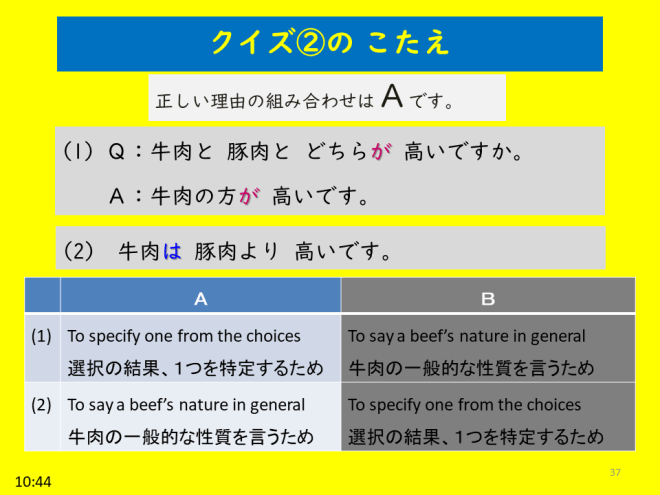
 

i00323

Figure.1 The Reasons for Use of “-ga” and “-wa” (Particularly for this Case)

Online Teaching for Class 1939 (Listening) on Apr.22, 2020

Date: April 22th on Wednesday, 2020 from 8:00 to 9:30 (9:00 – 10:30 in JST)

Course: Japanese Listening 2

Used app: Streaming on DingTalk, Presentation by Powerpoint (58 slides)

Numbers of Students: 27

26 students stayed with me from the start to the end. One student is recorded his?her shorter attendance of 81minutes.

Students’ Responses:

– Attendance Check : All the 27 students typed his/her attendance on BBS

– Quiz 1 : 23 students answered. This question was to measure students’ understanding about a newly introduced phrase [V-masu] -ni Ikimasu that means the purpose of movement.

– Quiz 2: 24  answered. Questions are to ask the difference between I-adjective “-hoshii” and auxiliary verb “-tai”. The slide for the answer is shown below as Figure 1.

– Quiz3: 24 answered. This question was to make the students answer their own preferences. The question was using the construction of the day; which do you like, a dog or cat? 18 students answered that they like cat, and only 6 students liked a dog.

– Quiz at the End: 27 students typed a sentence for question “Which do you like, A or B?”.

Teaching:

1: Review of conversation for suggestion and invitation.

2:Grammatical Topics of the first half of Section 16 of the Textbook

– A noun “Hou” that specifies one of the two as a selection.

– “-no” that makes an adjective a kind of noun

– Conjunctive particle “-kara” for stating a reason.

– Introduction of sentences to say capability

– “-noda/nda” for explaining and/or revealing

– Clauses that modify a noun

– Auxiliary verb “-tai” to express one’s wish

– “-to” that is putting between the thoughts and a thinking verb

Of course these topics were not the things that can be taught in one or two hours. I just explain briefly. I know that it was not enough for students to even figure out the concepts of these issues.

Homework Assignment:

– Homework was not assigned during the class. Although I said that it would be given through the BBS, it depends on me.

Issues and Problems:

– I am just wondering whether or not it could be effective by just playing the listening materials of the textbook and making the students listen to it. I think I have to do something to make it more effective. But I don’t know how to do right now.


i00322

Figure.1 The Difference between “-hoshii” and “-tai”


Online Teaching for Class 1939 (Listening) on Apr.20, 2020

Date: April 20th on Monday, 2020 from 9:50 to 11:20 (10:50 – 11:20 in JST)

Course: Japanese Listening 2

Used app: Streaming on DingTalk, Presentation by Powerpoint (47 slides)

Numbers of Students: 27

25 students stayed with me from the start to the end. Two students were recorded with their shorter participation of 78 and 75 minutes.These students did not respond to any of four quiz during the class.

Students’ Responses:

– Attendance Check : All the 27 students typed “Shusseki” on BBS

– Quiz 1 : 24 students answered. The students were asked to find the right answer whose tense was appropriate related to time and the endings of a sentence.

– Quiz 2: 23 students answered. Question was to choose the right stroke order of Hiragana “NA” from two selections. 16 were right, 7 were wrong. However, maybe, some students write their “NA” in wrong order, but looking at other’s answer, they just answered as others did. Figure 1 below shows the slide to show the answer of this question.

– Quiz3: 22 students answered. This question was to find an intransitive verb from three selections. The answer could be reached by looking at particles.

– Quiz at the End: 25 students typed a phrases that meant “I went (to somewhere) to do something” in the form of “[Verb]-ni Ikimasu”. Two students mistakenly made phrases “[Noun]-ni Ikimsau”, but then they corrected.

Teaching:

1st Half: Review of the last class

– V-te Kudasai / V-nai de Kudasai ; To ask someone to do/ not to do something

– V1 nagara V2 suru : Two actions simultaneously or two occupations at the same time.

– To make verb phrase a noun phrase by putting “-no” right after the verb

– V(-masu)-ni Ikimasu : Purpose of going to somewhere

– Introduction of 4 usages of “V-teiru” in time sequence

2nd Half: Listening to Conversations of the textbook.

Homework Assignment:

No homework. The students were asked to study themselves.

Issues and Problems:

I prepared less PPT slides this time. However, some slides were left unused because of time.


i00321

Fig.1 Stroke Order of Hiragana “NA”

Online Teaching for Class 1939 (Listening) on Apr.15, 2020

Date: April 15th on Wednesday, 2020 from 8:00 to 9:30 (9:00 – 10:30 in JST)

Course: Japanese Listening 2

Used app: Streaming on DingTalk, Presentation by Powerpoint (52 slides)

Numbers of Students: 27

26 students stayed with me from the start to the end. One student is recorded his?her shorter attendance of 61minutes.

Students’ Responses:

– Attendance Check : All the 27 students typed his/her attendance on BBS

– Quiz 1 : 24 students answered. This question was to measure students’ understanding about listening materials. Most students sent wrong answers.

– Quiz 2: 25  answered. Questions are to check if the students know several usages of particle “-no” or not. The students were asked to choose a wrong usage of “-no” that was “-no” placed between an I-adjective and a noun.This error happens quite often for this country’s Japanese learners.

– Quiz3: 23 answered. This question was to ask what type of speech style was used in the conversation.

– Quiz at the End: 26 students typed a clause of “V1 nagara V2-masu”.

Teaching:

1: Review of conversation for suggestion and invitation.

2: Redo of two listening activities that were done in the last class. One was daily life of three persons, the other was talks travel experiences by three persons.

3: Preparation for the Section 15

– V-te Kudasai / V-nai de Kudasai

– V1 nagara V2

– Making a noun phrase from a verb phrase by placing “-no”

– To express the purpose of movement with “V(-masu) + ni + transferring verbs”

– Usages of Te-forms that appeared in section 15 of the textbook.

Homework Assignment:

– Writing “V-nai de Kudasai” and “V-te imasu” from dictionary forms.

Issues and Problems:

– This is a listening class. But the section 15 of the textbook includes a lot of important grammatical issues. It needs explanations in addition to listening activities that are needed most.

Online Teaching for Class 1939 (Listening) on Apr.13, 2020

Date: April 13th on Monday, 2020 from 9:50 to 11:20 (10:50 – 11:20 in JST)

Course: Japanese Listening 2

Used app: Streaming on DingTalk, Presentation by Powerpoint (84 slides)

Numbers of Students: 27

24 students stayed with me from the start to the end. It seems that shorter participation is increasing; three students were recorded for their times as 82,74, and 72 minutes.

Students’ Responses:

– Attendance Check : All the 27 students typed “Shusseki” on BBS

– Quiz 1 : 27 students answered. This question was intended to know whether or not the students recognized that the man in the conversation was actually a suspicious guy.

– Quiz 2: 25  answered. Questions are to check if the students know or not the names of a cup of cold water, wet towel, and chop sticks in Japanese  restaurants.

– Quiz3: 24 answered. This question was to measure if students understand rough plot of the conversation or not.

– Quiz at the End: 26 students typed a sentence that meant “I am going to enjoy a party under the sakura flowers with my friends tomorrow”. One student missed particle “-o”.

Teaching:

1: Interrogative sentences of verbs predicate in past tense.

2: Listening to a Conversation for an invitation and making an appointment.

Homework Assignment:

Small test of particles “-ga”, “-o”, “-de”,”-ni”. Students are asked to fill blanks with particles in sentences. Deadline is 17th on Friday.

Issues and Problems:

It was difficult to conduct activities of conversation on line. I just imagine that the students are saying person B’s utterances while I speak as person A in a conversation.

Online Teaching for Class 1939 (Listening) on Apr.8, 2020

Date: April 8th on Wednesday, 2020 from 8:00 to 9:30 (9:00 – 10:30 in JST)

Course: Japanese Listening 2

Used app: Streaming on DingTalk, Presentation by Powerpoint (75 slides)

Numbers of Students: 27

26 students stayed with me from start to the end. One student was recorded 61minutes duration.

Students’ Responses:

– Attendance Check : All the 27 students typed “Shusskei” on BBS

– Quiz 1 : 22 students typed their answers.

– Quiz 2 at the End: 27 students typed a sentence that meant “What time did you get back home last night?”. Three students dropped the word “back home”.

Teaching:

1: Review of the last class;

2: Prep. for Section 14 of the textbook.

3: Mondai I and II of the section 14

Actually I didn’t get the purpose or intention of the section 14. I just thought that it would be to teach verb predicate sentences in past tense.

Homework Assignment:

No homework was assigned to the students. I didn’t have enough time to evaluate students’ homework.

Issues and Problems:

It was just a one way teaching using PPT slide show. There was hardly interactive communication between students and a teacher. Online teaching is not a good thing.

Online Teaching for Class 1939 (Listening) on Apr.1, 2020

Date: April 1st on Wednesday, 2020 from 8:00 to 9:30 (9:00 – 10:30 in JST)

Course: Japanese Listening 2

Used app: Streaming on DingTalk, Presentation by Powerpoint (86 slides)

Numbers of Students: 27

All 27 students stayed with me from start to the end.

Students’ Responses:

– Attendance Check : All the 27 students typed “Shusskei” on BBS

– Quiz 1 : 25 students typed their answers. Actually 21 answers were incorrect. 4 students revised their answers to correct.

– Quiz 2 at the End: 26 students typed the correct answer “-ni”. This was to ask a particle that fill blanks of three sentences. “-Ni’ is the answer for those three for functions of;

1: Time of action, 2: Destination that the movement is heading toward, and 3: Place of existence.

Teaching:

1: Review of the last class;

– How to use two adjectives

– Types of verbs:  Transitive v.s Intransitive verbs, Combination of a verb and particles, and especially putting emphasis on combination between transitive verbs and particle”-o”.

2: Listening Mondai3

I introduced a double meanings of “Iidesu”

3: Listening of conversation

Students memorization was promoted by increasing blanks on the script. Additional rote training of particles that fit into between objects and verb.

Homework Assignment:

Reading aloud conversation script twenty times, although there would be no evidence whether a student did or did not do this homework.

Issues and Problems:

It may be too early to teach the first grade students at this moment about how to connect two adjectives.

日语视听说1:12月11号(1939),12号(1938)

This is to inform 1st grade students about homework assignment of the listening course. You need to do the following by the next class on December 18th or 19th.

Homework Assignment (作业)

We will learn 9-2 in the next week.

(1) Listen to the track 9-2-00 that is “Kiku-mae-ni” on page 124 of section 9-2.

Note that audio says “Kiku” between “Nihongo” and “Nomu”, although “Kiku” does not appear on the textbook.

(2) Do 一、二、and 三 on page 124 through 126 of the section 9-2.

The audio has some problems. Please note the following when listening to it.

二、1. Two subjects of the sub and the main clauses are different. They are “fireworks” for the sub and “I” for the main clauses. Note that, in most of the case, it sounds incompletely if the sub and main subjects are not the same when they are connected by Te-form of the verb in the sub clause (“-atte”, in this case).

  1. The conversation is politically incorrect. Calling soccer men’s sport is unacceptable.
  1. Quite ugly conversation.
  1. The man says “Oshaberi-wo shi-tari”. In standard Japanese textbook, the “verb-tari” construction uses “tari” twice, not once like in this conversation.

三、2. It is very bad because the lady insults the man by saying “It is rare for you to read a textbook”.

日语视听说1:12月4号(1939),5号(1938)

This is to inform 1st grade students about homework assignment of the listening course. You need to do the following by the next class on December 11th or 12th.

Homework Assignment (作业)

LET US SKIP SECTIONS 8-1 AND 8-2. MOVE ON TO SECTION 9-1.

We will do only 9-1 in the next week.

<1> Listen to the track 9-1-00 that is “Kiku-mae-ni” on page 118 of section 9-1.

<2>Do 一、二、and 三 on page 118 through 120 of the section 9-1.

Note: The audio of our text book has some problems. Please note the following.

二、1. “Masenka” is better than “Mashouka” when suggesting others to do something together.

二、2. Speech style is completely broken. “Desu-masu style” and overly friendly expressions are mixed up. Always mind that Japanese speech style is strongly controlled by situation and relation.

二、3. The lady should say “gurai-desu” instead of “gurai-kana” for the same reason as above for 二、2.

二、4. Also for the same reason, the lady should avoid using “-kamone” for the ending. Another issue is that this textbook uses “Liyong” too many times. Think this as the first language interference. As a beginner of Japanese, you need to learn Japanese words ”和語” instead of relying on “漢語”.

三、4. This also has a problem with speech style. When a mother and a young child talk each other, they never use “Desu-masu style”.

日语视听说1:11月27号(1939),28号(1938)

This is to inform 1st grade students about homework assignment of the listening course.

Homework Assignment (作业)

You need to do the following by the next class on December 4th or 5th.

(1) Listen to the track 7-1-00 that is “Kiku-mae-ni” on page 88 of section 7-1. Please note that some of Japan’s national holidays have changed.

(2) Do 一、二、and 三 on page 89 through 91 of the section 7-1.

(3) Listen to the track 7-2-00 that is “Kiku-mae-ni” on page 95 of section 7-2.

(4) Do 一、二、and 三 on page 95 through 97 of the section 7-2.