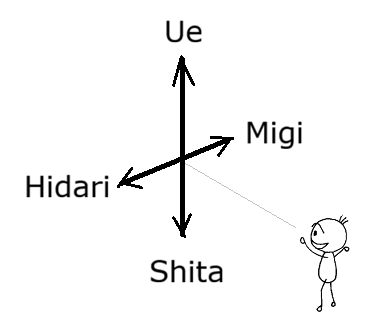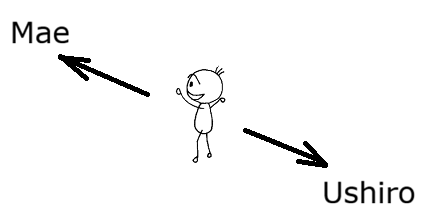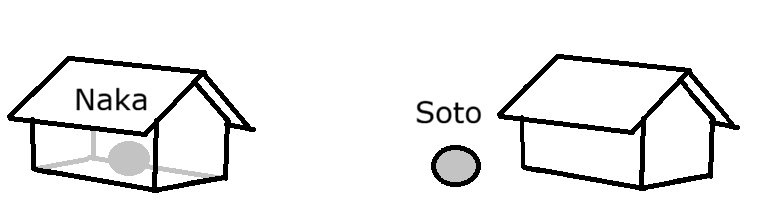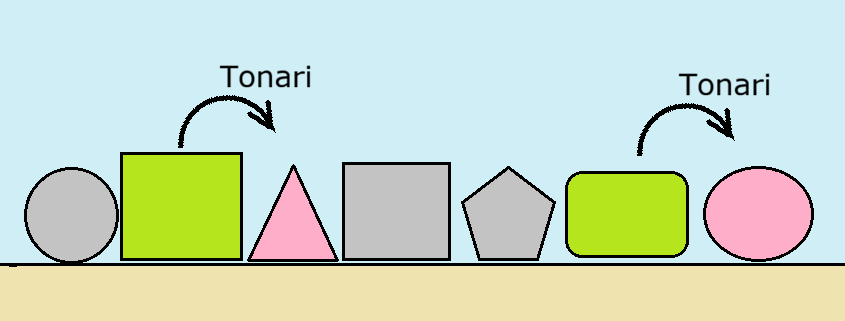
Japanese Learning: How to choose Pronouns “Kore”, “Sore”, or “Are”.

Kore, Sore, and Are are pronouns and one of the word groups of “Ko-So-A words”.

– Kore : a thing very near to the speaker and the listener

– Sore : a thing a little distant from the speaker but very near to the listener

– Are : a thing far from both of the speaker and the listener

How the person A and B would choose “Kore”, “Sore”, or “Are”? Think about them from Q1 to Q4.

Q1 : Ringo is “an apple”

A : { Kore or Sore or Are } wa nan desuka.

B : { Kore or Sore or Are } wa ringo desu.


Q2 : Banana is “a banana”

A : { Kore or Sore or Are } wa nan desuka.

B : { Kore or Sore or Are } wa banana desu.


Q3 : Sakana is “a fish”

A : { Kore or Sore or Are } wa nan desuka.

B : { Kore or Sore or Are } wa sakana desu.


Q4 : Tori is “a bird”

A : { Kore or Sore or Are } wa nan desuka.

B : { Kore or Sore or Are } wa tori desu.


The answers for Q1 through Q4 will be shown tomorrow.

Japanese Learning: Pronoun “Sore”; A speaker calls a thing “Sore” which is on a listener’s side.

Yesterday we learned “Kore”. Kore, Sore, and Are are pronouns and one of the word groups of “Ko-So-A words”. Yesterday I wrote that Kore, Sore, and Are are corresponding to “This”, “It”, and “That”, respectively. Another definition is like; Kore is a thing here or near, Sore is a thing in middle distance, Are is a thing that is in distant place. However, “Sore” is not so simple. If a speaker and a listener are together in limited space like inside taxi, the definition “Sore is in middle distance” is okay. But in many situations, what is Sore for a speaker can be Kore for a listener.

– Kore : a thing very near to the speaker and the listener

– Sore : a thing a little distant from the speaker but very near to the listener

– Are : a thing far from both of the speaker and the listener

Suppose that there is a dictionary on the table. Person A and B are standing by the table and they are face to face.

A : Kore wa nan desuka. (What is this?)

B : Kore wa Jisho desu. (This is a dictionary.)

This is yesterday’s conversation.

Different from the situation above, suppose that Person A and B are standing face to face with the distance of 2 meters (6 feet) between the two. The person B has a smartphone on her hand.

A : Sore wa nan desuka. (What is it?)

B : Kore wa Sumaatofon desu. (This is a smartphone.)

Japanese Learning: Interrogative form of Noun Predicate Sentences; [Noun1]wa [Noun2]desuka.

When trying to learn a construction of the second language, it is better to know three forms of the construction; Positive, Negative, and Interrogative forms. As for noun predicate sentences, these three forms are shown as below.

1. Positive form: [Noun1]wa [Noun2]desu.

2. Negative form: [Noun1]wa [Noun2]dewa arimasen.

3. Interrogative form: [Noun1]wa [Noun2]desuka.

It is very simple to make an interrogative sentence. You just put a particle “-ka” at the end of the sentence.

Please note that now we are talking about only “yes-no questions” for interrogative form. “Wh-questions” and “alternative questions” are not dealt with today.

So, “[Noun1]wa [Noun2]desuka.” is a “yes-no questions”. How do we answer to the question in Japanese? In general, yes is “Hai”, no is “Iie (in three moras; I-I-E)”, but be careful, “Hai”and “Iie” are not exactly the same as “yes” and “no”.

-Hai : What you are saying is right (The answer is not always followed by a positive expression)

-Iie : What you are saying is not right (The answer is not always followed by a negative expression)

Although this issue “yes-no and hai-iie are not the same” does not has to do with today’s examples, please note the difference between usages of yes-no and hai-iie.

Take a look at examples of yes-no questions and answers with “hai” and “Iie”. “Ja” is the short form of “Dewa”, in the following case means “Then”.

A : Koukousei desuka?

B : Iie, watashi wa koukousei dewa arimasen.

A : Ja, Daigakusei desuka?

B : Hai, Watashi wa Daigakusei desu.

You will find that two questions by A don’t use “Anata (you in English)”. “Anata(=you)” is a word often used when a wife calls her husband. So, use the word “Anata” sparingly, or avoid to use.

Japanese Learning: Present-Negative of Noun Predicate Sentence; [Noun1]wa [Noun2]dewa arimasen.

Japanese sentences are classified in three by the type of predicates;

1. Noun predicate sentences

2. Adjective predicate sentences (I-adjectives and Na-adjectives)

3. Verb predicate sentences

Today, too, we are going to learn “1. Noun predicate sentences”. Yesterday’s “[Noun1]wa [Noun2]desu.” is a positive sentence. A negative sentence is as follows;

[Noun1]wa [Noun2]dewa arimasen.

“Arimasen” is actually a negative form of a verb “aru/arimasu” that means something exists. However, now we are learning noun predicate sentences, not verb predicate sentences. Therefore, I recommend you just remember “dewa arimasen” like a one word. In conversations, “dewa arimasen” is usually contracted to be “ja arimasen”.

Let’s look at the sentence “[Noun1]wa [Noun2]dewa arimasen.”

-Noun1: a name of something.

-wa: this is the particle (post position) to indicate that preceding word is the topic of the sentence. When the topic and the subject are identical in the sentence, “-wa” can be a subject marker as well as topic marker.

-Noun2: a name of something.

-dewa arimasen (-ja arimasen): Being placed at the end of a sentence, this functions to make the sentence present-negative. This ending is polite. Do not use the short form “dewa nai (ja nai)” for an ending of the sentence because it sounds rude.

Let’s make a noun predicate sentence “[Noun1]wa [Noun2]dewa arimasen.” by putting real Japanese words.

Watashi: I (prenoun)

wa: topic marker (particle) — also subject marker in this case

Koukousei : a high school student. Although its spelling is “koukousei”, the pronunciation is like “Koh-koh-se-e”

dewa arimasen: present-negative, polite ending

Watashi wa Koukousei dewa arimasen. (I am not a high school student.)

「ら抜き」について:ある学生へのメッセージ

「ら抜き」とは、動詞の可能形から、「ら」を抜いてしまうことです。

可能形を見てみましょう。
辞書形 → 可能形です。

・一段動詞
(上一段)
見る:みる → みられる
着る:きる → きられる
(下一段)
寝る:ねる → ねられる
食べる:たべる → たべられる

・カ変動詞
来る:くる → こられる

・サ変動詞
する → できる

・五段動詞
ワ行:買う:かう → かえる
カ行:聞く:きく → きける
ガ行:泳ぐ:およぐ → およげる
サ行:話す:はなす → はなせる
タ行:持つ:もつ → もてる
バ行:飛ぶ:とぶ → とべる
マ行:飲む:のむ → のめる
ラ行:作る:つくる → つくれる

上に書いた可能形をよく見てください。「ら」があるのはどの動詞ですか?
・一段動詞
・カ変動詞
この2つです。この2つの可能形から「ら」を取って(抜いて)言うことが多くなっています。

「ら抜き」の例
・一段動詞
○みられる → ×みれる
○きられる → ×きれる
○ねられる → ×ねれる
○たべられる → ×たべれる
・カ変
○こられる → ×これる

このような「ら抜き」は、規範的な日本語としては、まだ認められていません。しかし、若者の間では「ら抜き」が一般的になっています。

ちょっと紛らわしいのですが、ラ行五段動詞の可能形は「ら」がありそうですが、ありません。
・作る → ○つくれる、×つくられる(可能形として)
・取る → ○とれる、×とられる(可能形として)
・帰る → ○かえれる、×かえられる(可能形として)
「ら」の入った方は、動詞や状況によりますが、受身や尊敬で使います。

受身や尊敬との関係で言えば、「ら抜き」は可能形と、受身・尊敬を区別するという効用があります。授業で示した例文は次のようでした。

例:日本から有名な先生が来られます。公開講義をしますから、来れる学生は参加しなさい。

「来られます」は先生に対する尊敬です。「来れる」は「ら抜き」ですが、可能を表します。このような効用がありますが、まだ「ら抜き」は正式には認められていません。しかし、「来れる」などの「ら抜き」は言いやすく、一般的になってしまったので、もう「来られる」に戻ることは難しいと思います。

以上、「ら抜き」の説明でした。

イ形容詞「いい」の変化

I-adjective “いい” consists from two letters of “い”.
The second letter conjugates (changes) as well as other I-adjectives. But the first letter also changes. Note that I-adjective “いい” came from “よい”.

1) The first letter “い” remains to be “い”
・今日は いい天気です。
 ・・・“いい” modifies the noun “天気”

・今日の天気は いいです。

・・・“いい” is the predicative.

2) The first letter “い” becomes “よ”

・今日の天気は よくないです。

・・・ Negative predicate in present tense

・昨日は 天気が よかったです。

・・・ Positive predicate in past tense

・天気がよくて、外で遊びました。

  ・・・ A kind of Te-form

・天気がよければ、外に出ます。

・・・ Conditional form

Therefore, “いい” turns to be the original “よい” in the cases of 2).

Morning Market in Niitsu, Niigata-shi, JAPAN

I like to go there. The morning market in Niitsu is held on the following days of a month. Niitsu is a town in Akiha-ward of Niigata city, JAPAN.

1st, 6th, 11th, 16th, 21st, and 26th days of a month, from 8:00 a.m. to noon

1st-6th day Morning Market in Niitsu, Niigata-shi, JAPAN

Of course I went to her shop to buy Kimchi.

Ms. Minami Yamashita’s Kimchi Shop

And I always go to papa’s&mom’s fruit shop near Yamashita-san’s Kimchi shop.

Fruits Shop in Niitsu Morning Market

Now it is no longer the season apple, I don’t see any good and reasonable apples in nearby supermarket. I had expected that his shop would be still selling apples.My expectation was right. His shop was selling the yellow apple “Shinano-Gold” which is a new apple with good balance of sweetness and sour taste. He was selling them with very reasonable prices because Shinano-gold apples have scratches and a little colored portions. They were usually not on the shelves in ordinary supermarkets.

Citrus fruits in Niitsu Morning Market

Flowers are being sold. If you plant those seedlings on your garden, you can enjoy the flowers from the day-1 without waiting to grow and for so long until winter comes.

Flower Seedlings in Niitsu Morning Market

Fishes are also being sold. I thinks one portion of squids is too much. Only a big family will be able to buy.

Fishes and Squids in Niitsu Morning Market

This small shop is selling vegetables and white collar flowers.

White Collar Flowers is being Sold with Vegetable

When it comes to Flowers, I asked this lady to make a flower bundle. Just before I left home, I was asked by my mom to buy the flowers to offer my dad.

Flower Shop in Niitsu Morning Market

So these are what I bought yesterday in the Niitsu Morning Market.

Chinese cabbage kimchi: 700-yen

Radish Kimchi: 500-yen

Shinano-Gold apple: 500-yen

Tribute Flowers: 1000-yen

Butterbur (Green Stems in the photo): 200-yen

2,900 JPY purchase in Niitsu Morning Market on June 6, 2020

An old lady told me how to cook the butterbur. I cooked as she told me, but I spent an hour to peel off them. I boiled them by soy sauce with small chips of ginger and red pepper.

Butterbur boiled wit Soy Sauce

Thanks for reading to the end.

山下南さんのキムチ。おいしいです。(新潟市秋葉区新津の周辺情報)

添加物、着色料いっさい無し。新鮮な天然素材のおいしいキムチはいかがですか。新潟県の新津、五泉、水原地区で山下南さんのキムチを買うことができます。白菜キムチ、大根キムチ、そしてキュウリのキムチの3種類です。

白菜キムチ

山下南さんのキムチは、次の場所と時間で買うことができます。

韓国食品 販売場所 (山下 南:やました みなみ)

 住所と電話番号は上の画像をご覧ください。

新津市場:1,6,11,16,21,26日 朝8時から12時まで

五泉市場:2,7,12,17,22,27日 朝8時から12時まで

水原市場:4,8,14,18,24,28日 朝8時から12時まで

ふるさと村:6月~10月まで毎週日曜日 朝6時から7時30分

直売所: 新鮮組(花夢里にいつ)0250-21-6633

     ベジらんどにいつ(下越病院となり)0250-21-1183

     朝9時から17時まで年中無休

新津の一六朝市での店舗。山下さんはノボリのうしろに隠れてしまいました。シャイなお方です。でも話しやすい人ですから、ぜひ朝市へ行って、キムチをお買い求めください。

大根のキムチ

この情報は2020年6月6日時点のものです。

新潟の中国料理店”鵬龍”に行きました-4

こんにちは。わたしは にほんじんです。49さいの おとこの ひとです。にいがたの ちゅうごく りょうりてん 「ほうりゅう(鵬龍)」へ いきました。みなさんに しょうかいします。ほんちょうの しょうてんがいの みなみがわに 青海ショッピングセンターが あります。「ほうりゅう」は 青海ショッピングセンターの いりぐちに あります。したの すうじを Google Mapsに にゅうりょく して ください。ばしょが わかります。

37.920115,139.046342

i265

めにゅー です。わたしは おみせの ひとに 「いちばん からい ラーメンは なんですか」と ききました。おみせの ひとは「しせんマーラーめん」だと いいました。わたしは「しせんマーラーめん」を ちゅうもんしました。

i266

四川マーラー麺です。

i267

おいしそうですね。

i268

めんは ふつうの ふとさ です。そんなに ちぢれて いません。

i269

にいがたの おみせの 「たべあるき」は これで おわりです。ほんちょういちばで ささだんごを うっている おばあさんが いました。5こ ほしかったです。でも、おばあさんは いいました「10こで 1000えんだよ」。やすいですね。わたしは ささだんごを 10こ かいました。

ばんだい橋を わたった ところで、しゃしんを とりました。にいがたの ばんだいばしと ささだんごは どちらも ゆうめいです。わたしの ふるさとは にいがたです。

i270

+++++++++++++++++++++++

ということで、鵬龍さんをもちまして、私の新潟島食べ歩きは終了しました。タイ料理のクワタイさんは新潟島の外ですが、距離的に近いので含めました。タイ料理といえば、関屋あるいは信濃町のタイファイタイフードさんでグリーンカレーを食べていないのが残念です。先日伺ったところ、休暇に入られたようでした。それから水餃子の食べ比べですが、結局安屋さんの水餃子は食べませんでした。安屋さんは、地元の方のお店であり、自分のようなきわめて一見さんに近い人間が行くのはどうかなあという気持ちもありました。Googleのレビューで見たのですが、お母さんの足が悪いので、食べ終わった器を自分で返却すると書いている人がいました。これを読んで、自分が情けなくなりました。足が悪そうだということは、私も気づきました。だけど、だったら自分にできることは何か、そこまで考えなかった自分の思い至らなさを恥じます。水餃子を食べた中国料理店のなかで、残念なことは;

i272

ハルピン餐庁さんが閉店しました。場所が悪く、お客さんはいつもだれもいませんでした。こちらの中国料理が大好きだったのに、残念です。閉店したばかりの頃でしょうか、私はそれと知らず、ヨーカドーでお店のお姉さんを見かけました。また行きますよ、と声をかけようと思ったのですが、それはせず、でもあとで考えたら、お店の時間にジャージ姿でヨーカドーにいるのも変な話なので、翌朝お店に行ってみたら、上の写真の通りでした。「貸店舗」の紙がシャッターに貼ってあります。もう一つ閉店といえば、

i271

「冬のソナタ」さんです。前はトラフグのお店だったのですね。イタリア軒の通りに面して、店内も明るくて入りやすい雰囲気だったのに、とても残念でした。新潟島がどんどんさびれていきます。寂しいことですが、庶民にはどうしようもありません。逃げ出す奴はけしからんといいたいところですが、私自身が逃げ出してしまいました。

最後のお店は鵬龍さんになりました。移動を考えると、お昼の営業で食べられるのが鵬龍さんだったので。こちらのご主人も中国の北の方から来られた方でした。人気メニューの広東麺を食べられなかったのが残念です。お店の繁盛をお祈りします。

萬代橋と笹団子を一緒の写真に撮ったおバカはおそらく私くらいだろうと自負しております。

新潟の韓国居酒屋「ドレミ」へ行きました。-4

こんにちは。わたしは にほんじんです。49さいの おとこの ひとです。にいがたの かんこく いざかや 「ドレミ」へ いきました。みなさんに しょうかい します。したの すうじを Google Mapsに にゅうりょく して ください。ばしょが わかります。

37.924266,139.044660

くらくて、 ちょっと はいり にくい ですね。でも とても いい おみせです。

i257

まず ビールと おとうしです。おや? ひだりに めずらしい ものが あります。

i258

「かに」です。

i259

こんな 小さい カニ、 わたしは はじめて たべました。からも あしも はさみも ぜんぶ そのまま たべることが できます。たべかけの アップの しゃしんです。ちょっと ぶれました。

i260

きょうは ちゅうもんに なやみました。でも キムチチゲと ごはんに しました。おさけも にはいめです。うめサワーです。

i261

キムチチゲのアップです。

i262

おさけは とうとう さんばいめ(三杯目)です。かんこくの おさけ マッコルリを のみました。おみせの ひとが いいました「きょうは たくさん のみますね」。わたしは いいました「ええ、じつは きょうが さいご なんです。だから おさけを たくさん のみます。」

i263

きょうで 「さよなら」ですから、おみせの ひとは わたしに かんこくの のりを くれました。ありがとうございます。みなさんも にいがたの かんこく いざかや 「ドレミ」へ いって、たくさん かんこくの りょうりを たべて ください。

i264

++++++++++++++++++++

お通しの沢ガニみたいなの、初めて食べました。マッコルリは普通、カメに入れて出してくれるようですが、それでは多すぎるので特別に一杯で注文したら、チューハイ用のグラスになみなみ入れて出してくれました。一枚目の写真にあるように、韓国居酒屋ドレミさんは、ちょっとわかりにくい所にあります。住所は以下です。

新潟県新潟市中央区西堀前通8番町1516-1 桂家ビル 1F

写真の上にあります緯度経度をGoogle mapsに入れていただければ、正確な場所が分かります。おじいさんには会えませんでしたが、にこやかなお母さん、南大門のお姉さんともども、末永くお店を続けてください。また会える日を楽しみにしています。