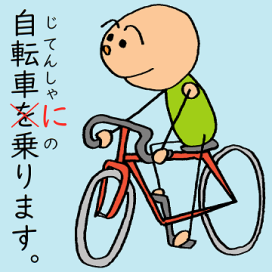
Since the exercises A2 and A3 are similar in terms of use of the combination of nominalizer “no” and particle “ni”. In A2, “-no+ni” phrase expresses a purpose of action of the predicate verb. In A3, the predicate expresses how much money or how long time it takes for accomplishing the “no+ni” phrase.
<1> An example of A2 sentence
1. Kono Pasokon wa Inta’anetto o Miru no ni Tsukai masu.
(I use this personal computer in order to browse the internet.)
<2> An example of A3 sentence
2. Kuruma o Kau no ni Nihyaku Man – en Kakari masu.
(Buying a car costs 2 million yen.)
where, Kakaru/Kakarimasu is an intransitive verb which means to take
When we look at A2 sentences and A3 sentences in macro perspective like;
[“no+ni” phrase] + [Predicate].
Saying [“no+ni” phrase] is important in the A2 sentences, while saying [Predicate] is slightly more important than [“no+ni” phrase] in the A3 sentences.
Other example sentences for A3are as below;
(1) How much money it costs;
1) [V-dic]+no+ni
3. Ryuugaku-Biza o Koushin-suru no ni Yon-man Hassen – en Kakari masu.
(In order to renew the international student visa, it costs 48,000 JPY.)
where, “Koushin-suru/Koushin-shimasu” is a transitive verb which means to “renew”.
2) [N] ni
4. Ryuugaku-Biza no Koushin ni Yon-man Hassen – en Kakari masu.
(For renewing the international student visa, it costs 48,000 JPY.)
“Koushin-suru” is a verb, but “Koushin” is a noun. Note that “Ryuugaku-Biza no Koushin” is in the form of “N1 no N2”.
(2) How long time it takes;
1) [V-dic]+no+ni
5. Kaisha e Iku no ni Ichi-jikan Kakari masu.
(In order for me to go to the office, it takes one hour.)
2) [N] ni
6. Tsuukin ni Ichi-jikan Kakari masu.
(It takes one hour for the commute.)
“Tsuukin” can be a verb in the form of “Tsuukin-suru”, but just “Tsuukin” is a noun.
Take a look at the sentences 2 and 6 again;
2. Kuruma o Kau no ni Nihyaku Man – en Kakari masu.
6. Tsuukin ni Ichi-jikan Kakari masu.
Do you find subjects in these sentences? Yesterday we learned that the subject and the predicate must be consistent in a sentence. The subject markers are particle “-wa” or “-ga”. Is there any word with “wa” or “ga”? Perhaps some people want to put “-ga” as shown below, but I don’t think it’s good.
2’. Kuruma o Kau no ni <Nihyaku Man – en ga> Kakari masu.
6’. Tsuukin ni <Ichi-jikan ga> Kakari masu.
The reason why I don’t think this is a good way to show the subject is that a number with quantifier is usually used without a particle because it works as an adverbial.
Let alone, words and phrases with the particle “ni” cannot be a subject because they are also adverbials that modify a verb behind. Therefore, if the subject should be stated in the sentences, it would be like the follows;
2’’. Kuruma o Kau no ni <Okane ga> Nihyaku Man – en Kakari masu.
6’’. Tsuukin ni <Jikan ga> Ichi-jikan Kakari masu.
Let us check the consistency between the subject and the predicate for these 2’’ and 6’’.
2’’=> [Okane ga]+[Kakari masu] => good
6’’=> [Jikan ga]+[Kakari masu] => good
But in most cases, when the predicate is “Kakari masu”, the listener can easily tell it costed some money or it takes some period of time. These [Okane ga] and [Jikan ga] can be omitted.
Anyway, it is good to look for a subject and a predicate in a sentence, and then once you have found them, to check the consistency between the subject and predicate. This procedure can improve your understanding about that particular sentence.
————————————–
This post was written with reference to the exercise A3 of Section42 in “Minna no Nihongo (2nd Edition)” published by “3A Corporation”

