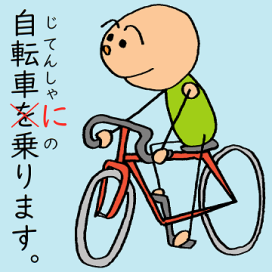
There is a very important issue when learning Japanese. But a textbook writer hardly writes it in the book explicitly, nor a teacher teaches well in the classroom. You have to choose the speech style properly in accordance with your listeners and the situation. If the level of learners is intermediate or higher, I would present four speech style; Rough, Friendly, Polite, and Honorific. But for beginners, I would tell learners to choose one of two speech style properly. They are casual and polite speech styles.
– Casual speech style: Use this style when talking to your friends. Ends of sentence take the forms of “short ending style” and often a friendly ending particles like “-yo.”, “-ne.”, and “-yone.” are attached at the end of the sentence.
– Polite speech style: Use this style when talking in public space like a school, company, station of the public transportation, and so on. Ends of sentence take the forms of “Desu-Masu style”.
If someone speaks in casual speech style where actually people should use polite speech style, his/her Japanese would sound rude. In worst case scenario, an error on selecting speech style would bring a serious consequence for foreign people. Therefore, a Japanese teacher must teach this speech style issue well, in order to prevent the learner from such a dangerous situation.
Most of Japanese sentences in Minna no Nihongo are written in polite speech style. So, it is safe for people from foreign country to speak to native Japanese speakers with what is written in Minna no Nihongo. Some exceptions are the section 20 which is to learn the short endings for sentences and the casual speech style. And also, the exercise A2 in the section 31 is introducing expressions that is to be used in casual speech style. It’s simple. It’s just to use a volitional form when telling your suggestion to people intimate to you, like friends.
The followings are examples of casual suggestions using Volitional form of verbs;
<Group 2 Verbs>
– Ashita, Roku-ji ni Okiyou. (Let’s get up at 6 tomorrow.)
– Isshoni Hiru-Gohan o Tabeyou. (Let’s have a lunch together.)
<Group 3 Verbs>
– Rainen mo Kono Umi ni Koyou. (Let’s come to this seashore again next year.)
– Kono Kouen o Sampo-shiyou. (Let’s walk this park.)
<Group1 Verbs>
Gr1-W : Uta o Utaou. (Let’s sing a song.)
Gr-K : Eki made Arukou. (Let’s walk to the station.)
Gr1-G : Pu’uru de Oyogou. (Let’s swim in the pool.)
Gr1-S : Nihongo de Hanasou. (Let’s talk in Japanese.)
Gr1-T : Basu o Matou. (Let’s wait for a bus.)
Gr1-B : Kono Kouen de Asobou. (Let’s play in this park.)
Gr1-M : Kono Hon o Yomou. (Let’s read this book.)
Gr1-R : Basutei made Hasirou. (Let’s run to the bus stop.)
So, the above suggestions using volitional form are to be used to your friend, because they are expressions in casual speech style. If the last one (Gr1-R) is changed to be expressions of polite speech style, it would be like follows;
A: Basutei made Hashirimasenka.
B: Hai, Hashirimashou.
————————————–
This post was written with reference to the exercise A2 on Section31 of “Minna no Nihongo (2nd Edition)” published by “3A Corporation”



 Agony or Fun?! Second Language Learning