First of all, quiz answers come first.
Q1: “Ni” should not be used for “senshuu”;
Senshuu, Hataraki mashita. (Last week, I worked.)
Q2: “Ni” should be used for “hachi-ji Juugo-fun”;
Hachi-ji Juu go-fun ni, Gakkou e Ikimasu. (I go to the school at eight fifteen.)
These days, we are studying “verb predicate sentences”. When you use a verb for the predicate, you need to choose the ending correctly. The ending is not “desu-type” but “masu-type”. The masu-type sentence ending has four variations;
– Present-positive => [verb] masu.
– Present-negative => [verb] masen.
– Past-positive => [verb] mashita.
– Past-negative => [verb] masen deshita.
The above four patterns are for predicate with politeness. Actually, verbs have more patterns not only for predicate but also for other usages for passive, hypothetical, modifying phrases, and so on. In other words, a verb conjugates. We won’t learn conjugations of verbs today, but I want you to know that verb conjugations are big issues in Japanese language.
Today’s main theme is introductions of transitive verbs and particle “o”. When an action works directly onto something (an object), the action is described by a transitive verb. And the object of the transitive verb needs to be marked with particle “o”.
The construction of a transitive verb sentence is as follows;
[Subject] wa [Object] o [Transitive verb] masu.
example: Watashi wa Yuugohan o Tabemasu. (I eat supper.)
Where;
– Yuugohan: noun; supper
– Tabemasu: transitive verb; eat
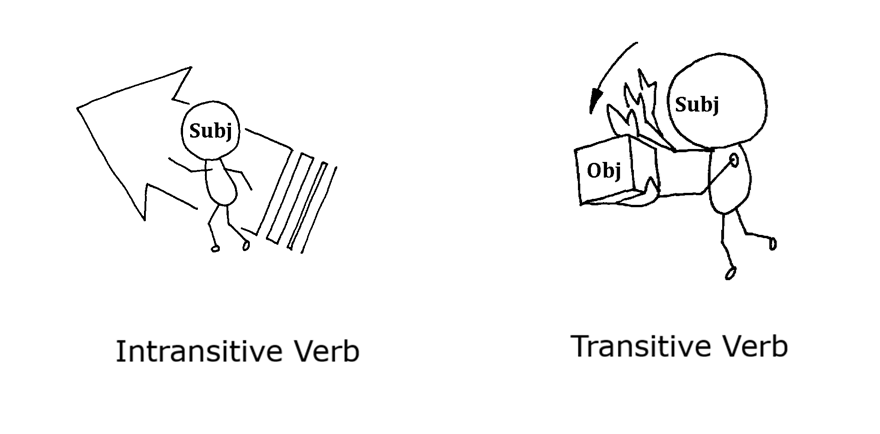
When you learn Japanese, you need to have a clear image of intransitive verb or transitive verb. Refer to the illustration below about the difference between intransitive verbs and transitive verbs.
Example:
Intransitive verb sentence; Watashi wa Gakkou e Ikimasu. (I go to the school.)
Transitive verb sentence; Watashi wa Yuugohan o Tabemasu. (I eat supper.)
 Agony or Fun?! Second Language Learning