
Japanese Learning: Difference between Wa-Ga Construction sentence and Transitive Verb predicate sentence

This series have explained “Wa-ga construction” for several days, because the Japanese textbook “Minna no Nihongo” is dealing with “Wa-ga construction” in Chapter 9. And it is not only an introduction of “Wa-ga construction”, also an introduction of particle “ga”. If you were introduced particle “ga” through “Wa-ga construction”, you might think that the particles “wa” and “ga” could coexist in a sentence. Yes, they can be in a sentence together if the sentence is Wa-ga construction, but most of the time you have to choose one of the two (wa or ga) for subject in a sentence.

1. Watashi wa Nihonjin desu. (I am Japanese.)

2. Watashi ga Nihonjin desu. (I am the person who is Japanese.)

In the both sentence 1 and 2, the subject is “Watashi”. But the subject marker in 1 is “wa”, while the subject marker in 2 is “ga”. How do you properly choose “wa” or “ga” for a subject? The exact explanation would be lengthy. For the simplicity, let me say as below.

– When the predicate is the important information, use “wa” for subject marker.

– When the subject itself is the important information, use “ga” for subject marker.

Anyway, sticking to “Wa-ga construction” would cause a huge damage on your sense about Japanese. The followings are quiz about Wa-ga construction sentences that use verbs for predicate and Verb predicate sentences. Choose “ga” or “o”. And answer the type of verb.

1. Watashi wa Okane { ga or o } arimasu. (I have money.)

   Type of verb? — { Intransitive or Mobile intransitive or Transitive }

2. Watashi wa Okane { ga or o } moraimasu. (I get money.)

   Type of verb? — { Intransitive or Mobile intransitive or Transitive }

3. Watashi wa Ie { ga or o } demasu. (I get out of my house.)

   Type of verb? — { Intransitive or Mobile intransitive or Transitive }

4. Watashi wa Imouto { ga or o } imasu. (I have a younger sister.)

   Type of verb? — { Intransitive or Mobile intransitive or Transitive }

5. Watashi wa Imouto ni Purezento { ga or o } agemasu. (I give a present to my younger sister.)

   Type of verb? — { Intransitive or Mobile intransitive or Transitive }

6. Watashi wa Yuugohan { ga or o } tabemasu. (I eat supper.)

   Type of verb? — { Intransitive or Mobile intransitive or Transitive }

Answers will be shown tomorrow.
Japanese Learning: How to make a transitive verb sentence interrogative; Asking what the object is or asking what the action is.

Yesterday, we learned verb predicate sentences that use transitive verbs and the particle “o”. A transitive verb expresses an action that exerts its effect onto an object directly. And the particle “o”, as the object marker, is attached to just behind the object. So, the sentence construction is as below;

1. [Subject] wa [Object] o [Transitive verb] masu.

example; Watashi wa Ocha o Nomi masu.

Where;

– Ocha: noun; tea

– Nomimasu: transitive verb; drink

Note that the order of words is different from transitive verb sentence of English.

English: [Subject] [Transitive Verb] [Object] — SVO

Japanese: [Subject wa] [Object o] [Transitive Verb] — SOV

How can we make a transitive verb sentence an interrogative sentence?

(1) Yes-No question

Put “ka” at the end of the sentence;

A : Satou-san wa Ocha o Nomi masuka. (Ms. Sato, do you drink tea?)

B : Hai, watashi wa Ocha o Nomi masu. (Yes, I drink tea.)

(2) Asking what the object is;

A : Satou-san wa Nani o Nomi masuka. (Ms. Sato, what do you drink?)

B : Watashi wa Mizu o Nomi masu. (I drink water.)

(3) Asking what the action is;

A : Satou-san wa Nani o Shimasuka. (Ms. Sato, what are you going to do?)

B : Watashi wa Koh’hii o Nomi masu. (I am going to drink a cup of coffee.)

In (3), the question uses verb “Shimasu”. Shimasu is a verb similar to the verb “do” in English. And most of the time “Shimasu” functions as a transitive verb, although occasionally it can be an intransitive verb (such a case will be explained later). It is interesting that even if the answer could use an intransitive verb, the question is “Nani o Shimasuka” which is obviously phrase of object and transitive verb. An example is as below

A : Satou-san wa Nani o Shimasuka. (Ms. Sato, what are you going to do?)

B : Watashi wa Gakko e Ikimasu. (I am going to the school.)

The verb “Ikimasu” is an intransitive verb.

<この投稿は“スリーエーネットワーク、みんなの日本語 初級I 第2版, 第6課A1とA2”の内容を参照しています。>

Japanese Learning: Introduction of transitive verbs that use the particle “o” for an object; [Object] o [Transitive verb] masu.

First of all, quiz answers come first.

Q1: “Ni” should not be used for “senshuu”;

Senshuu, Hataraki mashita. (Last week, I worked.)

Q2: “Ni” should be used for “hachi-ji Juugo-fun”;

Hachi-ji Juu go-fun ni, Gakkou e Ikimasu. (I go to the school at eight fifteen.)

These days, we are studying “verb predicate sentences”. When you use a verb for the predicate, you need to choose the ending correctly. The ending is not “desu-type” but “masu-type”. The masu-type sentence ending has four variations;

– Present-positive => [verb] masu.

– Present-negative => [verb] masen.

– Past-positive => [verb] mashita.

– Past-negative => [verb] masen deshita.

The above four patterns are for predicate with politeness. Actually, verbs have more patterns not only for predicate but also for other usages for passive, hypothetical, modifying phrases, and so on. In other words, a verb conjugates. We won’t learn conjugations of verbs today, but I want you to know that verb conjugations are big issues in Japanese language.

Today’s main theme is introductions of transitive verbs and particle “o”. When an action works directly onto something (an object), the action is described by a transitive verb. And the object of the transitive verb needs to be marked with particle “o”.

The construction of a transitive verb sentence is as follows;

[Subject] wa [Object] o [Transitive verb] masu.

example: Watashi wa Yuugohan o Tabemasu. (I eat supper.)

Where;

– Yuugohan: noun; supper

– Tabemasu: transitive verb; eat

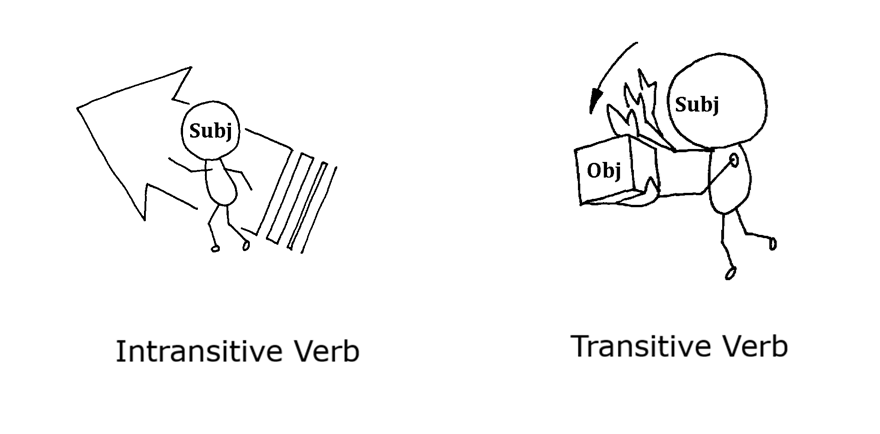
When you learn Japanese, you need to have a clear image of intransitive verb or transitive verb. Refer to the illustration below about the difference between intransitive verbs and transitive verbs.

Example:

Intransitive verb sentence; Watashi wa Gakkou e Ikimasu. (I go to the school.)

Transitive verb sentence; Watashi wa Yuugohan o Tabemasu. (I eat supper.)