Today’s post assumes that a viewer has already got a basic knowledge about sentence endings. For sentences of “Non-past positive”, the endings are;
[Noun]+desu : Heya desu. ((It’s) a Room.)
[Stem of Na-adj]+desu : Kirei desu. ((It’s) clean.)
[Stem of i-adj]+i+desu : Utsukushii desu. ((It’s) beautiful)
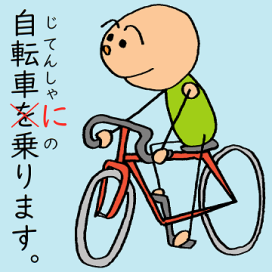
[V]+masu : Soujishi + masu : ((I’m going to) clean.)
The important thing is that only the verb predicates end with “masu”. For those Nouns, Na-adjectives, and I-adjectives, predicates end with “desu”. Can you tell the difference between the two below?
A : Yasumi masu.
B : Yasumi desu.
A is a verb predicate which means “(I will) take a break”, and B is a noun predicate which means “(It’s the) day-off”. You should never say like “{WRONG} Gohan o Tabe desu.”. It should be “{RIGHT} Gohan o Tabe masu.”. It is important to distinguish between verbs and nouns.
In the case of a Noun predicate, it is like;
[Noun]+desu.
Of course, “[Verb]+desu.” is fatally wrong. But how about the following one?
[Verb turns to be a “Noun-equivalent”] + desu.
In order to make a verb a Noun-equivalent, using “no” makes it possible.
[Verb + no ] + desu.
This is what we are going to learn today. “Verb +nodesu.” is okay but in conversation, it is usually shortened to be “Verb+ndesu.” The difference between “V+masu” and “V+ndesu.” is;
– V+masu : Simply telling about action
– V+ndesu : Telling about action with nuances of confiding and/or the action is the cause/reason of something.
The followings are 16 patterns with present-positive, present-negative, past-positive, past-negative for 4 types predicates.
<1> Verb Predicates (Iku/Ikimasu)
– Present-positive — Ikundesu.
– Present-negative — Ikanaindesu.
– Past-positive — Ittandesu.
– Past-negative — Ikanakattandesu.
<2> I-adjective Predicates (Takai)
– Present-positive — Takaindesu.
– Present-negative — Takaku naindesu.
– Past-positive — Takakattandesu.
– Past-negative — Takaku nakattandesu.
<3> Na-adjective Predicates (Kireina)
– Present-positive — Kireinandesu.
– Present-negative — Kireijanaindesu.
– Past-positive — Kireidattandesu.
– Past-negative — Kireija nakattandesu.
<4> Noun Predicates (Daigakusei)
– Present-positive — Daigakusei nandesu.
– Present-negative — Daigakuseija naindesu.
– Past-positive — Daigakusei dattandesu.
– Past-negative — Daigakuseija nakattandesu.
————————————–
This post was written with reference to the exercise A1 on Section26 of “Minna no Nihongo (2nd Edition)” published by “3A Corporation”

