Japanese Learning: Difference between Wa-Ga Construction sentence and Transitive Verb predicate sentence

This series have explained “Wa-ga construction” for several days, because the Japanese textbook “Minna no Nihongo” is dealing with “Wa-ga construction” in Chapter 9. And it is not only an introduction of “Wa-ga construction”, also an introduction of particle “ga”. If you were introduced particle “ga” through “Wa-ga construction”, you might think that the particles “wa” and “ga” could coexist in a sentence. Yes, they can be in a sentence together if the sentence is Wa-ga construction, but most of the time you have to choose one of the two (wa or ga) for subject in a sentence.

1. Watashi wa Nihonjin desu. (I am Japanese.)

2. Watashi ga Nihonjin desu. (I am the person who is Japanese.)

In the both sentence 1 and 2, the subject is “Watashi”. But the subject marker in 1 is “wa”, while the subject marker in 2 is “ga”. How do you properly choose “wa” or “ga” for a subject? The exact explanation would be lengthy. For the simplicity, let me say as below.

– When the predicate is the important information, use “wa” for subject marker.

– When the subject itself is the important information, use “ga” for subject marker.

Anyway, sticking to “Wa-ga construction” would cause a huge damage on your sense about Japanese. The followings are quiz about Wa-ga construction sentences that use verbs for predicate and Verb predicate sentences. Choose “ga” or “o”. And answer the type of verb.

1. Watashi wa Okane { ga or o } arimasu. (I have money.)

   Type of verb? — { Intransitive or Mobile intransitive or Transitive }

2. Watashi wa Okane { ga or o } moraimasu. (I get money.)

   Type of verb? — { Intransitive or Mobile intransitive or Transitive }

3. Watashi wa Ie { ga or o } demasu. (I get out of my house.)

   Type of verb? — { Intransitive or Mobile intransitive or Transitive }

4. Watashi wa Imouto { ga or o } imasu. (I have a younger sister.)

   Type of verb? — { Intransitive or Mobile intransitive or Transitive }

5. Watashi wa Imouto ni Purezento { ga or o } agemasu. (I give a present to my younger sister.)

   Type of verb? — { Intransitive or Mobile intransitive or Transitive }

6. Watashi wa Yuugohan { ga or o } tabemasu. (I eat supper.)

   Type of verb? — { Intransitive or Mobile intransitive or Transitive }

Answers will be shown tomorrow.
Japanese Learning: Verb predicate sentences with direct and indirect objects; [Person] ni [Object] o [Verb] masu.

Yesterday, we learned the verb “Agemasu” that is one of “Giving/Receiving verbs”. An example is as below;

1. Watashi wa Satou-san ni Hana o Agemasu. (I give Ms. Sato flowers.)

The sentence 1 is a verb predicate sentence, and its verb is “Agemasu” which is a transitive verb and also one of “Giving/Receiving verbs”. Usually in a sentence of “Giving/Receiving verbs”, two particles “o” and “ni” are used. The particle “o” is for direct object, and “ni” for indirect object. And sentence construction is as below;

2. [Subject] wa [Indirect Object] ni [Direct object] o [Giving/Receiving verb] masu.

And most of the time 2 can be;

2’. [Subject] wa [Person] ni [Thing] o [Giving/Receiving verb] masu.

So, in the case of 1, [Person] is Satou-san, and [Thing] is Hana.

Not only “Giving/Receiving verbs”, some other transitive verbs also become a sentence like 2’. Let’s expand the concept of “[Person] ni [Thing] o” to some verbs.

The following words are used in today’s sentences;

– Kurasumeeto: noun; classmate

– Nohto: noun; notebook

– Gakusei: noun; student

– Tomodachi: noun; friend

– Messeeji: noun; message

– Denwa: noun; telephone

– kashimasu: transitive verb; lend

– oshiemasu: tranisitive verb; teach

– okurimasu: transitive verb; send

– kakemasu: transitive verb; (“Denwa o kakemasu” = make a phone call)

Example: Watashi wa Kurasumeeto ni Nohto o Kashimasu.

(I lend my notebook to a classmate.)

Think about how the particle “o” and “ni” fit in the following sentences.

Q1 : Watashi wa Gakusei__ Nihongo __ Oshiemasu.

Q2 : Watashi wa Tomodachi__ Messeeji__ Okurimasu.

Q3 : Watashi wa Denwa__ Sensei__ Kakemasu.

Answers for Q1 to Q3 will be shown tomorrow.

Japanese Learning: Particle “de” to indicate what language you use for your language activity; [language] de [Verb] masu.

We have already learned several functions of particle “de”.

Like yesterday, today’s new function of “de” is also a kind of “what to use for your action”.

1. What language you use for language activity; [language] de [Verb] masu.

example: Watashi wa Nihongo de Tegami o Kakimasu. (I write a letter in Japanese.)

This function of “de” is used when the verb is of a language activity. Let us review verbs for language activities (they are for four language skills).

– Yomimasu: transitive verb; read

– Kikimasu: transitive verb; hear, listen

– Hanashimasu: transitive verb; speak, tell, say

– Kakimasu: transitive verb; write

In order to use in examples, let me introduce some new words.

– Eigo: noun; English

– Repohto: noun; report

– Nanigo: interrogative word coming from “Nani” and “go” in which “go” means language; what language

Practice and remember the following conversation;

A: Satou-san wa Nanigo de Repohto o Kakimasuka. (Ms. Sato, what language are you going to use for writing your report?)

B: Watashi wa Eigo de Repohto o Kaimasu. (I am going to write my report in English.)

<この投稿は“スリーエーネットワーク、みんなの日本語 初級I 第2版, 第7課A2”の内容を参照しています。>

Japanese Learning: Another function of Particle “de”; What you use for your action; [tool] de [Verb] masu.

We have already learned two functions of particle “de”.

1. What means of transportation is used when making movement.

example;

A: Sato-san wa Nani de Kaisha e Ikimasuka. (Ms.Sato, how do you get to the company?)

B: Watashi wa Chikatetsu de Kaisha e Ikimasu. (I go to the company by subway.)

2. Where the action is taking place; [Place] de [Verb] masu.

example;

A: Satou-san wa Doko de Kasa o Kaimashitaka. (Ms.Sato, where did you buy the umbrella?)

B: Watashi wa Kombini de Kasa o Kaimashita. (I bought the umbrella at a convenience store.)

Today’s new function of “de” is similar to “1.” in respect of “what to use for your action”.

3. What you use when making action; [tool] de [Verb] masu.

In order to show examples for sentences of this type, let me introduce several new words.

– Empitsu: noun; pencil,

– Bohrupen: noun; ballpoint pen

– Saimpen: noun; felt-tip pen

– Shaapupenshiru: nouns, mechanical pencils

– Ji: noun; character

– Kakimasu: transitive verb; write

Practice the following two conversations;

A: Satou-san wa Empitsu de Ji o Kakimasuka, Shaapupenshiru de kakimasuka.

(Ms. Sato, do you write a character by a pencil or a mechanical pencil?)

B: Watashi wa Shaapupenshiru de Ji o Kakimasu.

(I write a character by a mechanical pencil.)

A: Suzuki-san wa Nani de Ji o Kakimasuka.

(Mr. Suzuki, by what do you write a character?)

B: Watashi wa Bohrupen to Saimpen de Ji o Kakimasu.

(I write a character by a ballpoint pen and felt-tip pen.)

<この投稿は“スリーエーネットワーク、みんなの日本語 初級I 第2版, 第7課A1”の内容を参照しています。>

Japanese Learning: Introduction of particle “de” which indicates where the action is taking place; [Place] de [(Transitive) Verb] masu.

We have already learned one of functions of particle “de”. That function was to indicate what means of transportation is used when making movement. An example of conversation using “de” is as follows;

A: Satou-san wa Nani de Kaisha e Ikimasuka. (Ms. Sato, how do you get to the company?)

B: Watashi wa Chikatetsu de Kaisha e Ikimasu. (I go to the company by subway.)

Another function of “de” is introduced today.

1. [Subject] wa [Place] de [Object] o [Transitive Verb] masu.

Example : Watashi wa Depaato de Kasa o Kaimashita.

Where;

Depaato: noun; a department store

Kasa: noun; umbrella

Kaimasu: transitive verb; buy

In this sentence, the sentence ending “masu” turned to be “mashita”. Let’s have a quick review for sentence ending of a verb predicate sentence:

– Present-Positive ; masu.

– Present-Negative ; masen.

– Past-Positive ; mashita.

– Past-Negative ; masendeshita.

Therefore, “Kaimashita” means “bought”.

Practice and remember the following conversation;

A: Satou-san wa Doko de Kasa o Kaimashitaka. (Ms.Sato, where did you buy the umbrella?)

B: Watashi wa Kombini de Kasa o Kaimashita. (I bought the umbrella at a convenience store.)

<この投稿は“スリーエーネットワーク、みんなの日本語 初級I 第2版, 第6課A3”の内容を参照しています。>

Japanese Learning: Introduction of transitive verbs that use the particle “o” for an object; [Object] o [Transitive verb] masu.

First of all, quiz answers come first.

Q1: “Ni” should not be used for “senshuu”;

Senshuu, Hataraki mashita. (Last week, I worked.)

Q2: “Ni” should be used for “hachi-ji Juugo-fun”;

Hachi-ji Juu go-fun ni, Gakkou e Ikimasu. (I go to the school at eight fifteen.)

These days, we are studying “verb predicate sentences”. When you use a verb for the predicate, you need to choose the ending correctly. The ending is not “desu-type” but “masu-type”. The masu-type sentence ending has four variations;

– Present-positive => [verb] masu.

– Present-negative => [verb] masen.

– Past-positive => [verb] mashita.

– Past-negative => [verb] masen deshita.

The above four patterns are for predicate with politeness. Actually, verbs have more patterns not only for predicate but also for other usages for passive, hypothetical, modifying phrases, and so on. In other words, a verb conjugates. We won’t learn conjugations of verbs today, but I want you to know that verb conjugations are big issues in Japanese language.

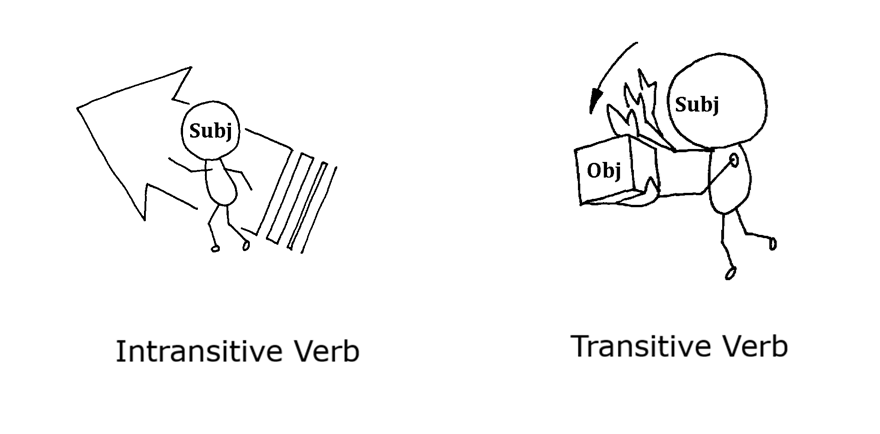
Today’s main theme is introductions of transitive verbs and particle “o”. When an action works directly onto something (an object), the action is described by a transitive verb. And the object of the transitive verb needs to be marked with particle “o”.

The construction of a transitive verb sentence is as follows;

[Subject] wa [Object] o [Transitive verb] masu.

example: Watashi wa Yuugohan o Tabemasu. (I eat supper.)

Where;

– Yuugohan: noun; supper

– Tabemasu: transitive verb; eat

When you learn Japanese, you need to have a clear image of intransitive verb or transitive verb. Refer to the illustration below about the difference between intransitive verbs and transitive verbs.

Example:

Intransitive verb sentence; Watashi wa Gakkou e Ikimasu. (I go to the school.)

Transitive verb sentence; Watashi wa Yuugohan o Tabemasu. (I eat supper.)

Japanese Learning: Whether or not to use the Particle “ni” which is the marker for when you do it; [when] ni [verb] v.s. [when] [verb]

We have already learned the Particle “ni” as a marker for time (on a clock) of action as below;

A : Satou-san wa Maiasa Nan-ji ni okimasuka. (Ms. Sato, what time do you get up every morning?)

B : Watashi wa Maiasa Shichi-ji ni okimasu. (I get up at seven every morning.)

Now the function is expanded so that “ni” would be the maker not only for time but also for when action is taken place.

A : Satou-san wa Itsu Kuni e Kaerimasuka. (Ms. Sato, when are you going back your home country?)

B : Watashi wa Hachi-gatsu Juu roku-nichi ni Kuni e Kaerimasu. (I am going back my country on August 16th.)

Where;

– Kuni: noun; country, but in this case, home country or home town region

– Kaerimasu: verb; go back

Note that when asking time, the interrogative word is “Nan-ji”, but when asking when, the word “Itsu” is used.

Now look at two sentences below;

1. Watashi wa Ku-gatsu Juu shichi-nichi ni Toukyou e Ikimasu.

2. Watashi wa Ashita Toukyou e Ikimasu.

In the sentence 1, The date “Ku-gatsu Juu shichi-nichi (September 17th )” is followed by the particle “ni. On the other, in the sentence 2, the word for when “Ashita is not followed by “ni”. Therefore, there is a difference between the sentences 1 and 2, about whether or not to use the particle “ni”

As to using “ni” or not right after the word for time or when the action is taken, apply the following rule. But this rule is not a strict one, so take it as a rough guideline. “The word” means that it is time or when the action is taken (e.g. ten thirty, tomorrow…and so on);

– The word is relative to “NOW”, then do not use “ni”.

example; Kinou(yesterday), Ashita(tomorrow), Raishuu(next week)

– The word specifies a certain time, then use “ni”.

example; Gogo Go-ji ni (at 5p.m.), Suiyoubi ni (on Wednesday), Juu-gatsu Juu Hachi-nichi ni (on October 18th)

Quiz: Answer if “ni” is used or not used. The answers will be shown tomorrow.

Q1: Senshuu (with or without ni?), Hataraki mashita. (Last week, I worked.)

Q2: Hachi-ji Juu go-fun (with or without ni?) Gakkou e Ikimasu. (I go to the school at eight fifteen.)

<この投稿は“スリーエーネットワーク、みんなの日本語 初級I 第2版, 第5課A4”の内容を参照しています。>

Japanese Learning: The particle to indicate who acts with you when you make action; [Person] to [Verb].

The particle “to” has already been introduced as the particle that parallelizes two nouns in the form of “[Noun1] to [Noun2]” as “1” below.

1. right : ringo to mikan (an apple and a Mandarin orange)

2. wrong : yasui to oishii (reasonable and tasty)

3. wrong : hashiru to oyogu (run and swim)

“2” and “3” above are wrong. The particle “to” cannot parallelize neither two adjectives nor two verbs. But today’s new function of “to” is to be used for a verb. Of course it’s not to say two verbs parallelly. today’s new function of “to” is to indicate who acts with you when you make action in the following form;

4. [Person] to [Verb].

example: Watashi wa Suzuki-san to Kombini e Ikimashita. (I went to a convenience store with Mr. Suzuki)

Where;

– Watashi: pronoun; I

– wa: particle; topic marker, and in this case also subject marker

– Suzuki-san: noun; a major family name of Japanese.

– to: particle; indicates who acts together with the subject

– Kombini: noun; a convenience store

– e: particle; the reaching point of the action

– Ikimashita: verb in form of past-positive; went

When you ask “With whom did you go there together?”, the interrogative word is “Dare”.

Practice and remember the following conversation.

A: Sato-san wa Dare to Depaato e Ikimashitaka. (Ms.Sato, with whom did you go to the department store?)

B: Watashi wa Suzuki-san to Depaato e Ikimashita. (I went to the department store with Mr. Suzuki.)

– Depaato: noun; a department store

<この投稿は“スリーエーネットワーク、みんなの日本語 初級I 第2版, 第5課A3”の内容を参照しています。>

Japanese Learning: The particle to indicate what transportation you use when you move to somewhere; [Transportation] de

Here is a new particle to learn. It is “de”. We are going to learn one of its functions, which is to indicate what means of transportation is used when making movement. Since the particle “de” has many functions, do not stick to today’s function only. Other functions will be introduced later.

There are several means of transportation such as a car, bus, taxi, train, subway, boat, ferry, airplane, but let us use one of these, subway.

Chikatetsu : noun ; Subway, underground railway

Then, today’s sentence construction is as follows;

[Subject] wa [Means of transportation] de [Destination] e [verb meaning move].

Example: Watashi wa Chikatetsu de Kaisha e Ikimasu.

Where;

– Watashi: pronoun; I

– wa: particle; topic marker, and in this case also subject marker

– Chikatetsu : noun ; Subway, underground railway

– de: particle; in this case, functions to indicate means of transportation

– Kaisha: noun; company

– e: particle; the reaching point of the action

– Ikimasu: verb in form of present-positive; go

When you ask “How do you get there?”, the interrogative word “Nan” or “Nani” is used. Many Japanese textbooks are using “Nan”. But if you say “Nan de Ikimasuka?”, there could be two renditions;

– Which means of transportation do you use to get there?

– Why are you going there?

So, I like “Nani” better in order to avoid double-meaning.

Practice and remember the following conversation.

A: Sato-san wa Nani de Kaisha e Ikimasuka. (Ms.Sato, how do you get to the company?)

B: Watashi wa Chikatetsu de Kaisha e Ikimasu. (I go to the company by subway.)

<この投稿は“スリーエーネットワーク、みんなの日本語 初級I 第2版, 第5課A2”の内容を参照しています。>

Japanese Learning: The particle to indicate the reaching point where the action is heading towards; [Place] e

Answers of yesterday’s Quiz :

example; Watashi wa Mainichi Hataraki masu. (I work every day.)

 => Non-past x Positive

1. Ashita, Watashi wa Hataraki masu. (I will work tomorrow.)

=> Non-past x Positive

2. Watashi wa Do-youbi Hataraki masen. (I don’t work on Saturday.)

=> Non-past x Negative

3. Watashi wa Kinou Hataraki masen deshita. (I didn’t work yesterday.)

=> Past x Negative

4. Kinou Watashi wa Hataraki mashita. (I worked yesterday.)

=> Past x Positive

Then let’s start today’s learning. There is a particle to indicate the reaching point of the action. It is similar to the preposition “to” in English. But Japanese particles are postpositions, the particle “e” is put behind a noun which means a place. The sentence construction is as below;

[Subject] wa [noun meaning a place] e [verb meaning move].

example : Watashi wa Kaisha e Iki masu.

Where;

– Watashi: pronoun; I

– wa: particle; topic marker, and in this case also subject marker

– Kaisha: noun; company (with nuance of a place)

– e: particle; the reaching point of the action

– Ikimasu: verb in form of present-positive; go

One thing you need to know is that the pronunciation of particle “e” is “e”, but its spelling is “he: へ”. So for writing, do not use “e: え”.

Let me introduce a just one noun;

Kombini: noun; a convenience store

Practice and remember the following conversation.

A: Sato-san wa Doko e Ikimasuka. (Ms.Sato, where are you going?)

B: Watashi wa Kombini e Ikimasu. (I am going to a convenience store.)

In addition, we learned four patterns of verb predicates yesterday. Four patterns are based on combinations of non-past/past tenses and positive/negative. As a review of yesterday, read carefully the followings:

– Kyou, Watashi wa Kombini e Ikimasu. (Today, I am going to a convenience store.)

=> Non-past x Positive

– Kyou, Watashi wa Kombini e Ikimasen. (Today, I am not going to a convenience store.)

=> Non-past x Negative

– Kinou, Watashi wa Kombini e Ikimashita. (Yesterday, I went to a convenience store.)

=> Past x Positive

– Kinou, Watashi wa Kombini e Ikimasen deshita. (Yesterday, I didn’t go to a convenience store.)

=> Past x Negative

<この投稿は“スリーエーネットワーク、みんなの日本語 初級I 第2版, 第5課A1”の内容を参照しています。”In addition”以下の内容は第4課A7です。>