Japanese Learning: How to make a transitive verb sentence interrogative; Asking what the object is or asking what the action is.

Yesterday, we learned verb predicate sentences that use transitive verbs and the particle “o”. A transitive verb expresses an action that exerts its effect onto an object directly. And the particle “o”, as the object marker, is attached to just behind the object. So, the sentence construction is as below;

1. [Subject] wa [Object] o [Transitive verb] masu.

example; Watashi wa Ocha o Nomi masu.

Where;

– Ocha: noun; tea

– Nomimasu: transitive verb; drink

Note that the order of words is different from transitive verb sentence of English.

English: [Subject] [Transitive Verb] [Object] — SVO

Japanese: [Subject wa] [Object o] [Transitive Verb] — SOV

How can we make a transitive verb sentence an interrogative sentence?

(1) Yes-No question

Put “ka” at the end of the sentence;

A : Satou-san wa Ocha o Nomi masuka. (Ms. Sato, do you drink tea?)

B : Hai, watashi wa Ocha o Nomi masu. (Yes, I drink tea.)

(2) Asking what the object is;

A : Satou-san wa Nani o Nomi masuka. (Ms. Sato, what do you drink?)

B : Watashi wa Mizu o Nomi masu. (I drink water.)

(3) Asking what the action is;

A : Satou-san wa Nani o Shimasuka. (Ms. Sato, what are you going to do?)

B : Watashi wa Koh’hii o Nomi masu. (I am going to drink a cup of coffee.)

In (3), the question uses verb “Shimasu”. Shimasu is a verb similar to the verb “do” in English. And most of the time “Shimasu” functions as a transitive verb, although occasionally it can be an intransitive verb (such a case will be explained later). It is interesting that even if the answer could use an intransitive verb, the question is “Nani o Shimasuka” which is obviously phrase of object and transitive verb. An example is as below

A : Satou-san wa Nani o Shimasuka. (Ms. Sato, what are you going to do?)

B : Watashi wa Gakko e Ikimasu. (I am going to the school.)

The verb “Ikimasu” is an intransitive verb.

<この投稿は“スリーエーネットワーク、みんなの日本語 初級I 第2版, 第6課A1とA2”の内容を参照しています。>
Japanese Learning: Introduction of transitive verbs that use the particle “o” for an object; [Object] o [Transitive verb] masu.

First of all, quiz answers come first.

Q1: “Ni” should not be used for “senshuu”;

Senshuu, Hataraki mashita. (Last week, I worked.)

Q2: “Ni” should be used for “hachi-ji Juugo-fun”;

Hachi-ji Juu go-fun ni, Gakkou e Ikimasu. (I go to the school at eight fifteen.)

These days, we are studying “verb predicate sentences”. When you use a verb for the predicate, you need to choose the ending correctly. The ending is not “desu-type” but “masu-type”. The masu-type sentence ending has four variations;

– Present-positive => [verb] masu.

– Present-negative => [verb] masen.

– Past-positive => [verb] mashita.

– Past-negative => [verb] masen deshita.

The above four patterns are for predicate with politeness. Actually, verbs have more patterns not only for predicate but also for other usages for passive, hypothetical, modifying phrases, and so on. In other words, a verb conjugates. We won’t learn conjugations of verbs today, but I want you to know that verb conjugations are big issues in Japanese language.

Today’s main theme is introductions of transitive verbs and particle “o”. When an action works directly onto something (an object), the action is described by a transitive verb. And the object of the transitive verb needs to be marked with particle “o”.

The construction of a transitive verb sentence is as follows;

[Subject] wa [Object] o [Transitive verb] masu.

example: Watashi wa Yuugohan o Tabemasu. (I eat supper.)

Where;

– Yuugohan: noun; supper

– Tabemasu: transitive verb; eat

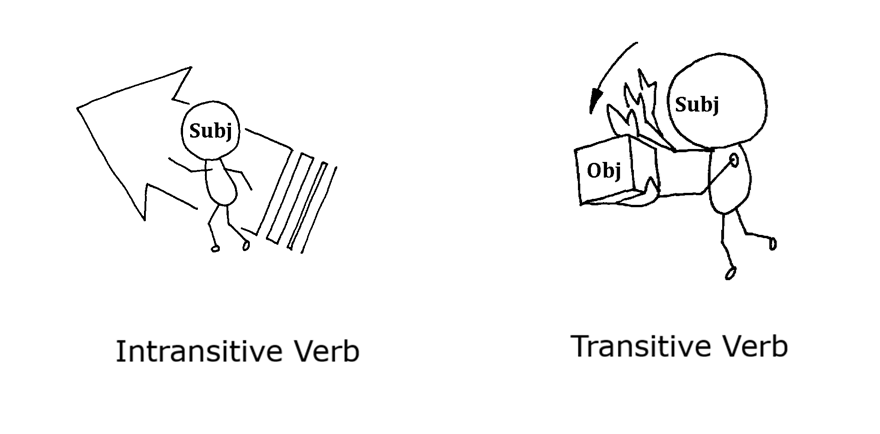
When you learn Japanese, you need to have a clear image of intransitive verb or transitive verb. Refer to the illustration below about the difference between intransitive verbs and transitive verbs.

Example:

Intransitive verb sentence; Watashi wa Gakkou e Ikimasu. (I go to the school.)

Transitive verb sentence; Watashi wa Yuugohan o Tabemasu. (I eat supper.)

Japanese Learning: The particle to indicate who acts with you when you make action; [Person] to [Verb].

The particle “to” has already been introduced as the particle that parallelizes two nouns in the form of “[Noun1] to [Noun2]” as “1” below.

1. right : ringo to mikan (an apple and a Mandarin orange)

2. wrong : yasui to oishii (reasonable and tasty)

3. wrong : hashiru to oyogu (run and swim)

“2” and “3” above are wrong. The particle “to” cannot parallelize neither two adjectives nor two verbs. But today’s new function of “to” is to be used for a verb. Of course it’s not to say two verbs parallelly. today’s new function of “to” is to indicate who acts with you when you make action in the following form;

4. [Person] to [Verb].

example: Watashi wa Suzuki-san to Kombini e Ikimashita. (I went to a convenience store with Mr. Suzuki)

Where;

– Watashi: pronoun; I

– wa: particle; topic marker, and in this case also subject marker

– Suzuki-san: noun; a major family name of Japanese.

– to: particle; indicates who acts together with the subject

– Kombini: noun; a convenience store

– e: particle; the reaching point of the action

– Ikimashita: verb in form of past-positive; went

When you ask “With whom did you go there together?”, the interrogative word is “Dare”.

Practice and remember the following conversation.

A: Sato-san wa Dare to Depaato e Ikimashitaka. (Ms.Sato, with whom did you go to the department store?)

B: Watashi wa Suzuki-san to Depaato e Ikimashita. (I went to the department store with Mr. Suzuki.)

– Depaato: noun; a department store

<この投稿は“スリーエーネットワーク、みんなの日本語 初級I 第2版, 第5課A3”の内容を参照しています。>

Japanese Learning: The particle to indicate what transportation you use when you move to somewhere; [Transportation] de

Here is a new particle to learn. It is “de”. We are going to learn one of its functions, which is to indicate what means of transportation is used when making movement. Since the particle “de” has many functions, do not stick to today’s function only. Other functions will be introduced later.

There are several means of transportation such as a car, bus, taxi, train, subway, boat, ferry, airplane, but let us use one of these, subway.

Chikatetsu : noun ; Subway, underground railway

Then, today’s sentence construction is as follows;

[Subject] wa [Means of transportation] de [Destination] e [verb meaning move].

Example: Watashi wa Chikatetsu de Kaisha e Ikimasu.

Where;

– Watashi: pronoun; I

– wa: particle; topic marker, and in this case also subject marker

– Chikatetsu : noun ; Subway, underground railway

– de: particle; in this case, functions to indicate means of transportation

– Kaisha: noun; company

– e: particle; the reaching point of the action

– Ikimasu: verb in form of present-positive; go

When you ask “How do you get there?”, the interrogative word “Nan” or “Nani” is used. Many Japanese textbooks are using “Nan”. But if you say “Nan de Ikimasuka?”, there could be two renditions;

– Which means of transportation do you use to get there?

– Why are you going there?

So, I like “Nani” better in order to avoid double-meaning.

Practice and remember the following conversation.

A: Sato-san wa Nani de Kaisha e Ikimasuka. (Ms.Sato, how do you get to the company?)

B: Watashi wa Chikatetsu de Kaisha e Ikimasu. (I go to the company by subway.)

<この投稿は“スリーエーネットワーク、みんなの日本語 初級I 第2版, 第5課A2”の内容を参照しています。>

Japanese Learning: Four patterns of verb predicates by combinations of non-past/past tenses and positive/negative.

We learned yesterday there were two patterns of verb predicates.

[Verb] masu : Non-past tense

[Verb] mashita : Past tense

So, two patterns above come from the difference of tense. If we consider other two patterns which come from if the sentence is positive or negative, we need to use four patterns correctly.

Let us use the verb “Hataraki masu” for the example, which means “work”.

– Non-past x Positive: Hataraki masu. (work/will work)

– Non-past x Negative: Hataraki masen. (don’t work/will not work)

– Past x Positive: Hataraki masita. (worked)

– Past x Negative: Hataraki masendeshita. (didn’t work)

Quizzes: Think about what pattern a sentence is in terms of non-past/past tenses and positive/negative.

example; Watashi wa Mainichi Hataraki masu => Non-past x Positive

1. Ashita, Watashi wa Hataraki masu.

2. Watashi wa Do-youbi Hataraki masen.

3. Watashi wa Kinou Hataraki masen deshita.

4. Kinou Watashi wa Hataraki mashita.

Answers will be shown tomorrow.

<この投稿は“スリーエーネットワーク、みんなの日本語 初級I 第2版, 第4課A7”の内容を参照しています。>

Japanese Learning: Change of verb predicates by tense: “[Varb] masu” for non-past tense and “[Verb] mashita” for past tense.

First of all, we need to review yesterday’s quiz.

A. Watashi wa Getsu-youbi kara Kin-youbi made Hataraki masu.

B. Watashi wa Kin-youbi ni Hataraki masu.

Q1: Which of sentences A or B says “My work ends on Friday”?

A1: The sentence A says “My work ends on Friday”, because the particle “made” is to indicate the ending time of continuous action.

Q2: Which of A or B says “I work on Friday”?

A2: The sentence B says “I work on Friday” because the particle “ni” is to indicate the time of action.

And let’s review about “Verb predicate sentences”. Its ending of a sentence is different from “Noun predicate sentences” as below;

“Verb predicate” => [verb] masu. ; example : Hataraki masu.

“Noun predicate” => [noun] desu. ; example : Shigoto desu.

What we are going to learn today is to use properly “masu” and its past tense “mashita”. Two days ago, I wrote there were other two important things about Japanese verbs. One of two is that a verb conjugates by changing the ending part of the verb. Conjugation patterns are many, and the change between “masu” and “mashita” is one of conjugations.

Just remember the simple things below

[Verb] masu : Non-past tense

[Verb] mashita : Past tense

Actually, the issue is not so simple, because “Non-past” is adopted for both present and future, and as for “Past”, in many times it’s better to call it the perfect tense rather than the past tense. But we are still on the early stage to learn Japanese verbs, let’s make it dichotomy of non-past or past, for simplicity.

In order to learn to use verbs in non-past and past tense, words describing time are necessary.

– Mainichi: every day

– Ashita: tomorrow

– Kinou: yesterday

Practice and remember the following three sentences;

1. Watashi wa Mainichi Hataraki masu: non-past (present); (I work every day.)

2. Watashi wa Ashita Hataraki masu: non-past (future); (I will work tomorrow.)

3. Watashi wa Kinou Hataraki mashita: past; (I worked yesterday.)

<この投稿は“スリーエーネットワーク、みんなの日本語 初級I 第2版, 第4課A6”の内容を参照しています。>

Japanese Learning: Introduction of Verb predicate sentences and the Particle “ni”; [Time] ni [Verb] masu.

Japanese sentences are classified in three by the type of predicates;

1. Noun predicate sentences

2. Adjective predicate sentences (I-adjectives and Na-adjectives)

3. Verb predicate sentences

So far, only Noun predicate sentences have been introduced. But we are going to learn Verb predicate sentences from today.

“Verb” is a word in most of the cases to express an action, although “naru(become)” is a verb to express change and “aru” and “iru” are verbs to express existence.

When a verb is used for a predicate, there is the clear difference from “noun predicate”

“Verb predicate” => [verb] masu.

“Noun predicate” => [noun] desu.

Where;

masu and desu is the sentence endings for present-positive with some politeness

As to verbs, the following two things are also important;

– A verb conjugates, in other words, the ending part of verb changes.

– Need to have a clear image of intransitive verb or transitive verb.

But these two points will be explained later. Today, you just note that a verb is a word to express action.

Along with introduction of verbs, the particle “ni” is also introduced. Particle “ni” has many functions actually, but only the function of “time of action” is introduced today.

Note that it is not a coincidence that verbs and particle “ni” are introduced at the same time. Do you remember that a segment in Japanese sentence is usually in the form of?;

[meaningful word] [functional word]

A word segment “[word][ni]” works as a modifier for a verb behind. Although there is sometimes an exception, you need to expect there is a verb behind if you find a segment using “ni”.

And new words are as below;

– Maiasa : adverb ; every morning

– Okimasu : verb ; get up

Practice and remember the following conversation;

A : Satou-san wa Maiasa Nan-ji ni okimasuka. (Ms. Sato, what time do you get up every morning?)

B : Watashi wa Maiasa Shichi-ji ni okimasu. (I get up at seven every morning.)

<この投稿は“スリーエーネットワーク、みんなの日本語 初級I 第2版, 第4課A4”の内容を参照しています。>

Japanese Learning: Start and end times of the continuous state; [Time1] kara [Time2] made

Simply said, what we learn today is two particles that are “from” and “to” in English. The sentence construction is as follows;

1. [Subject] wa [Time1] kara [Time2] made desu.

“1” is a noun predicate sentence (a verb predicate sentence will be introduced tomorrow).

Then, an example of sentence 1 can be;

– Shigoto wa Ku-ji kara Go-ji made desu. (My work is from nine to five.)

Where;

– Shigoto : noun : work

– wa: particle : topic marker, and in this case, “wa” also functions as the subject marker

– Ku-ji : nine o’clock

– kara : particle : marker for starting time

– Go-ji : five o’clock

– made : particle : marker for ending time

– desu : sentence ending for present-positive with some politeness

Actually, two particles “kara” and “made” are used not only for times but also for special starting and ending positions. But we are using these particles only for time today.

Practice and remember the following conversation;

A : Shigoto wa Nan-ji kara Nan-ji made desuka. (From what time to what time is your work?)

B : Shigoto wa Hachi-ji kara Yo-ji made desu. (My work is from eight to four.)

<この投稿は“スリーエーネットワーク、みんなの日本語 初級I 第2版, 第4課A3”の内容を参照しています。>

Japanese Learning: Quantifier “fun” that follows number for minute to say what time it is; Need to learn to use “Fun” or “Pun” depending on numbers (minutes)

Yesterday, we learned the following conversation.

A : Ima Nan ji desuka. (What time is it now?)

B : Ima Ku ji Juu-kyuu fun desu. (Now it is Nine Nineteen.)

Today, let’s learn how to read time for hours and minutes.

Hours

Gozen Rei ji = 0:00 a.m. (Japanese don’t use “12:00 a.m.”)

Gozen Ichi ji = 1:00 a.m.

Gozen Ni ji = 2:00 a.m.

Gozen San ji = 3:00 a.m.

Gozen Yo ji = 4:00 a.m. (Don’t say “Yon ji”)

Gozen Go ji = 5:00 a.m.

Gozen Roku ji = 6:00 a.m.

Gozen Shichi ji = 7:00 a.m. (Sometimes it’s “Nana ji”)

Gozen Hachi ji = 8:00 a.m.

Gozen Ku ji = 9:00 a.m. (Don’t say “Kyuu ji”)

Gozen Juu ji = 10:00 a.m.

Gozen Juu Ichi ji = 11:00 a.m.

Gogo Rei ji = 0:00 p.m.

Gogo Ichi ji = 1:00 p.m.

Gogo Ni ji = 2:00 p.m.

Gogo San ji = 3:00 p.m.

Gogo Yo ji = 4:00 p.m. (Don’t say “Yon ji”)

Gogo Go ji = 5:00 p.m.

Gogo Roku ji = 6:00 p.m.

Gogo Shichi ji = 7:00 p.m. (Sometimes it’s “Nana ji”)

Gogo Hachi ji = 8:00 p.m.

Gogo Ku ji = 9:00 p.m. (Don’t say “Kyuu ji”)

Gogo Juu ji = 10:00 p.m.

Gogo Juu Ichi ji = 11:00 p.m.

Gozen an Gogo are omitted when it is not necessary.

Minutes

Look at carefully if it’s “fun” or “pun” for minutes.

Ippun = Ichi + fun : One

Ni fun = Ni + fun : Two

Sampun = San + fun : Three

Yompun = Yon + fun : Four

Go fun = Go + fun : Five

Roppun = Roku + fun : Six

Nana fun = Nana + fun : Seven

Happun = Hachi + fun : Eight

Kyuu fun = Kyuu + fun : Nine

Juppun = Juu + fun : Ten (Old people may say “Jippun”)

Practice well how to read time in Japanese like the following examples;

 0:41a.m. = Gozen Rei ji Yon Juu Ippun

 3:27a.m. = Gozen San ji Ni Juu Nana fun

 6:03a.m. = Gozen Roku ji Sampun

 9:59 = Ku ji Go Juu Kyuu fun

 12:35 = Juu Ni ji San Juu Go fun

 4:11p.m. = Gogo Yo ji Juu Ippun

 7:44p.m.= Gogo Shichi ji Yon Juu Yompun

Sometimes 24 hour system is used like 21:36 that is “Ni Juu Ichi ji San Juu Roppun”.

Japanese Learning: Sentences to say what time it is now; Ima [Hour] ji [minutes] fun desu.

Today’s sentence is as follows.

1. Ima [Hour] ji [minutes] fun desu.

example; Ima Yo-ji Juu-yom pun desu. (Now, the time is Four fourteen.)

Recently I showed that a Japanese sentence can be simplified as below;

2. [Subject] [Predicate].

But this is too simple. Let’s take a look at with different concept about Japanese sentences. A Japanese sentence consists of several segments as below;

[meaningful word][functional word] + [m.w.][f.w.] + [m.w.][f.w.]+ …

For example; Watashi (I) and Daigakusei (university student) are meaningful words.

And a particle “wa” and sentence ending “desu” are functional words.

You get the sentence below;

3. Watashi wa Daigakusei desu. (I am a university student.)

This sentence 3 has the structure of [m.w.][f.w.] + [m.w.][f.w.]

If you carefully look at the sentence 1, you will find that the meaningful word “Ima (now)” is not followed by a functional word. Using the particle of topic marker “wa”, you may want to say;

4. Ima wa Yo-ji Juu-yom pun desu. (Now is the time of Four fourteen.)

This sentence 4 is okay. These is no error on grammar. However, today’s sentence is;

5. Ima Yo-ji Juu-yom pun desu. (Now, the time is Four fourteen.)

How do we think about the missing “wa”? It is possible to think that the topic marker “wa” is omitted. But I like to think that the word “Ima (now)” in sentence 5 is an adverbial. If a word is an adverb, some of them don’t need any particle behind.

The reason why I say like this is that if you are a beginner as Japanese learner, you need to try NOT to omit a particle in Japanese sentences.

In addition, you need to know how to read time to say what time it is now. Let’s learn how to read times tomorrow. For today, just practice and remember the following conversation;

A : Ima Nan ji desuka. (What time is it now?)

B : Ima Ku ji Juu-kyuu fun desu. (Now it is Nine Nineteen.)

<この投稿は“スリーエーネットワーク、みんなの日本語 初級I 第2版, 第4課A1”の内容を参照しています>