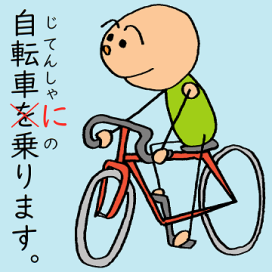
Japanese Learning (A6 S41): I did Something for Person of Lower Status than I ; Watashi wa [Person of Lower Status] ni/o/no [V-te] Yari mashita.

The exercise A4, A5, and A6 introduce the sentence constructions in which a giving/receiving verb is used as a supplementary verb and attached to the behind of a verb in Te-form.

– [V-te]+[Giving/Receiving Verb].

“Itadaki mashita” in A4 is the humble language of “Morai mashita”, and “Kudasai mashita” in A5 is the honorific of “Kure mashita”. Both A4 and A5 are introducing a type of treatment expressions that are to be used in conjunction with a person who is superior to “Watashi”. In contrast, A6 introduces a treatment expression that has to do with a person who is inferior to “Watashi”.

1. Watashi wa Mago ni Kutsuhimo no Musubi kata o Oshiete Yari mashita.

(I taught my grandchild how to tie shoelaces.)

Mago : Noun ; grandchild

Kutsu-himo : Noun ; shoelaces

Musubu/Musubimasu : Verb (Group1-B) : tie

kata ; how to, the way to do something; [Masu-form without “masu”] + kata

Note that the verb “Oshieru/Oshiemasu” is a transitive verb which usually use two particles “-ni” and “-o” in the form of “[person]ni [something]o Oshieru”.

2. Watashi wa Mago o Umi ni Tsurete itte Yari mashita.

(I took my grandchild to the sea.)

3. Watashi wa Mago no Shukdai o Tetsudatte Yari mashita.

(I helped my grandchild’s homework.)

Tetsudau/Tetsudaimasu : Verb (Group1-W) : help, assit

The particles after “Mago” is “-ni” in the sentence 1, “-o” in the 2, and “-no” in the 3. “Mago(grandchild)” is a receiver in those three sentences. But the particle attached to “Mago” is not always “-ni”. When it comes to sentences of giving/receiving, many sentences have particles as below;

-[Person] ni [Thing] o [Giving/Receiving Verb].

For example,

– Satou-san ga Watashi<ni> Chokore’eto<o> Kure mashita. (Sato-san gave me a chocolate.)

Also, in the sentence of a treatment expression that is using giving/receiving verb as a supplementary verb behind a verb in Te-form,

– Watashi wa Suzuki-san<ni> Nihongo<o> Oshiete Morai mashita. (I was taught by Suzuki-san Japanese.)  

But it is not always “[person]+ni” as shown in the sentence 2 and 3 above. When you need to choose particles for sentences of giving/receiving and/or treatment expressions, it is good to think that the particles in the core verb phrase are maintained. The core verb phrase of the sentence 2 is;

– Mago o Umi ni Tsurete iku (To take my grandchild to the sea)

Substituting this into “Watashi wa — Yari mashita.” then we get the sentence 2.

Likewise, the core verb phrase of the sentence 3 is;

– Mago no Shukudai o Tetsudau (To assist my grandchild’s homework)

Substituting this into “Watashi wa — Yari mashita.” then we get the sentence 3.

————————————–

This post was written with reference to the exercise A6 on Section41 of “Minna no Nihongo (2nd Edition)” published by “3A Corporation”

Japanese learning (A2 S41): Making a More Polite Expression in case that Someone Gave you Sth (Kure mashita); [Superior Person] ga Watashi ni [Object] o Kudasai mashita.

Yesterday we learned how to make “morai mashita” a more polite expression. That was a humble language “Itadaki mashita”. “Morai mashita” and “Itadaki mashita” are both verbs that are used in so-called “giving/receiving sentences”. Today too, we are learning an honorific expression of “giving/receiving sentences”. But there are several differences;

– Yesterday’s “Morai mashita” and “Itadaki mashita” are verbs of receiving.

– Today’s “Kure mashita” and “Kudasai mashita” are verbs of giving.

– Yesterday’s “Itadaki mashita” is a humble language.

– Today’s “Kudasai mashita” is an honorific.

First, check the level of politeness about a receiving verb “kureru/kuremasu” in past/perfect tense.

– Casual Language : Kureta.

– Polite Language : Kure mashita.

– Honorific of the level of Honolific Expression : Kudasai mashita.

People who speak Japanese always have to choose the proper level of politeness. When you talk to an intimate friend, you use “Kureta”, but think the chance to use “Kureta” is not often. When you talk to someone in the public space, it would be better to use “Kuremashita”. But if the person who gave you something is superior to you, “Kuremashita” is not enough polite. Then you need to use “Kudasai mashita” for the action of giving that the superior person did.

Again, “Kudasaru” is giving, while “Itadaku” is receiving. Take a look at the followings for sake of comparison;

(1) Humble language “Itadaku/Itadakimasu”

Watashi wa* [Superior Person] ni [Object] o Itadaki mashita.

Example : Watashi wa Sensei ni Hon o Itadaki mashita. (I received a book from my teacher.)

(2) Honorific “Kudasaru/Kudasaimasu”

[Superior Person] ga* Watashi ni [Object] o Kudasai mashita.

Example : Sensei ga Watashi ni Hon o Kudasai mashita. (My teacher gave me a book.)

When using a honorific in the sentence, the subject must be a superior person to you, because honorifics are words to pay respect to action that the superior person did.

Now, here are example sentences;

1. Shachou ga Watashi ni Ryuugaku no Kikai o Kudasai mashita.

(The company president gave me an opportunity to study abroad.)

– Shachou : noun : a company president

– Ryuugaku : noun (that can be Group3 verb “[Noun]+suru”) : Studying abroad

– Kikai : noun : an opportunity

2. Tonari no Ojiisan ga Watashi ni Niwa no Kaki o Kudasai mashita.

(The old man next door gave me persimmons of his tree.)

When making an old people the subject in your Japanese sentence, it is better to use honorific for his/her action.

And the same caution again as yesterday,

(WRONG) Haha ga Watashi ni Okane o Kudasai mashita.

(RIGHT) Haha ga Watashi ni Okane o Kure mashita.

Your mother is superior to you, of course, but you cannot use honorifics to your mother’s action when you are talking to people who are not a family member of yours. Calling your mom “Oka’asan” is also wrong in this situation.

* : The reason that the subject marker in the sentence (1) is “-wa” but that of sentence (2) is “-ga”

In the case of (1), “Watashi” is talking in front of the listener. The listener knows who the “Watashi” is. When what the subject has already been shared between the speaker and the listener, “-wa” is used for subject marker.

In the case of (2), the listener has not known who the subject is just before the utterance. When who the subject is is a new information to the listener, “-ga” is used for subject marker.

————————————–

This post was written with reference to the exercise A2 on Section41 of “Minna no Nihongo (2nd Edition)” published by “3A Corporation”

Japanese Learning: Giving/receiving Verbs; [Person] ni [Thing] o [Verb] masu.

Yesterday’s quizzes was as follows;

Think about how the particle “o” and “ni” fit in the following sentences.

Q1 : Watashi wa Gakusei<ni> Nihongo<o> Oshiemasu.

(I teach Japanese to my students.)

Q2 : Watashi wa Tomodachi<ni> Messeeji<o> Okurimasu.

(I send a message to my friends.)

Q3 : Watashi wa Denwa<o> Sensei<ni> Kakemasu.

(I make a phone call to my teacher.)

“[Person] ni [Thing] o [Verb] masu.”— this is applicable to Q1 and Q2. But for Q3, how do we use two particles “o” and “ni”?

“Denwa” in Q3 means a phone call that is not a person.

“Sensei” means a teacher who can be thought as a person.

So, in the case of Q3, functions of particles are prioritized rather than the order of words.

Particle “o” has the function to indicate an object on which action of a transitive verb exerts directly.

Particle “ni” has a function to indicate a direction to the reaching point where action a verb is heading to.

Although word order “[Person] ni [Thing] o [Verb] masu.” is often used, sometimes the order changes to be “[Thing] o [Person] ni [Verb] masu.”. So, look at the followings about Q3;

Wrong: Watashi wa Denwa<ni> Sensei<o> Kakemasu.

Right: Watashi wa Denwa<o> Sensei<ni> Kakemasu.

Now we are learning verbs that use two particles “o” and “ni”. “Giving/receiving verbs” are also verbs of this type. Look at the following two sentences 1 and 2, then think about relation between these two sentences.

1. Watashi wa Satou-san ni Choko o Moraimashita. (I received a chocolate from Ms. Sato.)

2. Satou-san wa Watashi ni Choko o Kuremashita. (Ms. Sato gave me a chocolate.)

(Be careful about difference between Agemasu and Kuremasu. Both can be “give” in English, but they need to be used properly according to the subject. I will explain this matter another time (not today).)

Although the subjects and verbs are different, sentences 1 and 2 have almost the same meaning in respect that a chocolate moved from Ms. Sato to “Watashi”. Likewise, some “giving/receiving verbs” have a verb that counteracts as below;

3. Watashi wa Kurasumeeto ni Nohto o Kashimasu.

(I lend my notebook to a friend.)

4. Kurasumeeto wa Watashi kara Nohto o Karimasu.

(A classmate borrows the notebook from me)

5. Watashi wa Gakusei ni Nihongo o Oshiemasu.

(I teach Japanese to my students.)

6. Gakusei wa Watashi kara Nihongo o Naraimasu.

(My students learn Japanese from me.)

7. Watashi wa Tomodachi ni Messeeji o Okurimasu.

(I send a message to my friends.)

8. Tomodachi wa Watashi kara Messeeji o Uketorimasu.

(My friend receives a message from me.)

There are large numbers of verbs. Some have a counterpart like the above, but some not. Build up your vocabulary about verbs.