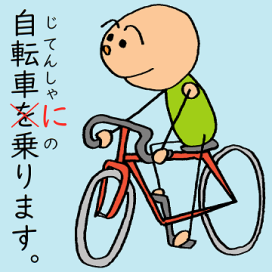
We already know that verbs in Japanese conjugate. When we learned expressions of desire for action, verbs needed to be “Masu-form without Masu” in order to be followed by the auxiliary verb “-tai”. Today’s expression also uses “Masu-form without Masu” of a verb.
Suppose a winter vacation is coming. you are talking to your friend, Sato-san. The topic is what you are going to do in the vacation. Hearing that Sato-san is going to Hokkaido, you want to know what kind of activities she will take in Hokkaido. The conversation with Sato-san would be like as following;
A : Satou-san, Hokkaidou e Nani o Shi ni Ikimasuka. (Sato-san, for what to do are you going to Hokkaido?)
B : Watashi wa Hokkaidou e Kani o Tabe ni Ikimasu. (I am going to Hokkaido to eat Crab.)
Look at Sato-san’s comment (B), “Ikimasu” which means “am going” is in Masu-form. Can you find “Masu-form without Masu” in B? It’s “Tabe” whose masu-form is “Tabemasu”. Given that today’s title is “Purpose of Movement”, two verbs in the comment B, Ikimasu and Tabemasu, can be thought of as below:
– Purpose : Kani o Tabemasu
– Movement : Hokkaido e Ikimasu
Therefore, in the construction;
1. [Subject] wa [Place] e [V1-masu] ni [V2].
(V1-masu: Masu-form without masu)
[V1-masu] is the purpose of movement, which is in “Masu-form without masu”
[V2] is a verb to describe movement for which “Ikimasu” is often used.
Then, let us think about time sequence of V1 and V2 of above construction.
Sentence B is;
B : Watashi wa Hokkaidou e Kani o Tabe ni Ikimasu. (I am going to Hokkaido to eat Crab.)
At first, Sato-san goes to Hokkaido. Once she has arrived in Hokkaido, and then she eats crab. So, V2 happens first, and V1 happens after V2. The order in the sentence is V1 and then V2, but in the time sequence, the order is in reverse, V2 first, V1 second.
Not today, but we will soon learn the other construction that uses two verbs.
2. [Subject] wa [V1te], [V2].
In this construction, V1 becomes “Te-form”. And V1 happens first and V2 second. The order of V1 and V2 in the sentence is the same as the order of time that V1 and V2 happen. Many of Japanese learners like the construction 2 better than 1. If Sato-san’s comment B is changed to be 2;
B2 : Watashi wa Hokkaido e Itte, Kani o Tabemasu.
However, if the purpose of going to Hokkaido is to eat crab, the construction 1 is much better. The construction 1 should be learned well before the construction 2 is introduced to Japanese learners of beginner’s level.
This post was written with reference to the exercise A4 on Section 13 of “Minna no Nihongo (2nd Edition)” published by “3A Corporation”
 Agony or Fun?! Second Language Learning