Yesterday, we learned the Japanese expression that is similar to “I want to do something” in English. Its construction is;
[Verb Clause]+tai desu.
And important thing is the form of a verb to be followed by the auxiliary verb “-tai” behind.
[verb]+ tai => [Verb in Masu-form without Masu]+tai
Then let us review yesterday’s three example conversations. In those three conversations, the questions are the same kind that is “[Name] wa Nani o shitai desuka.” But three answers are slightly different each other.
1. Watashi wa Sumaho o Kaitai desu. (I want to buy a smartphone.)
2. Watashi wa Tomodachi ni Aitai desu. (I want to see my friend.)
3. Watashi wa Amerika de Hatarakitai desu. (I want to work in U.S.)
You can see that different particles are used in 1, 2, and 3.
– Sumaho o Kaitai => “o” for the object of transitive verb “Kau (buy)”
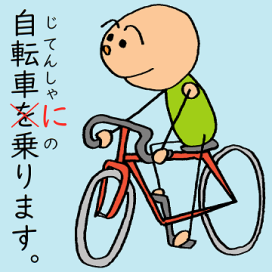
– Tomodachi ni Aitai => “ni” for the reaching point of the action “Au (meet)”
– Amerika de Hatarakitai => “de” for the place of action “Hataraku (work)”
Whenever you use a verb, particles need to be chosen and used properly in accordance with the verb.
Move back onto the auxiliary verb “-tai”. “-tai” is a word to change (conjugate). And its changing pattern is the same as a certain kind of words group. What is it? What is the last letter of “-tai”? It is the letter “i”. In fact, the auxiliary verb “-tai” conjugates in the same way as I-adjective. Today, we are learning only present-positive and present-negative when “-tai” is used for a predicate. So, remember I-adjective predicates for present-positive and present negative;
– present-positive : Kyou wa Atsui desu. (Today, it is hot.)
– present-negative : Kyou wa Atsukunai desu. (Today, it is not hot.)
Likewise, a predicate using “-tai” becomes “-i desu.” for present-positive, and “-kunai desu.” for present-negative.
The following is examples of predicates using “-tai” for present-positive and present-negative;
(want to do / don’t want to do)
<look, watch, see> Mitai desu. / Mitakunai desu.
<eat> Tabetai desu. / Tabetakunai desu.
<come to this side> Kitai desu. / Kitakunai desu.
<do> Shitai desu. / Shitakunai desu.
<buy> Kaitai desu. / Kaitakunai desu.
<go to somewhere> Ikitai desu. / Ikitakunai desu.
<speak, talk> Hanashitai desu. / Hanashitakunai desu.
<get back, go home> Kaeritai desu. / Kaeritakunai desu.
This post was written with reference to the exercise A3 on Section 13 of “Minna no Nihongo (2nd Edition)” published by “3A Corporation”
 Agony or Fun?! Second Language Learning