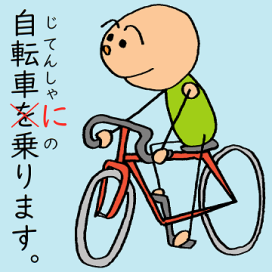
We have already learned two functions of particle “de”.
1. What means of transportation is used when making movement.
example;
A: Sato-san wa Nani de Kaisha e Ikimasuka. (Ms.Sato, how do you get to the company?)
B: Watashi wa Chikatetsu de Kaisha e Ikimasu. (I go to the company by subway.)
2. Where the action is taking place; [Place] de [Verb] masu.
example;
A: Satou-san wa Doko de Kasa o Kaimashitaka. (Ms.Sato, where did you buy the umbrella?)
B: Watashi wa Kombini de Kasa o Kaimashita. (I bought the umbrella at a convenience store.)
Today’s new function of “de” is similar to “1.” in respect of “what to use for your action”.
3. What you use when making action; [tool] de [Verb] masu.
In order to show examples for sentences of this type, let me introduce several new words.
– Empitsu: noun; pencil,
– Bohrupen: noun; ballpoint pen
– Saimpen: noun; felt-tip pen
– Shaapupenshiru: nouns, mechanical pencils
– Ji: noun; character
– Kakimasu: transitive verb; write
Practice the following two conversations;
A: Satou-san wa Empitsu de Ji o Kakimasuka, Shaapupenshiru de kakimasuka.
(Ms. Sato, do you write a character by a pencil or a mechanical pencil?)
B: Watashi wa Shaapupenshiru de Ji o Kakimasu.
(I write a character by a mechanical pencil.)
A: Suzuki-san wa Nani de Ji o Kakimasuka.
(Mr. Suzuki, by what do you write a character?)
B: Watashi wa Bohrupen to Saimpen de Ji o Kakimasu.
(I write a character by a ballpoint pen and felt-tip pen.)
<この投稿は“スリーエーネットワーク、みんなの日本語 初級I 第2版, 第7課A1”の内容を参照しています。>
 Agony or Fun?! Second Language Learning