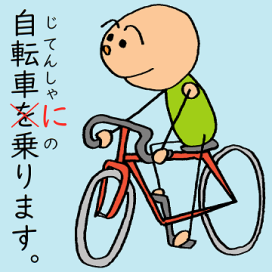
Here is a new particle to learn. It is “de”. We are going to learn one of its functions, which is to indicate what means of transportation is used when making movement. Since the particle “de” has many functions, do not stick to today’s function only. Other functions will be introduced later.
There are several means of transportation such as a car, bus, taxi, train, subway, boat, ferry, airplane, but let us use one of these, subway.
Chikatetsu : noun ; Subway, underground railway
Then, today’s sentence construction is as follows;
[Subject] wa [Means of transportation] de [Destination] e [verb meaning move].
Example: Watashi wa Chikatetsu de Kaisha e Ikimasu.
Where;
– Watashi: pronoun; I
– wa: particle; topic marker, and in this case also subject marker
– Chikatetsu : noun ; Subway, underground railway
– de: particle; in this case, functions to indicate means of transportation
– Kaisha: noun; company
– e: particle; the reaching point of the action
– Ikimasu: verb in form of present-positive; go
When you ask “How do you get there?”, the interrogative word “Nan” or “Nani” is used. Many Japanese textbooks are using “Nan”. But if you say “Nan de Ikimasuka?”, there could be two renditions;
– Which means of transportation do you use to get there?
– Why are you going there?
So, I like “Nani” better in order to avoid double-meaning.
Practice and remember the following conversation.
A: Sato-san wa Nani de Kaisha e Ikimasuka. (Ms.Sato, how do you get to the company?)
B: Watashi wa Chikatetsu de Kaisha e Ikimasu. (I go to the company by subway.)
<この投稿は“スリーエーネットワーク、みんなの日本語 初級I 第2版, 第5課A2”の内容を参照しています。>
 Agony or Fun?! Second Language Learning